Intellectual Prestige Team

Philosophy, Mathematics and Economics major from 3 European Universities turned entrepreneur who takes obscure and difficult intellectual history and turns it into insightful and actionable prose.

The Machiavelli School of Risk- Differentiating Between Calculated and Reckless Gambles

The Machiavelli School of Risk: Differentiating Between Calculated and Reckless Gambles

Five hundred years ago, a sharp eyed Florentine diplomat watched princes rise and fall with the regularity of bad weather. Some of them gambled their kingdoms on bold moves and walked away wearing crowns. Others made nearly identical moves and ended up exiled, beheaded, or worse, forgotten. Niccolò Machiavelli noticed something strange. The difference between […]

The Machiavelli School of Risk: Differentiating Between Calculated and Reckless Gambles Read More »

The Intellectual Division of Labor- Why Specialization is Harming Public Discourse

The Intellectual Division of Labor: Why Specialization is Harming Public Discourse

Adam Smith walked into a pin factory one day and changed how we think about work forever. He noticed something peculiar. One man drawing wire, another straightening it, a third cutting it, a fourth pointing it. Ten workers, each doing one tiny task, could produce 48,000 pins in a day. A single craftsman doing all

The Intellectual Division of Labor: Why Specialization is Harming Public Discourse Read More »

The Stoic Utopia- What the World Would Look Like If We All Mastered Anger

The Stoic Utopia: What the World Would Look Like If We All Mastered Anger

Imagine waking up tomorrow and discovering that overnight, every human being on the planet had read Seneca’s On Anger and actually taken it seriously. Not just nodded along at the clever lines, not just shared a quote on social media with a sunset background, but genuinely absorbed the ideas and applied them. The world you

The Stoic Utopia: What the World Would Look Like If We All Mastered Anger Read More »

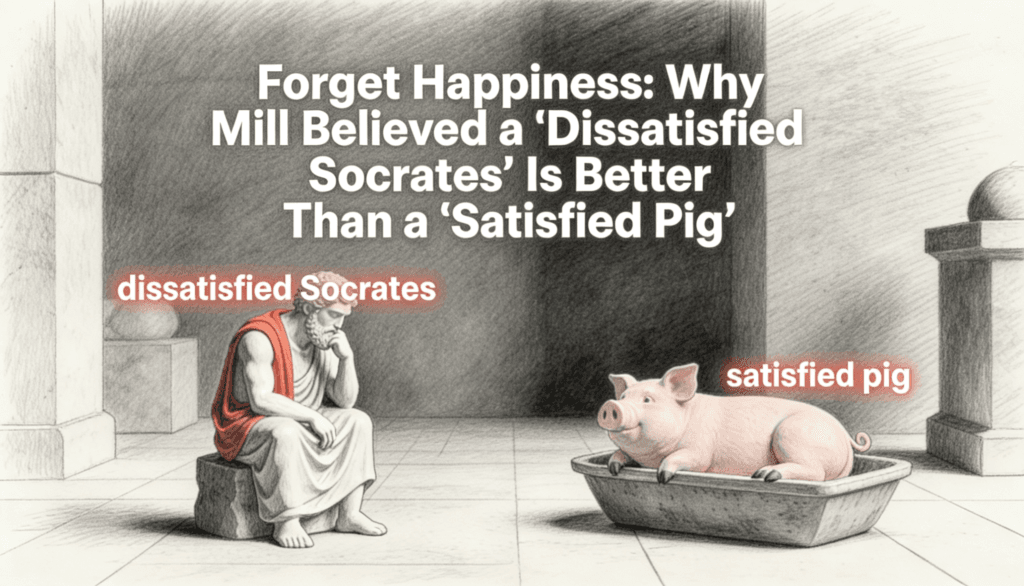
Forget Happiness- Why Mill Believed a Dissatisfied Socrates Is Better Than a Satisfied Pig

Forget Happiness: Why Mill Believed a “Dissatisfied Socrates” Is Better Than a “Satisfied Pig”

Most people want to be happy. That sounds so obvious it barely deserves a sentence. But John Stuart Mill, one of the sharpest minds of the nineteenth century, looked at that universal desire and said something strange: happiness is not enough. In fact, the wrong kind of happiness might be worse than no happiness at

Forget Happiness: Why Mill Believed a “Dissatisfied Socrates” Is Better Than a “Satisfied Pig” Read More »