Table of Contents
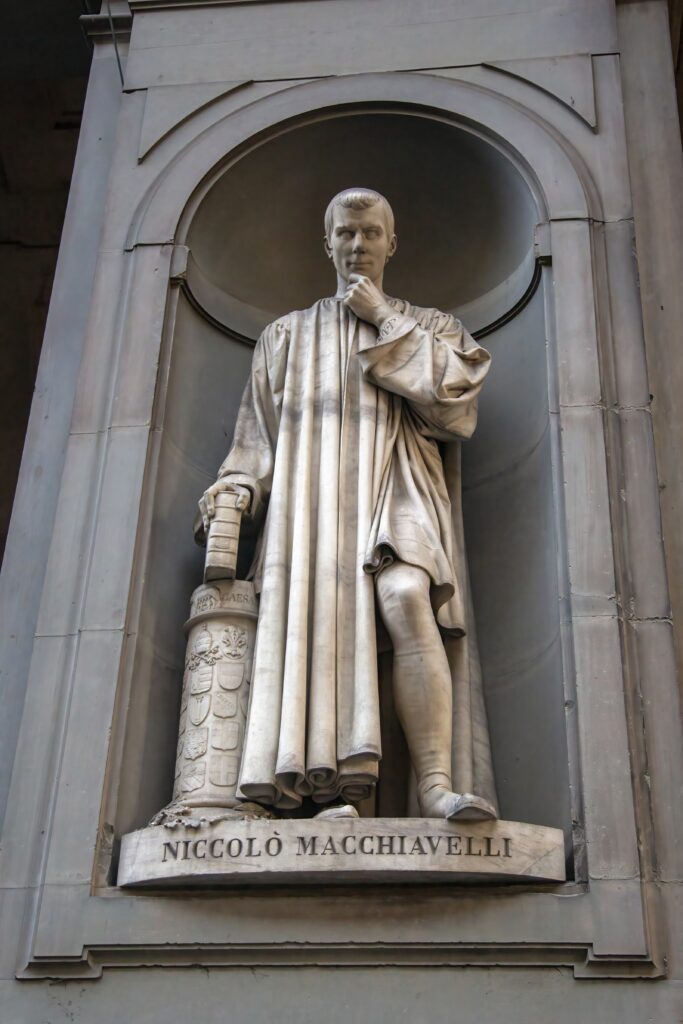
Five hundred years ago, a sharp eyed Florentine diplomat watched princes rise and fall with the regularity of bad weather. Some of them gambled their kingdoms on bold moves and walked away wearing crowns. Others made nearly identical moves and ended up exiled, beheaded, or worse, forgotten. Niccolò Machiavelli noticed something strange. The difference between the winners and losers was not always intelligence. It was not always courage. It was certainly not virtue. It was something quieter, harder to name, and much more useful to study.
He called it, more or less, the ability to read the moment. The ability to know when a gamble is a gamble and when it is just suicide dressed up in ambition.
We have lost a great deal of that wisdom. We live in a culture that worships risk takers without bothering to ask whether they actually took the risks they claim to have taken. We celebrate founders who bet everything and won, while quietly burying the obituaries of the founders who bet everything and lost in exactly the same way. Survivorship bias is the official religion of our time, and Machiavelli would have found this both amusing and slightly embarrassing.
So let us walk through what he understood, what we have forgotten, and how to tell the difference between a smart bet and a stupid one before you make it, rather than after.
The Problem With How We Talk About Risk
Most advice about risk is theatrically useless. You hear phrases like “fortune favors the bold” or “no risk, no reward” and they sound profound until you remember that fortune also flattens the bold on a regular basis, and that plenty of risk leads to plenty of nothing.
The trouble is that we treat risk as a single thing. We talk about it the way ancient sailors talked about the ocean, as one big unpredictable mass. But risk has internal architecture. It has shape. Some risks are like crossing a busy street, where the danger is real but the variables are visible and the upside is clear. Other risks are like walking into a casino, where the danger is hidden inside math that was designed by people much smarter than you.
Machiavelli understood this in a way most modern self help books do not. He observed that the same action could be brilliant in one context and catastrophic in another, and the entire art was in knowing which context you were standing in. A prince who attacks when his neighbor is weak is calculating. A prince who attacks when his neighbor has just signed a defense treaty with a larger power is, technically speaking, doing the same thing. He just happens to be doing it on the way to his own funeral.
The First Test: Can You Actually See the Board
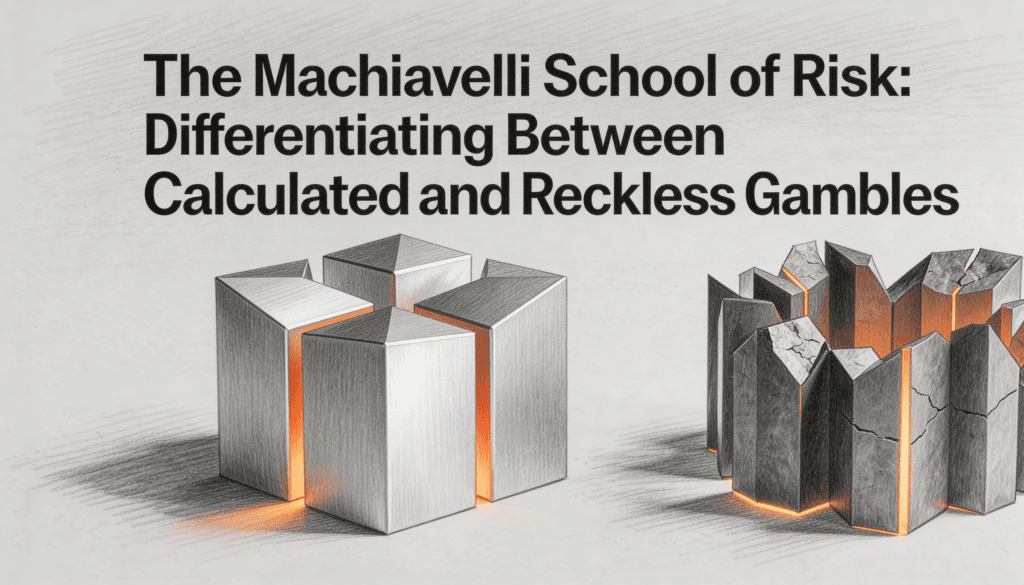
A calculated risk is one where you can see the variables, even if you cannot control all of them. A reckless risk is one where you cannot see the variables and you are pretending you can.
This sounds obvious. It is not. The most dangerous moments in anyone’s life tend to come when they confuse the two.
Consider the entrepreneur who quits a stable job to start a company. If he has spent three years building expertise in his field, has saved enough money to survive eighteen months without income, has talked to fifty potential customers who confirmed they would pay for his product, and has identified three competitors he believes he can outmaneuver, that is a calculated risk. He might still fail. Calculated does not mean guaranteed. But he has done the work to see the board.
Now consider the same entrepreneur who quits his job because he read a book about following his passion, has no savings, has not talked to a single customer, and believes his idea is so revolutionary that the market will simply have to recognize its brilliance. That is not a calculated risk. That is a person performing the aesthetics of risk taking without doing the work that makes risk taking sensible.
The brutal part is that both of these people will tell themselves the same story. They will both say they are being brave. They will both quote the same inspirational figures. The only difference will show up about fourteen months later, and by then it is too late to fix.
The Second Test: What Happens If You Are Wrong
This is where Machiavelli got genuinely cold blooded, and where most people refuse to follow him.
A calculated risk has a survivable downside. A reckless risk does not.
Take two investors. Both put money into a speculative venture. One of them invests an amount that, if lost, would be painful but not life altering. The other invests money he cannot afford to lose, sometimes money he does not actually have. They might be making the exact same bet on the exact same opportunity, but one of them is taking a calculated risk and the other is one bad week away from explaining things to his family.
The lesson here is unkind but true. The intelligence of a risk is not measured by the size of the potential reward. It is measured by what happens to you in the version of reality where things go wrong. If a bad outcome takes you out of the game permanently, the math does not matter. You cannot enjoy a fifty percent chance of doubling your wealth if the other fifty percent puts you on the street.
This is why the people who actually build durable wealth, durable careers, and durable lives tend to look boring from the outside. They are not refusing to take risks. They are refusing to take risks that have an asymmetric downside. They want exposure to the upside without total exposure to the downside.
The Third Test: Time
Machiavelli was obsessed with timing, and rightly so. He saw princes who did exactly the right thing at exactly the wrong moment and lost everything. He also saw mediocrities who did mediocre things at brilliant moments and ended up celebrated.
Reckless gambles tend to ignore time. They treat the present moment as eternal. The market will always be like this. My energy will always be like this. My relationships will always tolerate this. The world will keep behaving the way it is behaving right now.
Calculated gambles treat time as a variable. They ask whether the conditions that make this opportunity real today will still be real next year, and what happens if they are not. They ask whether you are arriving early, on time, or about ten minutes after the moment has passed.
A great deal of what looks like genius in retrospect is just decent timing. And a great deal of what looks like stupidity is just bad timing dressed up in the wrong outfit. The dot com investors of 1999 and the dot com investors of 2003 were often the same people with the same ideas. One group looked like fools and the other looked like prophets, separated only by when they showed up to the same party.
The Counterintuitive Part
Here is something that nobody wants to admit. Doing nothing is also a risk. A very large one.
We have a cultural bias toward action. We assume that the person who moves is brave and the person who waits is timid. Machiavelli would have laughed at this. He understood that inaction is itself a position. Refusing to act when action is required is just as dangerous as acting when patience is required. Maybe more so, because at least the reckless gambler knows he is gambling. The person who does nothing often does not realize he is making a choice at all.
The clearest example is the career professional who stays in a comfortable job for fifteen years while the industry quietly transforms around him. He thinks he is being prudent. He is actually taking an enormous, hidden risk. The risk that his skills become obsolete. The risk that his network calcifies. The risk that when the comfortable job finally disappears, as comfortable jobs eventually do, he will have nothing to offer the world that the world cannot get from someone twenty years younger and three times cheaper.
He did not see this as a gamble. But it was one. He just lost it slowly instead of quickly.
The Hardest Test of All
Calculated risk taking requires you to look at your own motivations without flinching. Are you taking this risk because the analysis genuinely supports it, or because you are bored? Because you are ego invested? Because someone told you that you could not do it? Because the alternative is admitting that your current life is not what you wanted it to be, and motion feels better than reflection?
Machiavelli understood that the worst gamblers are not the foolish ones. They are the smart ones who use their intelligence to construct elaborate justifications for things they have already decided to do emotionally. Their analysis is post hoc, dressed up to look prior. They can defend any decision because they were never really analyzing in the first place. They were just looking for permission.
The discipline of calculated risk is to know the difference between thinking and rationalizing. It is to notice when your spreadsheet has been quietly adjusted to confirm what you already wanted. It is to invite people who disagree with you into the conversation, and to listen when they speak, even when it is annoying. Especially when it is annoying.
The Quiet Conclusion
The people who take risks well are not the loud ones. They are not the ones giving speeches about courage or posting pictures of themselves on mountaintops. They are the quiet ones who have done the work, who can see the board, who know their downside, who respect time, who notice their own motivations, and who act, when they act, with a clarity that almost looks like calmness.
Machiavelli wrote his manual for princes, but the principles travel well. You do not need a kingdom to apply them. You just need to be making decisions, which means you qualify. Every job change, every investment, every relationship, every business move is a small version of the same problem Machiavelli was watching unfold five centuries ago.
The reckless gambler and the calculated risk taker often look identical at the moment of decision. They might make the same move, say the same words, even feel the same excitement. The difference shows up later, in the wreckage or the rewards.
The work, then, is to do whatever you can before the moment of decision to make sure you are the second one and not the first. To see clearly. To survive being wrong. To notice your own bias. To act, sometimes boldly, sometimes patiently, but always with eyes open.
Fortune does favor the bold. But fortune is also extremely picky about which kind of bold it favors. It tends to choose the ones who looked carefully before they jumped, even if they made it look easy afterward.
That is the school Machiavelli was teaching. The tuition is paid in attention, and the diploma is the rest of your life.