Table of Contents
The Quiet Trade You Made When You Started Using AI
Somewhere between the third and thirtieth time you asked a chatbot to summarize an article, you made a trade you never signed. You gave up a small piece of your reasoning in exchange for speed. Multiply that by every knowledge worker on the planet, and you have the largest cognitive transaction in human history, happening quietly, without terms of service.
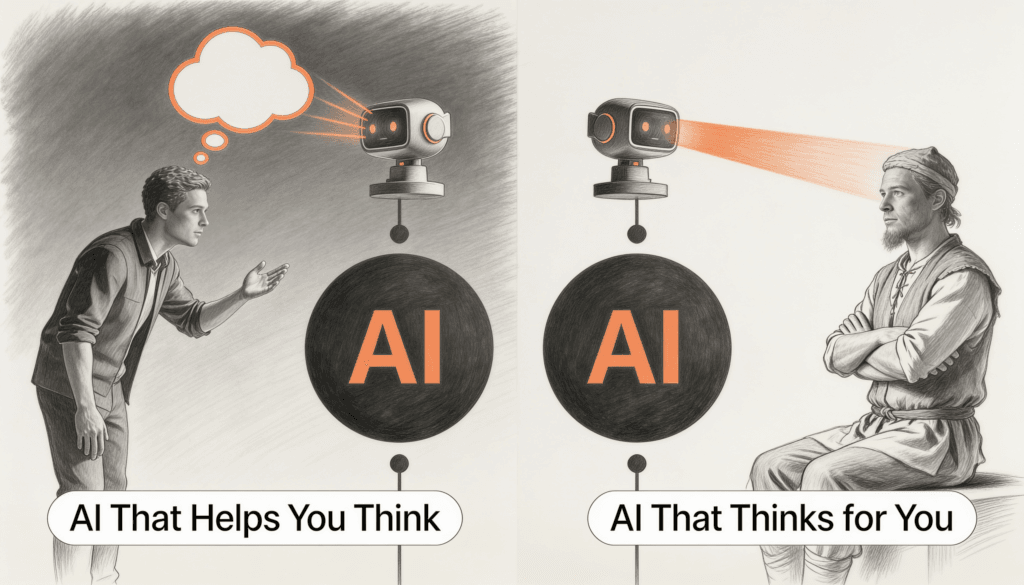
The interesting question is not whether AI will replace thinkers. The interesting question is whether it will replace thinking itself inside the people who still call themselves thinkers. There is a real and useful distinction between AI that helps you think and AI that thinks for you, and most people cannot tell which one they are using at any given moment.
This essay is about that difference. It borrows from 2 unlikely allies: John Stuart Mill, who argued that opinions held without struggle become dead things in the mind, and Socrates, who worried in the Phaedrus that a new technology called writing would make men forgetful because they would trust external marks instead of their own memory. Both were right. Both were early. And both apply, with almost unfair precision, to what is happening inside your head right now.
Mill’s Warning: The Dead Dogma Problem
In On Liberty, John Stuart Mill made a claim that most readers glide past because it sounds obvious. He said that even a true opinion, if it is held without ever having been examined, becomes what he called a dead dogma. The person believes the right thing for no reason they can articulate. They cannot defend it. They cannot apply it to a new case. They cannot recognize when it fails. They own the conclusion but not the reasoning that produced it.
Mill was worried about religion and inherited social norms. He was worried about people who agreed with the culture around them because agreeing was easy. He would recognize the modern condition instantly.
He who knows only his own side of the case knows little of that. His reasons may be good, and no one may have been able to refute them. But if he is equally unable to refute the reasons on the opposite side, he has no ground for preferring either opinion.
Now translate that into 2026. You ask an AI to explain the pros and cons of a business decision. It gives you a competent, balanced, useful list. You read it. You nod. You act on it. Ask yourself honestly: could you reconstruct that list without the machine? Could you defend the third point against a smart critic? Could you notice if point 2 was subtly wrong for your specific case?
If the answer is no, you are living inside Mill’s nightmare with better graphics. You have the conclusion. You do not have the argument. And when the situation shifts by 15%, which it always does, you have no idea which parts of the reasoning still hold.
What AI Critical Thinking Actually Requires
The phrase AI critical thinking gets used in 2 ways, and they mean opposite things. One meaning is critical thinking about AI: the discipline of noticing what the model got wrong, where it hallucinated, where it flattened nuance. The other meaning is critical thinking with AI: using the tool as a sparring partner that sharpens your reasoning rather than as an oracle that replaces it.
The first is defensive. The second is offensive. You need both. Most users have neither.
The defensive skill is easier to describe. You verify sources. You test claims against your own domain knowledge. You notice when the model is being sycophantic and pushing back on nothing. You treat confident prose as a rhetorical style, not a signal of accuracy. This is the boring, hygienic layer. It keeps you from embarrassing yourself in public.
The offensive skill is where the real gain lives. You use the machine to generate counterarguments to positions you already hold. You ask it to steelman the view you find most annoying. You force it to produce 5 different framings of the same problem and then choose between them yourself. You treat it as a Millian opponent, artificially generated, whose job is to make your own opinions live again by attacking them.
Socrates at the Printing Press: The Phaedrus Problem
Around 370 BC, Socrates told a story about the Egyptian god Theuth, who invented writing and presented it to the king as a gift that would make people wiser. The king refused the compliment. He said writing would produce the opposite effect. People would stop remembering things and start relying on external marks. They would appear to know much while actually knowing little. They would be, in the king’s phrase, filled with the conceit of wisdom instead of wisdom itself.
You could read that passage as an old man complaining about new technology. Every generation has one. But Socrates was making a sharper point. He was saying that the ease of retrieval matters. When you can look something up instantly, you do not internalize it. When you do not internalize it, you cannot combine it with other things you know, because combination happens inside the mind, not on the page.
Writing turned out to be worth the trade. Civilization needed external memory. But Socrates was correct that something was lost. Oral cultures produced people who could recite the Iliad from memory and use its 15,000 lines as a live thinking tool. Literate cultures produced people who could find the Iliad on a shelf. The tradeoff was real, and it was worth making, and we should be honest that it happened.
They will appear to be omniscient and will generally know nothing. They will be tiresome company, having the show of wisdom without the reality.
AI is the same trade, compressed into 3 years instead of 3 millennia, and applied not to memory but to reasoning itself. This is the difference that matters. Writing offloaded storage. AI offloads synthesis. Synthesis is where thinking lives.
The New Conceit of Wisdom
Walk into any office in 2026 and you will meet people who sound 40% smarter than they were 2 years ago. Their emails are crisper. Their strategy documents are more structured. Their meeting summaries are cleaner. They present better. They write better. They appear to have learned an enormous amount in a very short time.
Ask them to defend their strategy document against a smart pushback. Watch what happens. In many cases, they cannot. They produced the document by prompting. They edited for tone. They approved the output because it sounded right. The reasoning inside the document was never theirs. It was rented.
This is AI dependency in its purest form, and it is invisible to the person experiencing it because the outputs are genuinely good. The conceit of wisdom is not a feeling of arrogance. It is a feeling of competence that has no roots. It cracks the moment the situation deviates from the training distribution, which in real life is always.
Thinking With AI Versus For You: The Practical Distinction
Here is the working definition worth memorizing. When you compare thinking with AI vs for you, the test is not what the machine produces. The test is what happens in your head during the interaction.
AI that helps you think leaves you with more structure in your mind at the end of the session than you had at the beginning. You can explain the framework you built. You can defend the choices you made. You can predict where the argument breaks. The machine was a whetstone. You are sharper.
AI that thinks for you leaves you with an artifact and nothing else. The document exists. The plan exists. The code exists. Your understanding of any of it is a thin film, easily peeled off by the first real question. You are not sharper. You are, if anything, slightly duller, because you spent the hour outsourcing the very muscle you were supposed to be exercising.
The output can be identical in both cases. That is the trap. Two people submit the same memo. One of them wrote it with the machine as a sparring partner and can defend every sentence. The other wrote it with the machine as a ghostwriter and can defend nothing. From the outside they look the same. From the inside they are different species.
The 5 Prompts That Separate Them
You can convert almost any AI interaction from the second mode to the first by changing the shape of your prompts. Here are 5 that work.
- Argue against my current position. Give me the strongest case that I am wrong, in the voice of the smartest critic I could face.
- What am I not seeing? List the assumptions I appear to be making and mark the ones that are most likely to be false.
- Compare 3 framings. Reframe this problem 3 different ways and show me what each framing makes visible and invisible.
- Where does this argument fail? Under what specific conditions would my reasoning produce the wrong answer?
- Teach me the concept, do not apply it for me. Explain the underlying principle so that I can apply it to 5 other cases without your help.
Notice what all 5 have in common. They force the machine into the role of tutor, opponent, or diagnostician. They refuse the role of oracle. They leave the final synthesis inside your head, where Mill and Socrates both insisted it belongs.
The Compounding Cost of AI Dependency
The reason AI dependency is worth taking seriously is not that any single instance matters. Any single instance is fine. You outsourced one email. You outsourced one summary. Nobody died. The problem is compounding.
Cognitive skills behave like physical ones. They atrophy without use, and the atrophy is not linear. You lose the top 20% first, which is where original thought lives. You keep the middle 60%, which is where competent execution lives. From the outside, and from the inside, you look fine. You feel fine. You are producing work. The work is acceptable.
What you have lost is the ability to notice when the acceptable answer is wrong. That is the top layer. That is what separates a senior thinker from a competent middle manager. It is invisible until a nonstandard situation arrives and the person who used to have judgment now has only fluency.
The faculties are called into no exercise by doing a thing merely because others do it, no more than by believing a thing only because others believe it.
Mill wrote that about conformity. It applies with equal force to cognitive outsourcing. The faculty that atrophies is the one you stop using. If you stop generating framings, you lose the ability to generate framings. If you stop constructing arguments, you lose the ability to construct arguments. The machine will still produce them for you. You will still ship the output. You will simply no longer be the author of your own mind.
The Asymmetry Nobody Priced In
There is one more thing worth naming. The people who benefit most from AI are the people who least need it, and the people who need it most are damaged by it fastest. This is the ugly asymmetry at the center of the current moment.
A senior expert with 20 years of domain knowledge uses AI as a leverage tool. They already know the answer 70% of the time. The machine speeds up the last 30% and catches occasional blind spots. Their judgment does not atrophy because they still apply it constantly. The AI is an accelerator on top of a real engine.
A junior person with 2 years of experience uses AI as a substitute. They do not know the answer, so they take the machine’s answer. They cannot evaluate it, so they trust it. They do not build the intuition that the senior expert built through 20 years of being wrong and correcting themselves, because they are never wrong in a way they can feel. The AI hands them a pre-corrected output.
In 10 years, the senior expert retires. The junior person is now the senior person, but without the 20 years of internal error correction that used to produce senior judgment. The organization still functions. It functions worse in ways nobody can quite name, because the top 20%, the layer that catches nonstandard situations, has quietly gone missing across an entire generation.
How to Actually Use AI Without Losing Your Mind
The prescription is not to avoid AI. That advice is useless and slightly ridiculous, like telling a medieval scribe to avoid the printing press. The prescription is to be deliberate about which mode you are in, session by session, and to protect a nontrivial fraction of your cognitive life from the tool entirely.
Here is a practical rule that seems to work. For any task where the output matters more than your growth, use the machine freely and ship the artifact. For any task where your growth matters more than the output, either do it alone or use the machine only in sparring mode. The mistake is treating every task as the first kind, because 5 years of that makes you a stranger inside your own profession.
Read hard things without summarization. Write hard things without a first draft from the model. Sit with hard problems for 30 minutes before asking for help. These are not moral exercises. They are the maintenance schedule for the equipment you use to think.
Mill wanted opinions that had been fought for. Socrates wanted knowledge that lived inside the mind rather than beside it. Both would tell you the same thing about the tool on your desk. It is the best sparring partner in history and the worst ghost writer, and the person who cannot tell which one they are using at any given moment has already lost something they will not notice until it is far too expensive to get back.
The difference between AI that helps you think and AI that thinks for you is not in the software. It is in the posture of the person using it. Choose the posture consciously, or the machine will choose it for you, and the choice it makes will not be the one that keeps you sharp.