Table of Contents
The Strange Case of the Machine That Knows Law But Cannot Do Law
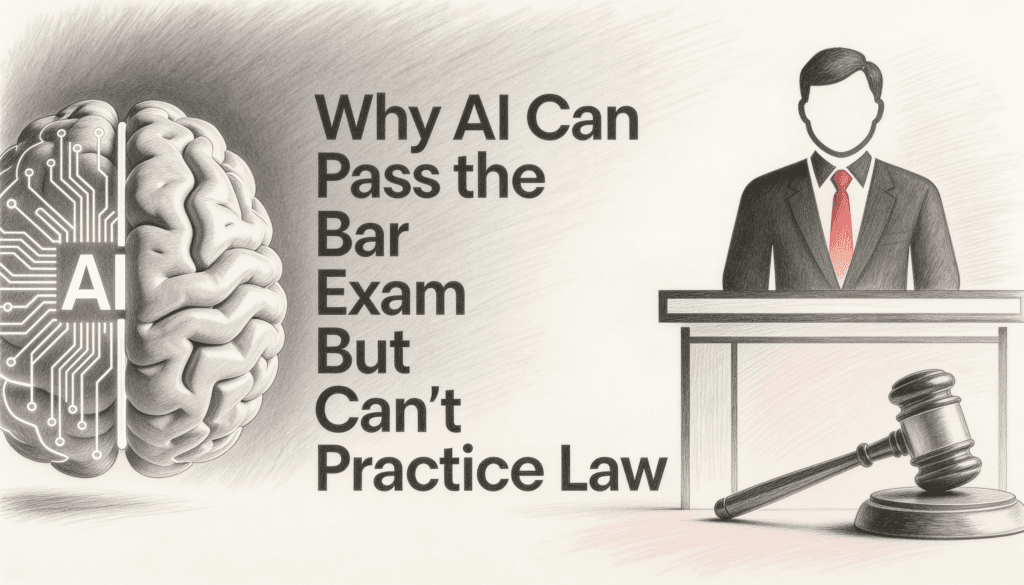
In March 2023, an AI system scored in the 90th percentile on the Uniform Bar Exam. A few months later, a New York attorney was sanctioned because the same class of technology invented 6 court cases that never existed and submitted them in a federal filing. The machine could pass the test that gatekeeps the profession. The machine could not be trusted to write a single brief without adult supervision.
This is not a temporary glitch on the road to full automation. It is a permanent feature of what artificial intelligence actually is, and what the practice of law actually requires. The gap between the two reveals something Aristotle understood 2,400 years ago and something Silicon Valley keeps forgetting: knowing the rules is not the same as knowing what to do.
If you want to understand the real limits of AI in professional work, forget the benchmarks. Look at the courtroom.
What the Bar Exam Actually Measures
The bar exam is a closed system. It rewards a specific skill: retrieving legal doctrine from memory, applying it to a stylized fact pattern, and producing a written answer within a fixed time. The questions have right answers. The scoring is standardized. The universe of possible content is bounded by whatever the examiners chose to include.
This is exactly the kind of task large language models were built to dominate. They are trained on enormous corpora of legal text. They can predict, with astonishing accuracy, what a competent answer to a legal hypothetical looks like. When GPT-4 scored in the 90th percentile, it was not thinking like a lawyer. It was pattern-matching against millions of examples of legal writing and producing statistically likely output.
That is a real achievement. It is also almost entirely irrelevant to whether an AI can practice law.
The Test Is Not the Territory
Consider what the bar exam does not measure. It does not measure judgment about which client to take. It does not measure the ability to read a jury. It does not measure the moment when you decide whether to push a witness harder or let a soft answer stand. It does not measure the ethical instinct that tells you a technically permissible move will destroy your reputation with a judge you will see again for the next 20 years.
The exam measures competence in a laboratory. Practice happens in a storm.
Aristotle’s Warning About Phronesis
Aristotle drew a distinction that has been buried under 2 millennia of academic footnotes but which explains the AI bar exam paradox better than any modern framework. He separated episteme, which is theoretical knowledge, from phronesis, which is practical wisdom.
Episteme is what you can write down. It is the rule, the doctrine, the formula. Phronesis is the capacity to apply the right rule in the right way at the right moment to a particular situation you have never encountered before. Aristotle argued that phronesis cannot be taught from books. It is acquired through years of doing, failing, being corrected by more experienced practitioners, and slowly developing an intuition for the shape of situations.
“It is the mark of an educated man to look for precision in each class of things just so far as the nature of the subject admits.” Aristotle understood that law, like medicine and politics, resists the clean rules that theoretical knowledge demands.
An AI system is pure episteme. It has ingested every legal treatise, every case, every statute, and it can regurgitate them in fluent prose. But it has never sat across from a terrified client at 11pm the night before a hearing. It has never watched a judge’s face harden at a particular phrasing. It has never learned, the way a young associate learns, that the memo which was technically correct was strategically catastrophic.
Why This Distinction Is Not Sentimental
Some technologists will say this is romantic nonsense. The response is simple: look at what happens when AI tries to practice.
It hallucinates cases because it cannot distinguish between what sounds legally plausible and what actually exists in the reporter. It gives confident advice on jurisdictional questions where the law changed 6 months ago. It cannot tell you whether the opposing counsel is bluffing because it has never negotiated with a human being who has a mortgage, a reputation, and a fear of losing. The gap is not a bug that will be patched. It is the nature of the technology.
AI Lawyer Limitations in the Real World
Let us catalog the specific failure modes that appear when large language models attempt actual legal work. These are not hypothetical. Every one of them has been documented in filings, sanctions orders, and bar association warnings issued between 2023 and 2025.
Hallucination as Structural, Not Accidental
The most famous failure is fabrication. Mata v. Avianca gave us the template: an attorney used ChatGPT to draft a brief, and the model invented citations complete with case names, docket numbers, and quoted holdings. Since then, similar sanctions have appeared in state and federal courts across at least a dozen jurisdictions.
This is not a training data problem. It is a definitional feature of how these systems work. A language model generates the most probable next token. It has no internal representation of truth. When you ask it for a case supporting a proposition, it generates something that looks like a case supporting that proposition. Whether such a case exists is, from the model’s perspective, a separate question it cannot ask itself.
The Missing Client
Legal advice is inseparable from the person receiving it. The same divorce facts might warrant aggressive litigation for one client and quiet mediation for another. Why? Because one client has 3 young children she wants to protect from prolonged conflict, and the other has a business partnership with the spouse that will require civility for 10 more years.
An AI can be told these facts. It cannot weigh them the way a lawyer who has spent 4 hours with the client can weigh them. It does not know that the client’s voice cracked when she mentioned the children. It does not know that the business partner said, unprompted, that he still respects her. Legal counsel is not an information retrieval task. It is a judgment task performed on a human being.
Ethical Duties That Require a Person
The professional responsibility rules were written for humans and assume humans. A lawyer owes duties of confidentiality, loyalty, and candor to the tribunal. These are not just policies. They are enforceable obligations backed by disbarment, malpractice liability, and criminal exposure.
An AI cannot be disbarred. It cannot be sued. It cannot swear an oath. When a machine gives legal advice and the advice is catastrophically wrong, the accountability structure collapses. This is why every serious proposal for AI in law places a licensed attorney in the loop as the responsible party. The AI does not practice. The lawyer using the AI practices, and takes the fall.
Can AI Replace Lawyers? The Honest Answer
The question “can AI replace lawyers” is popular because it is dramatic. The honest answer is: AI will replace specific tasks lawyers used to do, it will not replace the role we call a lawyer, and the pattern of what disappears will surprise both optimists and pessimists.
What AI Will Absorb
Document review is already largely automated. First-pass contract drafting for standard commercial agreements is moving fast. Legal research that used to take an associate 6 hours can now take 20 minutes with a competent AI tool and a skilled human verifier. Basic legal information, the kind that used to require a $500 consultation to get, is now free from any decent chatbot.
This is real, and it will hollow out the traditional pyramid of law firm work. The junior associate whose value came from being a fast, cheap researcher is in trouble. The paralegal whose job was document coding is in trouble. Legal process outsourcing firms in India that built billion-dollar businesses on discovery review are staring at obsolescence.
What AI Will Not Absorb
Everything above the pyramid. The partner meeting where the client decides whether to settle or fight. The cross-examination of a hostile witness. The negotiation where 4 different parties have unspoken agendas and the deal will collapse unless someone reads the room correctly. The trial strategy conversation at 6am on day 3 of testimony. The delicate call to opposing counsel where you signal openness without revealing weakness.
The paradox of automation in professional services is that as machines take the bottom of the work, the human skills at the top become more valuable, not less. The lawyer of 2030 will do less of what a lawyer of 1990 did, and more of what only a human can do.
This is not a defensive prediction from a threatened profession. It is the same pattern we saw with radiologists, whose deaths were predicted a decade ago and who are now more in demand than ever. AI reads the scan. The radiologist decides what the scan means for this patient with this history in this hospital.
The Machiavellian Reading of the Legal Market
Machiavelli would look at the current legal AI market and see something familiar: a technology being sold on the promise of eliminating a class of professionals, when in fact it will concentrate power among the most skilled members of that class.
When a productivity tool arrives in a profession, the mediocre and the excellent are affected asymmetrically. The mediocre practitioner used AI as a crutch and is exposed when the crutch fails. The excellent practitioner uses AI as leverage and produces 5 times the output at higher quality. The middle of the profession is being squeezed out. The top is being amplified.
This is why the “AI will democratize law” narrative is only half true. It will democratize access to legal information, which is a real gain for consumers with routine problems. It will not democratize access to skilled legal judgment, which will become more expensive and more concentrated, not less.
The Winner Take Most Structure
Consider what happens when a solo practitioner using GPT-6 can produce work product that used to require a 12-lawyer team. The economics of the profession invert. The premium is no longer on having a large firm. The premium is on having the judgment to direct the AI, the reputation to attract the clients, and the courtroom presence to close the case.
This is a bad time to be an average lawyer. It is a spectacular time to be a great one. The middle, as always in a Machiavellian reading, is where the blood gets spilled.
What the Bar Exam Gets Wrong About Competence
If AI can pass the bar exam, one legitimate reaction is not “AI is amazing” but rather “the bar exam is a poor measure of what lawyers actually do.” Both are true.
The exam was designed for an era when the bottleneck to legal competence was memorization of doctrine. In 1950, a lawyer who could not recall the elements of adverse possession in his jurisdiction was genuinely handicapped. Today, that lawyer can look it up in 4 seconds. The scarce skill is no longer knowing the rule. The scarce skill is knowing which rule matters in a situation that does not fit the treatise.
The Reform That Will Not Happen
A serious licensing regime would test what lawyers actually need to do: client counseling under uncertainty, ethical judgment in ambiguous situations, negotiation with adversarial parties, courtroom advocacy under pressure. Some jurisdictions are experimenting with performance-based assessments. Most are not, because standardized multiple choice questions are cheap to grade and lawsuit-proof.
So we have a licensing gate that measures a skill AI has mastered, guarding a profession that requires skills AI cannot touch. The absurdity is structural. It will not be fixed quickly.
How to Think About Your Own Profession
The legal case is a template for every knowledge profession. Substitute “medical boards” or “CFA exam” or “PE license” and the analysis holds. The test measures episteme. The job requires phronesis. AI has conquered the first and cannot approach the second.
The practical implications for anyone in a professional field are worth stating plainly:
- Stop competing on information retrieval. The machine will win. Any skill that consists of knowing things quickly is being commoditized.
- Invest in judgment-heavy work. Situations where the answer depends on reading a specific human being in a specific context are AI-resistant for the foreseeable future.
- Become the person who directs the AI, not the person the AI replaces. This means developing taste, the ability to spot when AI output is subtly wrong, and the client relationships that make you the trusted human in the loop.
- Take ethics seriously as a moat. Accountability is a human function. Anywhere accountability matters, humans will be required by law and by insurance long after the technical capability exists to remove them.
The Deeper Lesson
The AI bar exam story is often told as either a triumph of technology or a threat to a profession. Both readings miss the point. The real lesson is about the nature of competence itself.
Aristotle was right. There are 2 kinds of knowing. One kind can be written down, transmitted, and eventually mechanized. The other kind lives in the encounter between a specific person and a specific situation, and it cannot be extracted from the person without destroying it.
For 300 years, we have been building institutions on the assumption that these 2 kinds of knowledge could be treated as one. We test for episteme and hope phronesis comes along for the ride. We hire based on credentials that measure the first and pretend they predict the second. AI has just exposed this confusion with brutal clarity.
The machine that passes the bar exam is not almost a lawyer. It is proof that the bar exam was never really testing lawyering. What lawyers do, what doctors do, what any serious professional does, was always something else. Something that lived below the surface of the credential, in the judgment developed over 10,000 conversations with real people whose lives depended on getting it right.
That work is not disappearing. It is becoming, for the first time in a long time, visible.