Table of Contents
Sun Tzu wrote The Art of War roughly 2,500 years ago, and yet the man reads like he showed up to last week’s strategy meeting and walked out shaking his head. His thinking has outlived empires, dynasties, languages, and just about every general who ever quoted him. But here is the thing most readers miss when they pick up his work looking for clever lines about deception and battlefield positioning. Sun Tzu was not really writing about war. He was writing about the slow, polite death that comes from sitting still.
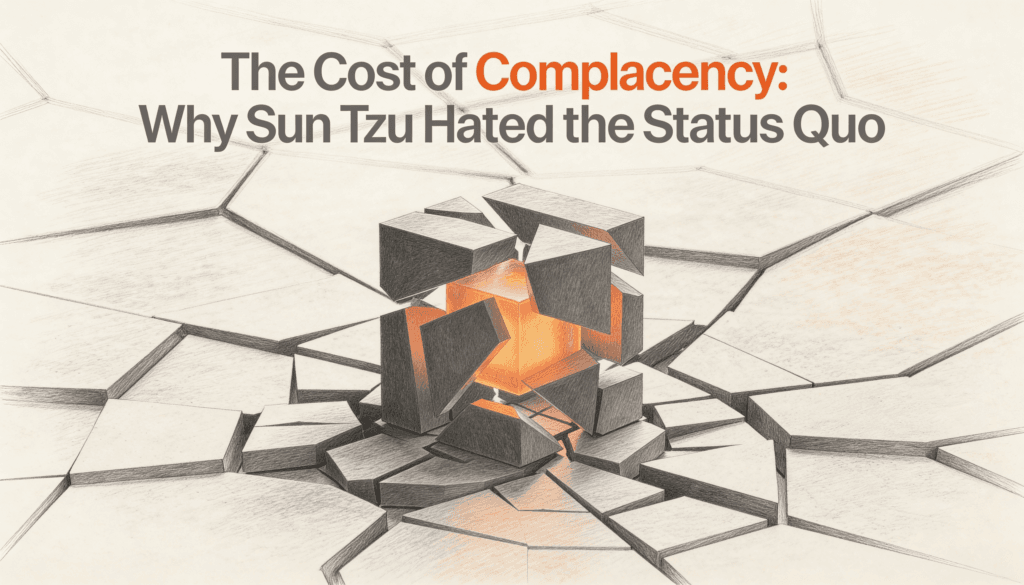
Complacency was, in his view, the most expensive habit a person or a kingdom could develop. Not arrogance. Not weakness. Not even cowardice. Complacency. The quiet conviction that what worked yesterday will keep working tomorrow because, well, it worked yesterday. Sun Tzu treated this assumption the way a doctor treats a tumor. Find it early, cut it out, and never assume it will not return.
To understand why he held such a sharp view of the status quo, it helps to look at his world through a few different lenses. Not just the military one, because frankly that lens has been overused to the point of caricature. Anyone who has sat through a business book that compares quarterly earnings to ancient Chinese cavalry maneuvers knows exactly what I mean.
The Philosophical Lens: Stillness Is an Illusion
Sun Tzu lived during the Spring and Autumn period of Chinese history, a time when small states were constantly being absorbed by larger ones. The intellectual climate around him was shaped by Taoist thought, which held that the universe was in a state of perpetual change. Nothing was ever truly still. A river that looks calm is moving underneath. A mountain that looks eternal is eroding. A kingdom that looks secure is already being plotted against by someone three borders away.
This was the cultural water Sun Tzu swam in, and it shaped his most uncomfortable idea. If everything is always moving, then standing still is not neutral. Standing still is moving backward relative to everyone else. The status quo is not a safe harbor. It is a treadmill that someone else is steadily turning up.
Most people instinctively reject this. They want to believe that once they have built something, whether a career, a relationship, a company, or a reputation, they have earned a period of rest. Sun Tzu would have considered this a charming but fatal piece of optimism. The rest never comes. The moment you stop adapting, the world starts taking pieces of your position without asking permission.
You can see this play out in nearly every story of decline ever written. The undefeated boxer who skips one camp. The brilliant student who coasts on talent until talent runs out. The company that dominated a market until a competitor showed up with something the dominant player thought was a toy. None of these failures happened because someone made a catastrophic mistake. They happened because someone did not make any moves at all.
The Economic Lens: The Hidden Bill of Inaction
There is a concept economists love called opportunity cost. It refers to the value of the thing you did not choose. Every choice carries an invisible price tag attached to the path you abandoned. Sun Tzu, without ever using the term, understood this with painful clarity.
When a general sits in a fortified camp and waits, he is not saving resources. He is burning them. Food gets eaten. Soldiers grow restless. Information becomes stale. Meanwhile the enemy, who might be doing the exact same thing somewhere else, is at least theoretically capable of doing something useful. Sitting still feels free. It is, in fact, one of the most expensive things a person can do.
Modern life has only made this worse. The cost of complacency in Sun Tzu’s era was measured in seasons and harvests. Today it is measured in quarters, then months, then weeks. A skill that was valuable five years ago might be a museum piece today. A business model that printed money in 2018 might be a cautionary tale by 2025. The treadmill keeps speeding up, and the people who refuse to acknowledge it tend to end up flat on their faces, wondering when the floor moved.
Here is the part that stings. The bill for complacency does not arrive on time. It accumulates quietly, almost invisibly, and then lands all at once. People who get comfortable rarely notice the moment they became vulnerable. They notice the moment the consequences become unavoidable, which is usually too late to do anything elegant about it. Sun Tzu would have called this the worst kind of defeat. Not the one inflicted by a clever enemy, but the one inflicted by your own assumption that yesterday’s victory still counts.
The Psychological Lens: Comfort as a Sedative
There is a reason complacency is so seductive. The human brain is wired to conserve energy, and adapting is expensive. Learning new things hurts. Updating beliefs hurts more. Admitting that a strategy that used to work is now failing might be the most expensive cognitive operation of all, because it involves dismantling a piece of identity that was built on that strategy.
Sun Tzu, in his blunt way, kept telling his readers to do the painful thing anyway. He insisted that the wise commander studies the terrain, the enemy, the weather, the morale of his own troops, and crucially, his own assumptions. He demanded constant reassessment. Not because he loved work for its own sake, but because he understood that the alternative was a quiet sedation that ends in disaster.
Consider how often people confuse comfort with progress. A familiar routine can feel like stability when it is actually stagnation. A long tenure at a job can feel like loyalty when it is actually inertia. A relationship that has stopped growing can feel like peace when it is actually slow drift. The feeling of safety is one of the least reliable signals a human being can act on. Sun Tzu knew this, which is why he urged commanders to be most suspicious precisely when they felt most secure.
There is also the social dimension. Complacency rarely happens in isolation. It tends to be a group activity. Everyone in the room agrees that things are fine. Everyone nods at the same charts. Everyone laughs at the same jokes about the competition. The collective hum of agreement becomes its own evidence that nothing needs to change. By the time someone has the courage to say the obvious, the damage is already done. Sun Tzu would have noted, dryly, that this is exactly how kingdoms fall.
The Long View: Why This Matters Now More Than Ever
It is easy to read Sun Tzu and treat him as a curiosity. An ancient general with some clever lines about deception and timing. But the reason his work has survived is that the human tendency he was warning about has not gone anywhere. If anything, it has gotten worse.
We live in a time of unprecedented comfort, at least for many people in the developed world. The systems around us are designed to remove friction. Food arrives at the door. Entertainment streams on demand. Algorithms curate the news to match what we already believe. The architecture of daily life is one giant invitation to complacency, and it is far more sophisticated than anything Sun Tzu could have imagined.
You can coast for a while and feel fine. The bill takes longer to arrive than it used to, because the cushioning around modern life is thick. But when it arrives, it tends to be larger, because the world has moved further while you were not looking. Industries reshape themselves in five years. Relationships drift in eighteen months of inattention. Sun Tzu’s warning, written for a world of swords and chariots, applies with almost embarrassing accuracy to a world of software updates and shifting markets.
The deeper point, the one that gives his work its strange power, is that the status quo is never actually the status quo. It is a story we tell ourselves about a situation that is in fact already changing. The map we are using is always slightly out of date. The only question is how quickly we are willing to update it.
What Sun Tzu Would Probably Tell You
If Sun Tzu could speak to a modern reader, he would probably not give a stirring speech about seizing the day. That kind of energy was not really his style. He would more likely ask a few uncomfortable questions. What assumption are you making right now that has not been tested in the last year? What part of your situation feels safe in a way that has stopped being examined? What habit are you defending because it used to work, even though the conditions that made it work have changed?
He would not expect you to have good answers. He would expect you to start looking for them. The cost of complacency, he would remind you, is not that something terrible happens to you. It is that something terrible happens to you in slow motion, and you are the last person in the room to notice.
That, more than any battlefield maneuver, is what made him worth reading then and worth reading now. He understood that the most dangerous opponent any of us ever faces is the quiet voice that says everything is fine. Everything is rarely fine. It is just not yet obviously broken.