Table of Contents
Imagine waking up tomorrow and discovering that overnight, every human being on the planet had read Seneca’s On Anger and actually taken it seriously. Not just nodded along at the clever lines, not just shared a quote on social media with a sunset background, but genuinely absorbed the ideas and applied them. The world you would step into would be so radically different that you might not recognize it. You might even find it slightly unsettling, in the way that perfect silence can feel louder than noise.
Seneca, writing nearly two thousand years ago to his older brother Novatus, called anger the most hideous and frenzied of all emotions. He did not mean it was simply unpleasant. He meant it was a kind of temporary madness, a brief possession by something that wears your face but is not really you. And here is the part that tends to catch people off guard: he did not believe anger had any legitimate use. None. Not even righteous anger. Not even the anger that drives reform or punishes wrongdoing. He thought we could do all of those things better, more precisely, and with far less collateral damage, if we simply removed anger from the equation entirely.
Most people, hearing this for the first time, react with a kind of reflexive resistance. Of course anger has its place, they say. Without anger, how would we fight injustice? How would we protect what we love? How would we even know we cared about something? These are reasonable questions. They are also, according to Seneca, the exact rationalizations that keep us trapped in cycles we claim to hate.
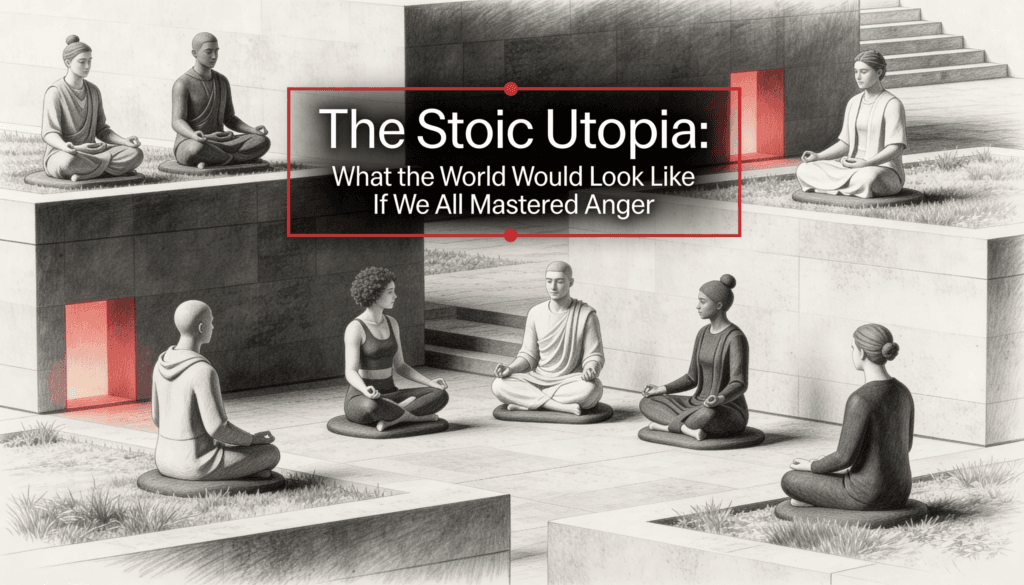
So let us actually play the thought experiment out. What would the Stoic utopia look like?
The Morning Commute Becomes Unrecognizable
Start with something small. Traffic. In our current world, the average driver experiences several flashes of irritation per trip, and a meaningful percentage of those flashes escalate into honking, gesturing, or in the worst cases, violence. Road rage kills people every year. It is responsible for a staggering amount of stress hormones flooding through bodies that then carry that chemical residue into offices, homes, and bedrooms.
In the Stoic utopia, the driver who cuts you off is not a villain. He is just a person making a driving decision you did not anticipate. Your blood pressure does not spike. Your knuckles do not whiten on the wheel. You simply adjust and continue. The total reduction in stress hormones across a single morning rush hour in a single major city would probably be enough to extend the collective lifespan of its residents by a measurable amount.
This is not a small thing. This is millions of small wounds, healed before they are even inflicted.
Politics Stops Being a Blood Sport
Modern political discourse runs almost entirely on anger. Outrage drives clicks, clicks drive revenue, and revenue funds more outrage. The entire ecosystem is built on the assumption that you can be made furious about something within roughly fifteen seconds of opening any app on your phone.
In the Stoic utopia, this engine seizes up overnight. Headlines designed to provoke fail to provoke. Pundits screaming on television find themselves talking to empty rooms. Politicians who built careers on the cultivation of grievance discover that grievance is no longer a renewable resource. The entire architecture of inflammatory media collapses, not because it was banned, but because no one is buying what it sells.
What replaces it? Probably something slower and far less entertaining. Real debates about real tradeoffs. Calm analysis of policy. Disagreements that resolve into compromises rather than feuds. The cable news industry would have to reinvent itself or die. Social media platforms would lose a substantial portion of their engagement metrics. A whole economy built on the monetization of human reactivity would have to find something else to sell.
Some people would mourn this. They would say something essential had been lost, that the passion was gone, that politics had become boring. They might be right. But Seneca would point out that the passion they are mourning is the same passion that produces wars, riots, and the steady erosion of trust between neighbors. He would say that boring is a small price to pay for not destroying each other.
Relationships Get Strange and Beautiful
Most arguments between people who love each other are not actually about the thing they are arguing about. They are about something that happened earlier, or something that has been building for months, or something one person never said out loud. Anger is the wrapper. The actual content underneath is usually fear, exhaustion, or a need that was never named.
In the Stoic utopia, when your partner forgets to do the thing they said they would do, your first response is not a sharp comment. It is curiosity. Why did this happen? Is there a pattern? Is something else going on? You ask, calmly, and they answer, calmly, because they are not bracing for impact. The conversation goes somewhere. It might still be hard. It might still uncover real problems. But it does not detonate.
Children grow up in homes where the adults around them do not yell. Not because the adults are suppressing their feelings, but because they have genuinely stopped having the explosive feelings in the first place. These children develop nervous systems that are differently calibrated. They become adults who handle stress differently. The effects ripple forward for generations.
Friendships last longer because they are not severed by misunderstandings that could have been resolved with one calm conversation. Estranged family members reconnect because the original wound, when examined without the protective armor of resentment, often turns out to be smaller than it seemed. People say what they actually mean, because they are not afraid of how it will land, and they are not using their words as weapons.
There is something almost eerie about imagining a world like this. We are so accustomed to the friction of human relationships that a frictionless version of them feels artificial. But Seneca would say we have simply mistaken our wounds for our nature.
The Workplace Transforms
Anyone who has worked in an office knows that a meaningful percentage of professional life is spent managing the emotional weather of other people. The boss who is in a mood. The colleague who took something personally. The client who blew up over a minor delay. Vast amounts of human energy go into preventing, defusing, or recovering from these episodes.
In the Stoic utopia, that energy is freed up. Meetings get shorter because people are not posturing or scoring points. Feedback gets clearer because no one is delivering it with hidden barbs or receiving it with defensive walls. Difficult decisions get made faster because the discussion can stay on the substance rather than constantly veering into who feels disrespected.
The counterintuitive part is that productivity, which we usually associate with intensity and pressure, might actually increase when the pressure decreases. Stressed brains make worse decisions. Anxious teams produce worse work. The pursuit of excellence has been so thoroughly conflated with the cultivation of urgency that we have forgotten you can do excellent work without being miserable while you do it.
Why This Will Never Happen, and Why It Matters Anyway
Of course, the Stoic utopia will never arrive. Anger is too deeply wired into our biology, too profitably exploited by our systems, and too thoroughly normalized by our culture for it to vanish from the human experience. Even Seneca, who spent decades teaching these principles, did not claim to have fully escaped anger himself. He admitted he was working on it, like everyone else.
But that is not really the point of the thought experiment. The point is to notice how much of what we accept as inevitable is actually optional. The traffic rage, the political fury, the family blowups, the workplace dramas. We have come to treat these as the natural texture of human life, like weather, but they are not weather. They are choices. Not always conscious choices, not always easy choices, but choices nonetheless.
You will not single handedly bring about the Stoic utopia. But you can, in your own life, conduct a smaller version of the experiment. You can notice the moment when irritation begins to harden into anger, and you can let it pass through you instead of latching onto it. You can ask, in the middle of an argument, whether you are actually trying to solve something or just trying to win. You can recognize that the person who annoyed you today probably did not wake up planning to ruin your day, and that your day is largely yours to ruin or preserve.
These are not grand gestures. They are small, ordinary acts of self management. But Seneca believed that ordinary acts, repeated over a lifetime, were what shaped a person. And if enough people shaped themselves this way, the world would shape itself differently in response.
The utopia is not a destination. It is a direction. And the strangest thing about Seneca’s vision is not how unreachable it is. It is how close it actually sits, just on the other side of a few thousand small decisions we are all entirely capable of making, if we ever decide to.