Table of Contents
The Real Threat Is Not Empty Offices. It Is Full Ones Doing Average Work
Every week another consulting firm publishes a report warning that AI will erase 300 million jobs. Every week another billionaire tells a podcast that white collar work is finished. They are looking at the wrong disaster.
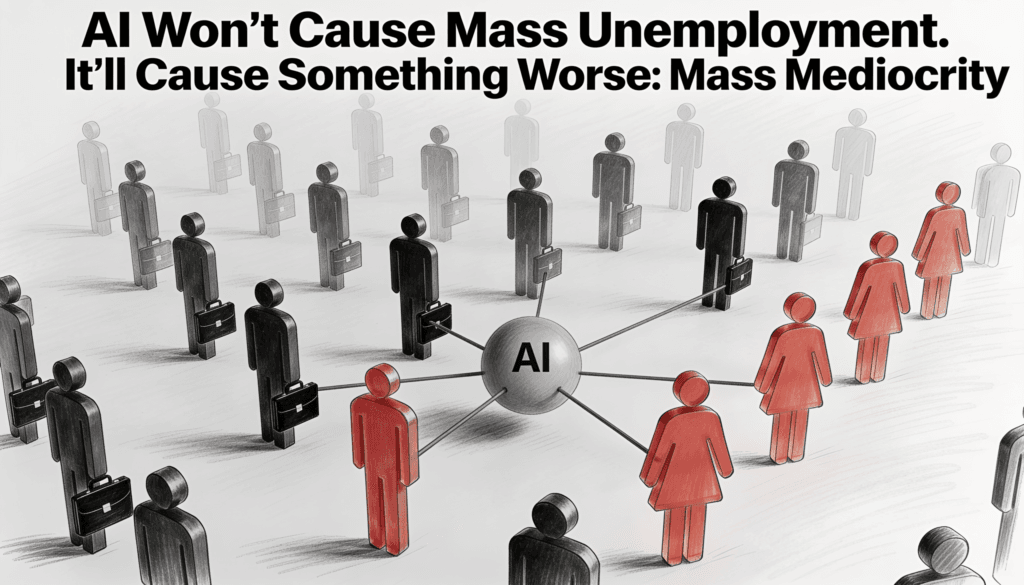
The catastrophe coming for the modern economy is not unemployment. It is the quiet, uniform, unremarkable competence of everyone using the same tools to produce the same output. AI will not empty the offices. It will fill them with people who all sound alike, think alike, and produce work indistinguishable from one another.
John Stuart Mill saw this coming 160 years ago, though he thought the culprit would be public opinion rather than a language model. In On Liberty he warned that the greatest danger to civilization was not tyranny but the “tyranny of prevailing opinion and feeling,” a soft pressure that made people “ape” one another until originality itself became suspect. Replace public opinion with GPT and you have a description of 2026.
The conversation about AI and the future of work has fixated on job counts because job counts are easy to measure. Mediocrity is harder to see on a spreadsheet. But mediocrity is what compounds, and it is what will define the next two decades of professional life.
The Unemployment Panic Is Mostly Wrong
Start with the numbers everyone quotes. Goldman Sachs said 300 million jobs. The IMF said 40 percent of global employment is “exposed.” The World Economic Forum predicted 83 million roles gone by 2027. These figures share a common flaw. They confuse task automation with job elimination, which economic history has shown are different things.
The spreadsheet did not kill accountants. ATMs did not kill bank tellers, and in fact the number of tellers grew for two decades after the ATM was introduced because branches became cheaper to open. Email did not kill secretaries so much as it turned every executive into their own typist, which is a subtler form of degradation we will return to.
What The Doomers Get Wrong About Labor
The ai unemployment thesis assumes that when a task becomes cheaper, demand for that task stays flat. It almost never does. William Stanley Jevons noticed in 1865 that making coal-burning engines more efficient did not reduce coal consumption in Britain. It multiplied it. Cheaper coal meant more uses for coal.
Cheaper cognition will mean more uses for cognition. Companies that could only afford one analyst will hire three. Marketing departments that produced 4 campaigns a year will produce 40. Legal teams that reviewed 100 contracts will review 10,000. The volume of work expands to fill the available compute.
The question is not whether AI will replace workers. The question is whether the workers who remain will still be capable of thinking without it.
Why The Displacement Story Persists Anyway
The ai job displacement narrative persists because it is emotionally satisfying and journalistically clean. A layoff is a photograph. A slow erosion of professional judgment across an entire generation is not. But the second story is the real one, and it maps almost exactly onto a warning Alexis de Tocqueville made about democratic societies in 1840.
Tocqueville feared that equality of condition would produce a “manufactured” sameness of thought, where citizens, freed from the tyranny of kings, would submit voluntarily to the tyranny of average opinion. He called it “democratic despotism,” and it worked not by breaking men but by softening them until resistance felt pointless.
Substitute “worker” for “citizen” and “AI” for “public opinion.” The mechanism is identical.
The Mediocrity Machine And How It Actually Works
To understand why AI produces mediocrity rather than excellence, you have to understand what a large language model actually does. It predicts the most probable next token given everything that came before. Probable. Not best, not truest, not most surprising. Most probable.
A model trained on the entire internet has learned, with extraordinary precision, the shape of the average sentence, the average argument, the average business email. When you ask it to write for you, it returns something that sits at the exact statistical center of everything it has read. This is a feature. It is also, at scale, a civilizational problem.
Regression To The Mean, Automated
Consider what happens when every consultant, every marketer, every mid-level manager, and every graduate student uses the same three tools to draft the same kinds of documents. The output does not converge on excellence. It converges on the median.
Nietzsche had a word for this outcome, though he was aiming at Christianity and mass democracy rather than software. He called it the reign of the “last man,” the creature who wants comfort above all, who has “his little pleasure for the day and his little pleasure for the night,” and who has forgotten how to shoot the arrow of longing beyond himself. The last man does not fail. He simply does not aim.
AI is the perfect infrastructure for the last man. It removes the friction that used to force people to think. Friction is where thought lives. When a writer struggles for the right word, that struggle is the thinking. When a strategist wrestles with an ambiguous market, that wrestling is the strategy. Remove the friction and you remove the cognition.
The Homogenization Problem
Researchers at MIT and Cornell have already begun documenting what happens to creative output when large groups use the same generative tools. In one 2024 study, participants who used ChatGPT to brainstorm ideas produced individually more novel work than those without it, but collectively their ideas became more similar to one another. The pool of possibilities shrank even as individual productivity rose.
This is the paradox at the heart of the ai and future of work question. Individual performance improves. Collective originality collapses. Everyone gets better at producing the same thing.
A workforce optimized by identical tools does not become 10 times smarter. It becomes 10 times more predictable, which is the opposite of valuable in a competitive economy.
What Machiavelli, Sun Tzu, And Adam Smith Would Say
The great strategists understood something modern productivity gurus have forgotten. Advantage comes from asymmetry. If your enemy is doing what you are doing, you are not winning. You are tying.
Machiavelli On The Value Of Being Feared And Different
In chapter 17 of The Prince, Machiavelli argues that a ruler must cultivate a reputation that distinguishes him from his rivals, because reputations built on generic virtue are quickly forgotten. He was writing about statecraft, but the logic applies precisely to the modern professional. A consultant whose deck looks like every other consultant’s deck is not a consultant. He is a commodity.
AI turns knowledge workers into commodities faster than any technology in history. The junior analyst who used to spend 40 hours building a financial model and, in that struggle, learned something about the business, now produces the same model in 20 minutes and learns nothing. He has become efficient and interchangeable in the same movement.
Sun Tzu On The Uniform Army
Sun Tzu observed that armies that fight in identical formations, using identical tactics, are defeated by the general who introduces even one unexpected element. “All warfare is based on deception,” he wrote, meaning: do not be predictable, because predictability is death.
An economy where every proposal, every pitch, every strategic memo has been passed through the same three models is an economy of predictable armies. The people who will win are the ones who look nothing like the output of a language model. This is not a romantic point. It is a strategic one.
Adam Smith On The Division Of Labor’s Dark Side
Even Adam Smith, patron saint of specialization, worried about what specialization did to the human mind. In book 5 of The Wealth of Nations, he wrote that a worker who spends his life performing “a few simple operations” becomes “as stupid and ignorant as it is possible for a human creature to become.” He was talking about pin factories. The observation applies with unsettling accuracy to a knowledge worker whose job has been reduced to prompting, reviewing, and pasting.
Who Wins In The Age Of Automated Average
If the diagnosis is mediocrity rather than unemployment, the prescription changes entirely. The question stops being “how do I keep my job” and becomes “how do I remain distinguishable from a machine that produces the median output of my profession.”
The Return Of Taste
Taste is the ability to tell what is good from what is merely acceptable. It cannot be automated because it is not a rule. It is a judgment refined over years of exposure, argument, and failure. The people who will command premiums in the AI economy are the ones with taste, because taste is the only quality that filters mediocre output into excellent output.
Steve Jobs did not code. He did not design in the technical sense. He rejected. His value to Apple was his willingness to say “this is not good enough” 400 times until something was good enough. AI produces infinite drafts. Taste is what selects among them, and taste is rare because it is expensive to develop.
The Return Of Voice
Every writer, every executive, every founder now faces a strange incentive. Sound too polished and you sound like a model. Sound too raw and you sound unprofessional. The winners will figure out that the polished middle is now worthless, because it is free. Only the ends of the spectrum, the deeply personal and the deeply rigorous, retain value.
In a world where competent prose is free, the only prose worth paying for is prose that could not have been written by anyone else.
This applies to strategy documents, to product decisions, to legal arguments, to everything. Voice is now a moat. It used to be a nice-to-have.
The Institutional Consequences Nobody Is Discussing
Zoom out from the individual worker to the institution. What happens to a company where every internal memo, every customer email, and every strategy deck has been drafted by the same model?
The Death Of The Junior Track
Law firms, consulting firms, and investment banks built their training pipelines on the assumption that junior professionals would suffer through repetitive work and, in the suffering, acquire judgment. Remove the suffering and you remove the judgment. The junior associate who has never manually built a discounted cash flow model does not know what its assumptions feel like when they are wrong.
Firms that automate the junior track without replacing it with a new form of apprenticeship will discover, in about 10 years, that they have no senior talent left. The ai job displacement conversation misses this entirely because it counts jobs, not competence. The jobs may still exist. The competence will not.
The Collapse Of Institutional Memory
Institutions run on tacit knowledge. The reason we do it this way. The client you never argue with. The regulation that reads one way and is enforced another. AI cannot capture this because it is not written down, and often it is not even conscious. It is transmitted through the friction of actual work performed by actual people.
Montesquieu, in The Spirit of the Laws, argued that laws were only half the story of any society. The other half was the “spirit,” the accumulated customs and dispositions that made the laws function. Strip out the customs and the laws become brittle. Strip out the tacit knowledge of a firm and the firm becomes brittle too, no matter how efficient its outputs look on a quarterly basis.
The Rise Of The Anti-AI Premium
Watch for the emergence of the “handmade” economy in white collar work, mirroring what happened to physical goods after industrialization. Bespoke tailoring survived the sewing machine. Artisanal bread survived Wonder Bread. Live music survived recorded music. In each case, the machine version dominated the mass market and the human version commanded premium pricing.
The same bifurcation is coming to knowledge work. The mass market will be served by AI. The premium market will be served by humans who can prove they are not using it, or that they are using it in ways nobody else has figured out. Expect law firms, agencies, and advisors to start marketing “human-authored” as a differentiator within 3 years.
What To Actually Do About It
If you accept the diagnosis, the individual response is not to reject AI. That is like rejecting electricity. The response is to use AI aggressively while systematically investing in the qualities AI cannot produce.
- Develop taste deliberately. Read the best 5 percent of anything in your field, not the average 95 percent. Taste comes from exposure to excellence, not exposure to volume.
- Guard your friction. Identify the tasks where struggling is the point, and refuse to automate them. For most knowledge workers this includes writing your own arguments from scratch at least once a week.
- Cultivate a voice. Read your own work aloud. If it sounds like anyone could have written it, rewrite it until it does not.
- Go deep on one thing. The generalist who knows a little about everything is exactly what a model is. The specialist who knows the contradictions of one domain is what a model is not.
- Study the humans, not the tools. The tools will change every 6 months. The psychology of clients, colleagues, and markets will not.
Mill closed On Liberty with a sentence that reads today like a warning label on a language model. “A state which dwarfs its men, in order that they may be more docile instruments in its hands even for beneficial purposes, will find that with small men no great thing can really be accomplished.”
Swap “state” for “software.” The warning holds. The economy that dwarfs its workers into docile prompters of a common tool will find, when the moment for a great thing arrives, that there are no great workers left to accomplish it.
The unemployment story is a distraction. The mediocrity story is the one to watch. And the professionals who understand this early, who refuse to become interchangeable, who invest in the friction and the taste and the voice that no model can produce, will be the ones who look back in 15 years and realize they were not disrupted at all. They were sorted.