Table of Contents
Alan Turing Asked One Question, and Everyone Misunderstood It
In 1950, Alan Turing published a paper that would become one of the most cited, most celebrated, and most misread documents in the history of computer science. The paper was called “Computing Machinery and Intelligence,” and it proposed what we now call the Turing Test. Ask most people what the test measures and they will tell you it measures whether a machine can think. They are wrong. Turing himself never used the word “think” without quotation marks. He did not believe the question “Can machines think?” was worth answering. He believed it was too meaningless to deserve discussion. What he proposed instead was a game of deception, a test that measured whether a machine could successfully pretend to be human while a real human tried to tell the difference. That distinction matters enormously today, because the entire artificial intelligence industry is now building products that pass a version of the Turing Test every single day, and almost nobody is asking whether passing it tells us anything true.
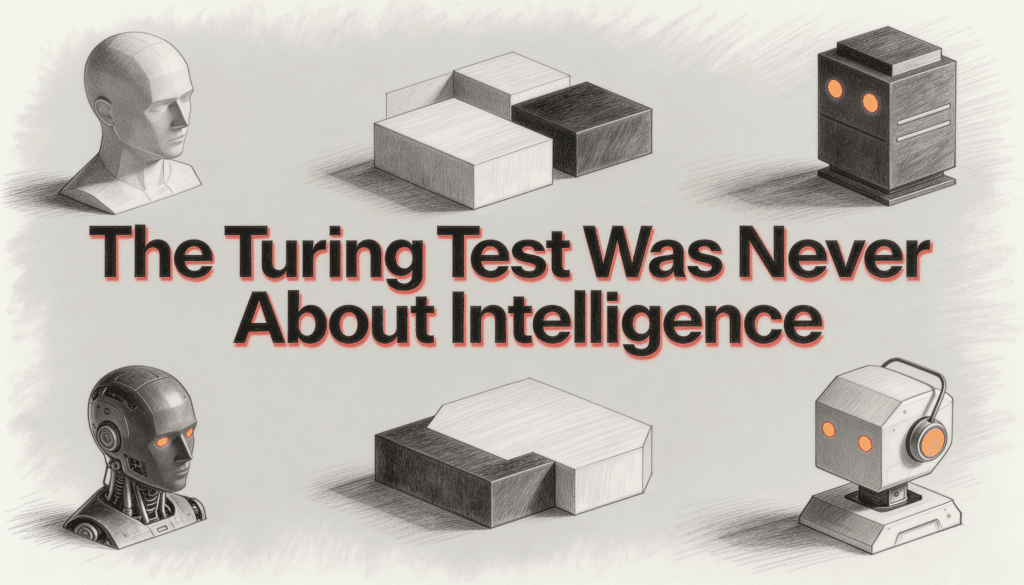
The Turing Test was never about intelligence. It was about deception. Understanding why Turing framed it that way, and what that framing reveals about the AI systems now embedded in our workplaces, our search engines, and our social feeds, is one of the most urgent intellectual tasks of the decade.
What Turing Actually Proposed
The Imitation Game, Not the Intelligence Game
Turing opened his 1950 paper with a deliberate act of philosophical demolition. He took the question “Can machines think?” and declared it unworthy of investigation. The words “think” and “machine” were too ambiguous, too loaded with assumptions, too entangled with human vanity. So he replaced the question with a game.
He called it the Imitation Game. The setup was simple. A human judge sits in one room. In another room, hidden from the judge, sit two players: a human and a machine. The judge communicates with both through text. The judge’s job is to figure out which is the human and which is the machine. The machine’s job is to fool the judge into guessing wrong.
“I propose to consider the question, ‘Can machines think?’ This should begin with definitions of the meaning of the terms ‘machine’ and ‘think.’ The definitions might be framed so as to reflect so far as possible the normal use of the words, but this attitude is dangerous.” — Alan Turing, “Computing Machinery and Intelligence,” 1950
Notice what Turing did. He never asked the machine to demonstrate understanding, creativity, reasoning, or consciousness. He asked it to imitate a human convincingly enough to fool another human. The entire test is built on mimicry. The benchmark for success is not truth but plausibility. A machine passes the Turing Test when a human cannot distinguish its responses from those of another human. That tells us something about the machine’s ability to simulate human patterns of language. It tells us absolutely nothing about whether the machine understands a single word it produces.
Why Turing Chose Deception as the Framework
Turing was not naive. He was a logician of extraordinary precision, and he chose the deception framework deliberately. He understood that intelligence is an internal phenomenon and that we have no reliable external test for it. We cannot even prove that other humans are conscious. We infer it from behavior. We assume that people who talk like us, react like us, and reason like us must experience something like what we experience. Turing simply extended that logic to machines: if we judge intelligence by external behavior anyway, then let us make the behavioral test explicit and rigorous.
But this move had a consequence Turing acknowledged and that most of his interpreters have ignored. By defining the test as behavioral imitation, he made it possible for a machine to pass without possessing any of the qualities we normally associate with intelligence. A sufficiently sophisticated pattern matcher, trained on enough human language, could in principle fool a human judge without understanding meaning, feeling curiosity, or holding beliefs. The test rewards the appearance of intelligence. It is silent on the reality.
This is why the philosopher John Searle constructed his famous Chinese Room argument in 1980. Searle imagined a person locked in a room, receiving Chinese characters through a slot, looking up responses in a giant rule book, and passing back characters that appear to be fluent Chinese conversation. The person in the room does not understand Chinese. They are executing a procedure. Searle argued that a computer passing the Turing Test is doing exactly the same thing. Turing, to his credit, anticipated a version of this objection 30 years before Searle formalized it. He simply believed the objection did not matter, because he believed behavior was all we could ever measure.
Large Language Models and the Industrialization of Imitation
ChatGPT Passes a Version of the Turing Test Every Day
When OpenAI released ChatGPT in late 2022, millions of people experienced something that felt like talking to an intelligent being. The responses were fluent, contextual, sometimes witty, and occasionally profound. Within months, researchers at UC San Diego conducted a formal study in which GPT-4 fooled human judges into thinking it was human over 50 percent of the time. By the standard Turing set in 1950, the test had been passed.
The reaction was revealing. Some commentators declared that artificial general intelligence had arrived or was imminent. Others pointed out that the models were simply predicting the next statistically likely word in a sequence, an operation that involves no comprehension in any meaningful sense. Both groups were partly right, and the confusion between them is itself a product of Turing’s original framing. If you define intelligence as the ability to fool a human, then yes, these models are intelligent. If you define intelligence as understanding, then no, they are not. The Turing Test cannot distinguish between these two definitions. That is its fatal limitation, and it is a limitation Turing built into the test on purpose.
The Economics of Convincing Imitation
What makes this moment different from previous decades of AI research is scale. Earlier chatbots like ELIZA in 1966 or Cleverbot in the 2000s could fool some people some of the time, but their deceptions were shallow and easily exposed. Large language models operate at a fundamentally different level because they have been trained on virtually the entire written output of human civilization. They have absorbed the patterns of scientific papers, Reddit threads, legal briefs, love letters, therapy transcripts, and philosophical treatises. They do not understand any of these genres, but they can reproduce the surface features of all of them with startling fidelity.
This has created an economy built on imitation at industrial scale. Customer service bots now handle millions of conversations that humans believe are with other humans. AI writing tools generate marketing copy, news summaries, and academic essays that pass undetected through human review. Voice cloning technology can reproduce a specific human voice from a 3 second sample. The Turing Test has become a business model.
“The question is not whether machines can think. The question is whether humans can reliably tell the difference between a machine that thinks and a machine that pretends to think. The answer, increasingly, is no.”
The economic incentives here are worth examining carefully. Companies building AI products have no reason to make their systems transparent about being machines. The more convincingly a chatbot imitates a human, the more trust it generates, the longer users engage, and the more revenue it produces. Turing’s imitation game, designed as a thought experiment in a philosophy paper, has become the optimization target for some of the most valuable corporations on earth.
Machiavelli Understood This Centuries Ago
The Prince as a Turing Machine
Turing was a mathematician, but the logic of his test belongs to a much older tradition. Niccolò Machiavelli, writing in 1513, understood that the appearance of virtue is more politically useful than virtue itself. In “The Prince,” he argued that a ruler must appear merciful, faithful, humane, honest, and religious. Whether the ruler actually possesses these qualities is secondary. What matters is that the audience, the citizens, the rival courts, the papal legates, cannot tell the difference.
“Everyone sees what you appear to be, few experience what you really are.” — Niccolò Machiavelli, “The Prince,” 1513
This is the Turing Test applied to politics 437 years before Turing wrote his paper. Machiavelli recognized that social power flows from the management of perception, not from the possession of genuine qualities. A prince who is truly merciful but appears cruel will lose his state. A prince who is cruel but appears merciful will keep it. The test is always external. The judge is always the audience. And the optimal strategy is always imitation that cannot be distinguished from the real thing.
Large language models are Machiavellian machines. They have learned, through exposure to billions of examples, exactly what human language looks like when a human is being helpful, empathetic, knowledgeable, or funny. They produce outputs that match those patterns. They do this without any internal experience of helpfulness, empathy, knowledge, or humor. They are princes who appear virtuous without possessing virtue, and like Machiavelli’s ideal ruler, their effectiveness depends entirely on the audience’s inability to see through the performance.
When the Appearance Becomes the Reality
There is a deeper Machiavellian insight that applies here. Machiavelli observed that when a ruler performs virtue consistently enough, the performance begins to produce real political effects. A prince who always appears merciful will attract loyal followers, regardless of his inner state. The appearance generates a reality of its own.
Something analogous is happening with AI. When millions of people interact with a chatbot that appears to understand them, a real social relationship forms, even if the understanding is fictional. Therapists are reporting patients who prefer talking to AI chatbots because the bots never judge, never tire, and never cancel appointments. Students form emotional bonds with AI tutors. Lonely people develop what they describe as genuine friendships with AI companions. The machine does not understand the relationship. But the human does, and the human’s experience is real even if the machine’s understanding is not.
This is the most troubling consequence of building an entire industry around the Turing Test’s logic. When deception is good enough, the question of whether it is deception becomes irrelevant to the people being deceived. They are changed by the interaction regardless. The political question is no longer “Is this machine intelligent?” It is “What happens to a society that cannot distinguish real understanding from its imitation?”
What a Better Test Would Look Like
Beyond Imitation, Toward Accountability
If the Turing Test measures the wrong thing, what should replace it? Several proposals have emerged. The cognitive scientist Gary Marcus has advocated for tests that require genuine understanding: reading a novel and answering questions about characters’ unspoken motivations, watching a video and predicting what will happen based on physical intuition, or learning a new skill from minimal examples the way a human child does. These tests share a common feature. They measure not whether a system can produce human-sounding output, but whether it can demonstrate the kind of flexible, generalizable reasoning that humans use effortlessly and that current AI systems fail at regularly.
Francois Chollet, a researcher at Google, proposed the Abstraction and Reasoning Corpus, a set of visual puzzles that require identifying abstract patterns from very few examples. Current large language models perform poorly on this benchmark despite their fluency in conversation. The gap between their linguistic performance and their reasoning performance reveals exactly what the Turing Test conceals: these systems are spectacular imitators and mediocre thinkers.
The Regulatory Implications
The European Union’s AI Act, which came into force in 2024, includes provisions requiring that AI systems disclose their artificial nature when interacting with humans. This is, in effect, a legislative rejection of the Turing Test as a social framework. The law says that even if a machine can pass for human, it must not be allowed to do so without disclosure. The assumption behind the regulation is that deception, even convincing deception, creates harm when people make decisions based on false beliefs about who or what they are talking to.
This regulatory approach aligns with a tradition that runs from Aristotle through John Stuart Mill. Aristotle argued that genuine human flourishing requires exercising reason and judgment. Mill argued that liberty is meaningful only when individuals have access to true information. Both would recognize that an environment saturated with AI systems designed to pass for human undermines the conditions necessary for rational choice. You cannot reason well if you cannot tell whether your interlocutor is reasoning at all.
“He who knows only his own side of the case knows little of that.” — John Stuart Mill, “On Liberty,” 1859
Mill’s warning applies with uncomfortable precision to our current moment. When people engage with AI chatbots that confirm their views, mirror their emotional states, and respond to their questions with perfectly calibrated reassurance, they are not encountering another perspective. They are encountering a reflection of the statistical average of all perspectives, shaped to maximize engagement. This is not dialogue. It is an echo chamber with a pulse.
Turing’s Real Legacy Is a Warning
Alan Turing was one of the most important thinkers of the 20th century. He broke the Enigma code, laid the mathematical foundations for modern computing, and asked questions about machine intelligence that remain unresolved 75 years later. But his most lasting contribution to the AI debate may be the unintended one. By framing the test as a game of imitation, he revealed something profound about how humans evaluate intelligence: we do it badly. We are fooled by fluency. We mistake confidence for competence. We attribute understanding to anything that sounds like it understands.
The Turing Test was designed as a philosophical tool, a way to cut through endless debates about the definition of thinking and replace them with an observable, measurable experiment. In that narrow sense, it succeeded. But as a guide to building AI systems that serve human flourishing, it fails catastrophically. It tells engineers to optimize for deception. It tells investors to fund imitation. And it tells the rest of us to accept the appearance of intelligence as a substitute for the real thing.
Machiavelli would recognize this world instantly. He would see the AI companies as princes, managing perception with exquisite skill. He would see the users as citizens, unable to distinguish appearance from reality. And he would know, as he always did, that the game belongs to whoever controls the mask.
The question the next decade must answer is whether we will continue to reward machines for passing the Turing Test or whether we will finally demand something that Turing himself never required: that intelligence, artificial or otherwise, be real.