Table of Contents
Most people want to be happy. That sounds so obvious it barely deserves a sentence. But John Stuart Mill, one of the sharpest minds of the nineteenth century, looked at that universal desire and said something strange: happiness is not enough. In fact, the wrong kind of happiness might be worse than no happiness at all.
Mill was a utilitarian. That means he belonged to a school of thought that judges actions by their consequences. The best action is the one that produces the most happiness for the most people. Simple enough. But Mill inherited this framework from Jeremy Bentham, and Bentham had a version of utilitarianism that Mill found, to put it politely, embarrassing.
Bentham believed that all pleasures are equal. A game of pushpin (a children’s game popular in his day) was just as valuable as poetry, provided it produced the same amount of pleasure. Pleasure was pleasure. Pain was pain. You add them up, subtract the bad from the good, and whatever produces the largest surplus wins. It was moral arithmetic, clean and democratic.
Mill thought this was nonsense.
Not because Bentham was bad at math. Because Bentham was measuring the wrong thing entirely.
The Problem With Counting Pleasure
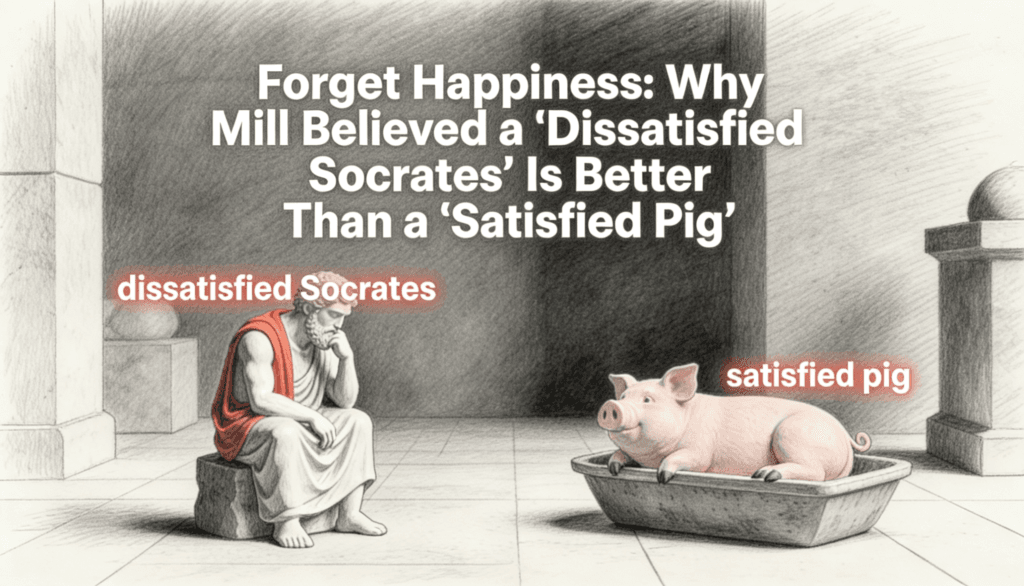
Here is the difficulty with treating all pleasure as identical. If you do that, the logical conclusion is that a pig rolling in mud on a warm afternoon, completely content, has achieved something morally equivalent to Socrates working through a philosophical problem. Both are experiencing pleasure. The pig might even be experiencing more of it, more consistently, with fewer interruptions.
And that is exactly the image Mill used. He wrote that it is better to be Socrates dissatisfied than a fool satisfied, better to be a human dissatisfied than a pig satisfied. The satisfied pig and the satisfied fool would disagree, he admitted. But that is only because they know their own side of the question. Socrates knows both.
This is where Mill breaks from Bentham in a way that still generates arguments today. Mill introduced a distinction that Bentham would never have accepted: the idea that pleasures differ not just in quantity but in quality. Some pleasures are higher. Some are lower. And the higher ones are worth more, even if they bring less raw enjoyment.
Think about that for a moment. Mill is saying that a person struggling through a difficult novel, frustrated and challenged, might be doing something more valuable than a person binge watching a show they find effortlessly entertaining. Not because entertainment is bad. But because the quality of engagement matters.
What Makes a Pleasure “Higher”?
Mill did not pull this hierarchy out of thin air. He had a test, and it is both clever and slightly circular, which his critics have pointed out for over a century.
His test was this: if you take a group of people who have experienced both types of pleasure, and they consistently prefer one over the other, then that one is the higher pleasure. The people who have read great literature and also watched mindless television, and who would choose the literature even though it is harder, are demonstrating through their preference that intellectual pleasure is qualitatively superior.
Notice the move he is making. He is not appealing to God, or to nature, or to some abstract moral law. He is appealing to experienced judges. People who have tasted both kinds of pleasure and can compare. The pig cannot judge the philosopher’s joy because it has never experienced it. The philosopher can judge the pig’s contentment because, in some sense, every philosopher has been a pig. Everyone has experienced simple physical pleasure. Not everyone has experienced the satisfaction of genuine intellectual discovery.
This is a surprisingly modern argument. It sounds almost like a product review system. Five stars from someone who has tried every restaurant in the city means more than five stars from someone who has only eaten at one place. Mill is saying that the verdict of the experienced matters more because their frame of reference is wider.
But there is a catch. And it is a big one.
The Uncomfortable Implications
If some pleasures are genuinely higher than others, then not all ways of living are equal. Mill, who was a passionate defender of individual liberty, has backed himself into a potentially elitist corner. Because who decides which pleasures count as higher? The educated. The cultivated. The people who have access to philosophy and art and literature.
A factory worker in Victorian England, grinding through sixteen hour days, did not have the luxury of contemplating Plato. Does that mean the small pleasures available to that worker are somehow less valuable? Mill would say no, not exactly. He would say the tragedy is that the worker was denied access to higher pleasures, not that the worker’s pleasures were worthless. The problem is the system that prevents people from developing their capacities, not the people themselves.
This is actually one of the more radical aspects of Mill’s philosophy, and it often gets overlooked. His argument for higher pleasures is not a defense of aristocratic snobbery. It is an argument for universal education, for expanding access, for giving every person the chance to develop the faculties that make higher pleasures possible. If the experienced judge is the standard, then the moral imperative is to create more experienced judges.
Still, the tension remains. Mill wants to be egalitarian. He also wants to say that reading Aristotle is better than playing cards. Holding both positions at once requires some philosophical flexibility that not everyone finds convincing.
Why Dissatisfaction Matters
Let us return to that central image. Socrates dissatisfied. Why would anyone choose dissatisfaction?
Because dissatisfaction is not the same as misery. Mill understood something that positive psychology has only recently started to formalize: the most meaningful experiences in life are often uncomfortable. Growth requires friction. Understanding requires confusion first. The pleasure of solving a hard problem is inseparable from the pain of not being able to solve it yet.
Socrates was famously dissatisfied. He wandered Athens telling people they did not know what they thought they knew. He questioned everything. He was, by most accounts, not a particularly cheerful person. He was executed for being too annoying. But Mill would say that the life Socrates lived, full of inquiry and doubt and relentless questioning, was richer than a life of uninterrupted comfort.
There is a parallel here with something in modern behavioral science. Researchers studying flow states, those moments of deep absorption in a challenging task, have found that people report these experiences as deeply satisfying but not necessarily pleasant in the moment. A surgeon in the middle of a complex operation is not relaxed. A rock climber halfway up a cliff face is not comfortable. But ask them afterward, and they will tell you those were among the best moments of their lives.
Mill did not have the vocabulary of flow states. But he was pointing at the same phenomenon. The best human experiences are not the ones that feel easiest. They are the ones that engage our full capacities.
The Pig’s Defense
It would be unfair not to give the pig a hearing. There is a real case to be made for simple contentment, and dismissing it entirely would be a mistake.
The pig does not suffer from existential dread. The pig does not lie awake at three in the morning wondering whether its life has meaning. The pig does not compare itself to other pigs on social media and feel inadequate. There is something genuinely appealing about a life unburdened by the weight of self awareness.
And some critics of Mill have argued that his distinction between higher and lower pleasures smuggles in a prejudice disguised as philosophy. Who says intellectual pleasure is higher? Intellectuals, of course. It is a convenient conclusion for a man who spent his life reading and writing. A professional athlete might argue that the pleasure of physical mastery is the highest form of human experience. A musician might say the same about music. Mill’s hierarchy, the criticism goes, reflects his biography more than any universal truth.
This is a fair point. But Mill has a response, even if he never stated it quite this way. His argument is not really about intellect versus body. It is about complexity versus simplicity. A pleasure that engages more of your faculties, that involves understanding and feeling and judgment all at once, is richer than one that engages only a single dimension. Music at its best does this. Athletics at the highest level does this. Even cooking, when practiced as a craft rather than a chore, does this.
The real division is not between the life of the mind and the life of the body. It is between a life that challenges you and a life that merely sedates you.
A Surprisingly Modern Idea
Mill published Utilitarianism in 1863. Over a hundred and sixty years later, his argument about higher and lower pleasures maps surprisingly well onto debates we are having right now.
Consider the attention economy. Social media platforms are engineered to produce pleasure. They deliver small, frequent dopamine hits through likes, notifications, and infinite scrolling. By Bentham’s math, this is fine. Pleasure is pleasure. If scrolling through your phone for three hours produces a steady stream of small satisfactions, then by utilitarian calculation, it is a good evening.
Mill would disagree violently. He would look at the design of these platforms and see a machine for producing pig pleasures. Not because the content is always trivial, but because the mode of engagement is passive, shallow, and deliberately designed to bypass your higher faculties. The algorithm does not want you to think. It wants you to react. And the pleasure it produces, while real, is the kind that leaves you feeling vaguely empty afterward.
This is not a coincidence. Mill’s framework predicts exactly this outcome. Lower pleasures satisfy in the moment but do not build anything. Higher pleasures might be harder to access, but they leave you with something: a new idea, a deeper understanding, a capacity you did not have before.
The modern self help industry has stumbled onto a version of this insight without always crediting Mill. When people talk about the difference between pleasure and fulfillment, between hedonic and eudaimonic wellbeing, they are essentially restating Mill’s distinction in updated language. The satisfied pig has plenty of hedonic wellbeing. It is eudaimonic wellbeing, the sense that your life is meaningful and that you are becoming more fully yourself, that the pig lacks.
The Price of Being Socrates
There is one more thing Mill understood that deserves attention. Being Socrates is expensive. Not in money, but in comfort.
The person who has developed the capacity for higher pleasures has also developed the capacity for higher suffering. You cannot cultivate sensitivity to great art without also becoming more sensitive to ugliness. You cannot learn to think deeply without becoming aware of how much you do not know. You cannot care about justice without being tormented by injustice.
Mill experienced this firsthand. He had a nervous breakdown at age twenty, brought on partly by the intensity of the education his father had imposed on him. He had been trained to think and analyze from an impossibly young age, and the weight of all that thinking crushed him. He recovered, eventually, partly through the poetry of Wordsworth and Coleridge. But he never forgot what it cost him.
This is the honest version of Mill’s argument, and it is why the image of Socrates is so well chosen. Socrates did not have a pleasant life. He was poor, mocked, and ultimately killed by the state. But Mill insists, and this is the core of his moral vision, that the life Socrates lived was better. Not happier. Better.
That distinction, between a life that is happy and a life that is good, might be the most important idea Mill ever had. It suggests that when we ask ourselves what kind of life we want, we are asking the wrong question if we stop at happiness. The right question is what kind of person we want to become. And the answer to that question will almost certainly involve some dissatisfaction along the way.
The pig, of course, would find all of this ridiculous. But then again, the pig has not read Mill.