Politics

We do not do partisan commentary. What we do is harder: we take the structural questions of political life – why democracies stagnate, why borders matter, why bureaucracies grow, why rights are never as universal as they claim — and trace them back to the thinkers who first saw these patterns. Hayek, Rousseau, Weber, Huntington. The names change. The tensions do not. Intellectual Prestige writes about the tensions.

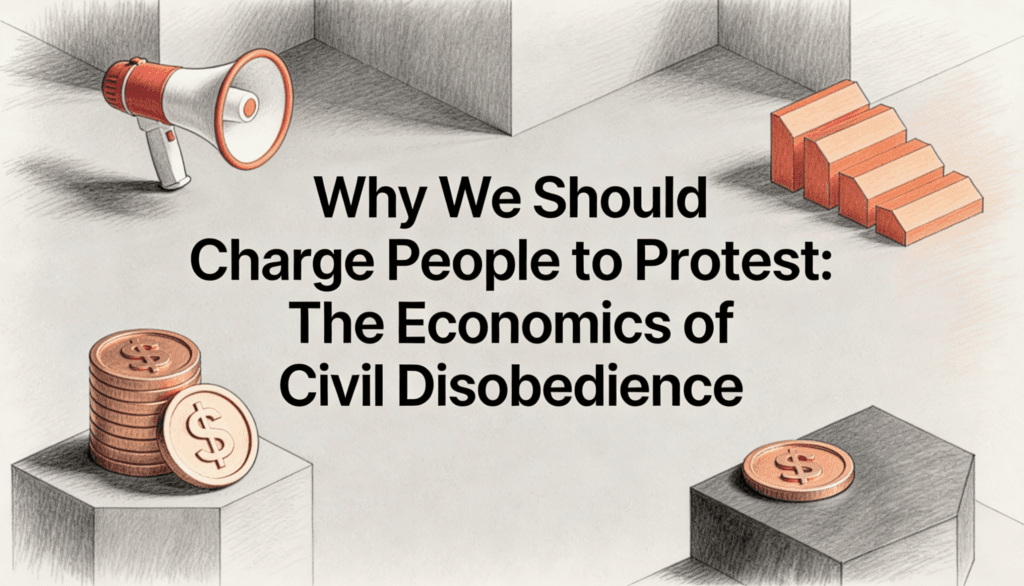
Why We Should Charge People to Protest- The Economics of Civil Disobedience

Why We Should Charge People to Protest: The Economics of Civil Disobedience

There is something deeply uncomfortable about putting a price tag on moral outrage. Which is precisely why Gary Becker thought we should do it. Becker, the Nobel laureate who spent his career dragging economics into places it was not invited, had a talent for making people squirm. He applied cost benefit analysis to marriage, crime, […]

Why We Should Charge People to Protest: The Economics of Civil Disobedience Read More »

Why Markets Are More Fair Than Democracy- The Kirznerian View

Why Markets Are More Fair Than Democracy: The Kirznerian View

Most people assume democracy is the fairest system humans have invented. Markets, by contrast, get treated like a necessary evil. We tolerate them the way we tolerate a loud neighbor. Useful, maybe, but not exactly noble. Israel Kirzner would disagree. Not politely, either. Kirzner, an economist who spent decades at New York University, built a

Why Markets Are More Fair Than Democracy: The Kirznerian View Read More »

The Stoic vs. The Realist- Why Thucydides Is More Useful Than Marcus Aurelius

The Stoic vs. The Realist: Why Thucydides Is More Useful Than Marcus Aurelius

There is a certain kind of person who, when life falls apart, reaches for Marcus Aurelius. You know the type. They post quotes about controlling what you can control. They journal in the morning. They treat every setback as a character building exercise. And to be fair, there is something admirable about that. Marcus Aurelius

The Stoic vs. The Realist: Why Thucydides Is More Useful Than Marcus Aurelius Read More »

Why Your Boss Follows the Rules (and Why It Is Annoying)- Understanding Bureaucracy Through Max Weber

Why Your Boss Follows the Rules (and Why It Is Annoying): Understanding Bureaucracy Through Max Weber

You filled out the form. Then you filled out the form about the form. Then someone asked you to resubmit the first form because it was the wrong version. You sat there, staring at your screen, wondering how an organization of supposedly intelligent adults could make ordering a new laptop feel like applying for a

Why Your Boss Follows the Rules (and Why It Is Annoying): Understanding Bureaucracy Through Max Weber Read More »

Blockchain and global identity concept

Crypto Civilizations: Can Blockchain Replace National Identity?

Samuel Huntington argued that the future of conflict would not be drawn along ideological or economic lines, but along civilizational ones. Culture, religion, language, history. These were the fault lines that mattered. The Cold War had fooled everyone into thinking the world was split between capitalism and communism, but once that curtain fell, older and

Crypto Civilizations: Can Blockchain Replace National Identity? Read More »

Rousseau's Warning to Globalists- The Danger of Scaling the Social Contract Too Far

Rousseau’s Warning to Globalists: The Danger of Scaling the Social Contract Too Far

There is a particular kind of ambition that looks noble from a distance but turns dangerous up close. It is the ambition to unite everyone under a single agreement, a single set of rules, a single moral framework. The people who hold this ambition usually mean well. They talk about cooperation, shared values, and the

Rousseau’s Warning to Globalists: The Danger of Scaling the Social Contract Too Far Read More »

Digital Serfdom- Why You Are Less Free Than a Victorian Factory Worker

Digital Serfdom: Why You Are Less Free Than a Victorian Factory Worker

John Stuart Mill would have hated your smartphone. Not because of the technology itself. Mill was no Luddite. He believed in progress, in science, in the expansion of human capability. What would have horrified him is what you do with it. Or more precisely, what it does with you. Because here is the uncomfortable truth

Digital Serfdom: Why You Are Less Free Than a Victorian Factory Worker Read More »

Why Freedom Is a Cultural Artifact, Not a Biological Constant

Why Freedom Is a Cultural Artifact, Not a Biological Constant

There is a comfortable story we like to tell ourselves. It goes something like this: all human beings are born wanting freedom, and the arc of history bends naturally toward liberty. It is a beautiful idea. It is also, according to Samuel Huntington, almost entirely wrong. Huntington, the Harvard political scientist best known for The

Why Freedom Is a Cultural Artifact, Not a Biological Constant Read More »

The Three Faces of Power- Why Money, Prestige, and Law Run Your Life

The Three Faces of Power: Why Money, Prestige, and Law Run Your Life

You probably think power is simple. Someone has it, someone does not. The boss tells you what to do. The government passes a law. The rich guy buys what he wants. End of story. Max Weber, the German sociologist who spent his career dissecting how societies actually work, would tell you that you are barely

The Three Faces of Power: Why Money, Prestige, and Law Run Your Life Read More »