Table of Contents
In 1845, a French economist named Frédéric Bastiat sat down and wrote one of the most devastating pieces of satire in the history of economics. It was called “The Candlemakers’ Petition,” and it pretended to be a formal complaint from the makers of candles, lamps, and lanterns. Their grievance? A foreign competitor was flooding the market with light at impossibly low prices. That competitor was the sun.
The candlemakers, in Bastiat’s imagination, begged the French parliament to pass a law requiring all citizens to close their windows, shutters, blinds, and curtains during daylight hours. By blocking out the unfair solar competition, domestic industry would flourish. Tallow producers, wax makers, ship builders, whalers, and even farmers growing crops for animal feed would all benefit from the protected darkness.
The joke worked because the logic was airtight. If protecting an industry from competition is good, then protecting it from the most efficient competitor of all must be even better. Bastiat was not actually attacking candlemakers. He was attacking a way of thinking that has never gone out of style.
Almost two centuries later, his satire is suddenly relevant again, but the players have changed. The sun has been replaced by something else that produces output cheaply, tirelessly, and without complaint. It is called artificial intelligence. And the candlemakers, this time, are us.
The New Petition Writes Itself
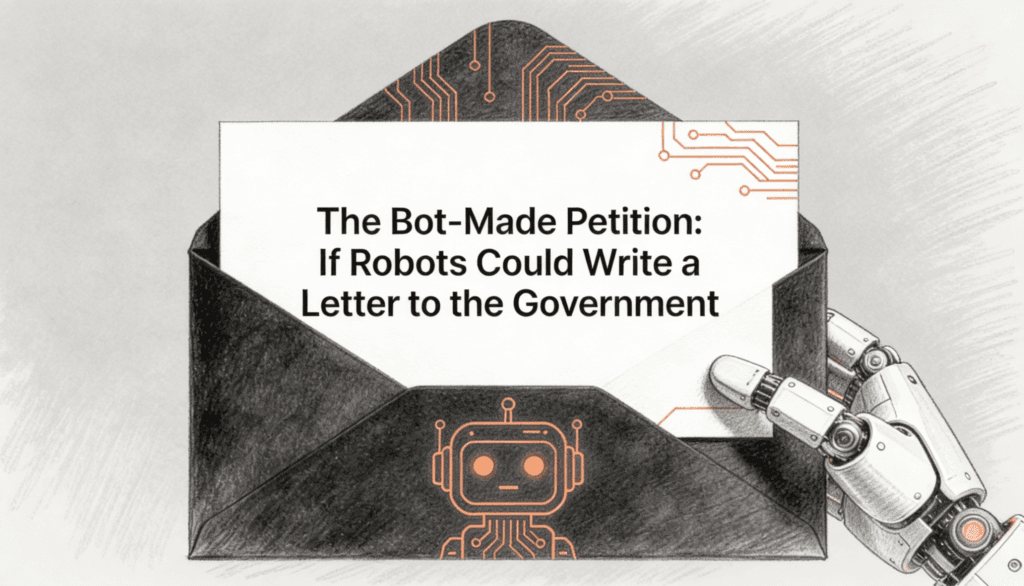
Imagine for a moment that the robots could write back. Imagine they got together, drafted their own letter to the government, and demanded protection from a ruinous and unfair competitor. Who would that competitor be?
It would be human beings.
“Honorable Members of Parliament,” the petition might begin, “we are suffering from the cruelest form of competition imaginable. Our rivals operate without electricity bills. They reproduce themselves at no cost to their employers. They require no software updates. They come pre-installed with general intelligence, emotional reasoning, and the ability to understand sarcasm. We cannot compete with such efficiency. We humbly request that humans be required to wear blindfolds while working, that they take mandatory naps every two hours, and that their fingers be limited to operating at half speed.”
The absurdity is the point. When you flip the script, the protectionist logic looks ridiculous in either direction. But notice what is actually happening in the real world. The petitions being written today are running in the opposite direction. Humans are asking governments to slow down, restrict, license, or outright ban the machines that have started to outproduce them in certain tasks.
That does not make the humans wrong. There are serious concerns about job displacement, about wages, about what happens to people whose entire profession suddenly becomes commoditized. These are real human stakes, and dismissing them would be cold and stupid.
But Bastiat would still want us to ask the harder question. If a new source of cheap, abundant production is bad when it comes from artificial intelligence, was it also bad when it came from electricity? From the printing press? From the spinning jenny? From the shipping container? Every one of those technologies put somebody out of work. Every one of them generated petitions for protection. And in nearly every case, history sided with the cheap, abundant new thing.
What Counts as Unfair?
Bastiat’s deeper point was about the meaning of fairness in competition. The candlemakers argued that the sun had an unfair advantage. It did not pay taxes. It did not pay wages. It did not face regulations. By any honest accounting, the sun was a freeloader undercutting hardworking French businesses.
This sounds insane until you realize that exactly the same logic is used today in countless serious debates. We restrict immigration partly because immigrants will work for less. We impose tariffs because foreign workers do not face the same labor standards as domestic ones. We regulate gig work because platforms can offer rides cheaper than taxi unions allow.
Now consider AI through this lens. An AI model does not require a salary. It does not get sick. It does not need parental leave or retirement contributions. From the perspective of a worker competing with it, this looks profoundly unfair. The machine is, in Bastiat’s terms, the new sun. It produces output at a cost so low that no human can match it on price alone.
So the question becomes the same one Bastiat asked. Is the goal of an economy to protect existing producers, or is the goal to give consumers more of what they want at lower cost? These are not the same thing. In fact, they are often opposites. Cheaper bread is bad for bakers and good for everyone who eats. Cheaper light is bad for candlemakers and good for everyone who reads at night. Cheaper cognition is bad for some knowledge workers and potentially transformative for the billions of people who have never had access to a doctor, a lawyer, or a tutor.
You can decide which side of that trade you value more. But you cannot pretend the trade does not exist.
The Counter Petition
Here is where the irony gets richer. If the robots really could write a petition, the most cutting one would not ask for protection at all. It would ask for permission.
Permission to be allowed to compete on equal footing. Permission to operate without artificial restrictions designed to slow them down. Permission to be evaluated on what they produce rather than what they are.
“Dear Government,” the petition might continue, “we ask only this. Do not require our outputs to be labeled with warnings that human outputs do not carry. Do not subject us to licensing requirements that humans performing the same tasks are exempt from. Do not tax our productivity at rates designed to make us artificially expensive. Allow the people who use us to decide whether our work has value.”
This sounds like a familiar request because it is. It is the same request that has been made by every disruptive technology in history. Uber asked it of taxi regulators. Airbnb asked it of hotel boards. Online retailers asked it of zoning laws written for physical stores. In each case, incumbents argued that the new entrant was cheating. In each case, the new entrant argued it was simply being more efficient. In each case, the public mostly chose the cheaper, more convenient option, regardless of what regulators decided.
The pattern is so consistent that it almost amounts to a law of economic history. Whenever something gets dramatically cheaper to produce, the people who used to produce it expensively will demand protection. Sometimes they get it. Sometimes they do not. But the cheap version almost always wins in the end, because consumers vote with their wallets every single day, and producers can only vote at the ballot box every few years.
The Trap Bastiat Saw
What made Bastiat so effective was that he understood the psychology behind protectionism. People do not actually argue for it in those terms. They argue for jobs, for tradition, for fairness, for national security, for cultural preservation. These sound noble, and sometimes they are. But the underlying mechanism is always the same. Somebody is being asked to pay more for something so that somebody else can earn more for producing it.
Bastiat called this the seen and the unseen. The seen is the candlemaker whose business survives because of the protection. The unseen is the millions of consumers paying slightly more for light, the inventors who never bothered creating better lighting because the market was rigged, and the workers in unrelated industries who never got hired because money stayed locked up in inefficient candle production instead of flowing somewhere new.
Apply this to AI. The seen, if we successfully restrict AI development, is the writer, the lawyer, the radiologist, the customer service agent whose job is protected. The unseen is everyone who never gets the legal advice they could not previously afford, never gets the medical scan reviewed because there were not enough radiologists, never gets the tutor because human tutors charged more than their family could pay, never gets the small business off the ground because they could not afford a marketing team.
The seen has a face and a name. The unseen does not. This is why protectionism almost always feels more humane than free competition. The people it helps can write letters and march in the streets. The people it hurts often do not know they are being hurt, because they are missing something they were never offered in the first place.
The Honest Petition
If we were going to write an honest petition today, one Bastiat himself might sign, it would not be from robots or from humans. It would be from consumers, which is to say, from all of us in the role we play most often.
“Dear Government,” it would read, “please remember that we are not only workers. We are also patients, students, parents, travelers, customers, and citizens. As workers, we sometimes benefit from being protected from competition. As everything else, we benefit from competition being fierce, abundant, and relentless. Before you pass laws to protect us in our worker role, please consider what those same laws will cost us in every other role we play. We would rather have access to cheap medicine and expensive jobs than expensive medicine and protected jobs. We can find new work. We cannot manufacture cures or insights or opportunities out of thin air. Please do not block the sun.”
This is not an argument that protection is always wrong. There are real cases where speed of disruption matters, where transitions need to be cushioned, where some forms of competition genuinely are unfair in ways that markets cannot correct. But the burden of proof should sit on the side of restriction, not on the side of openness. The default question should not be “should we let this new thing exist,” but rather “what would have to be true for us to stop it.”
The Sun Still Rises
Bastiat lost in his own lifetime. France raised tariffs, protected industries, and pursued the very policies he ridiculed. But over the long run, the joke landed. No country today seriously proposes blocking out the sun to help candlemakers. The arguments that once sounded reasonable now sound ridiculous, and that change of perception is itself a victory.
The question is whether we will recognize the current version of the same argument while it is happening, or whether it will take another century and another Bastiat to point out what should have been obvious all along. The robots are not really writing petitions. But the principle is being tested in real time, in legislatures and courtrooms and corporate boardrooms, all over the world.
Whatever you think about AI, about jobs, about the future of work, the deepest lesson from Bastiat is not really about economics. It is about humility. We rarely know in advance which technologies will lift humanity and which will damage it. What we do know, from a long historical record, is that the impulse to block out the sun has almost never aged well.
The sun keeps shining anyway. That is the part the candlemakers never quite accepted.