Table of Contents
There is a popular story we tell about the Enlightenment. It goes something like this: a group of brilliant European thinkers finally decided that reason was better than superstition, that science was better than dogma, and that all men were created equal. Then they wrote some declarations, started some revolutions, and the modern world was born.
It is a nice story. It is also, in several important ways, a lie.
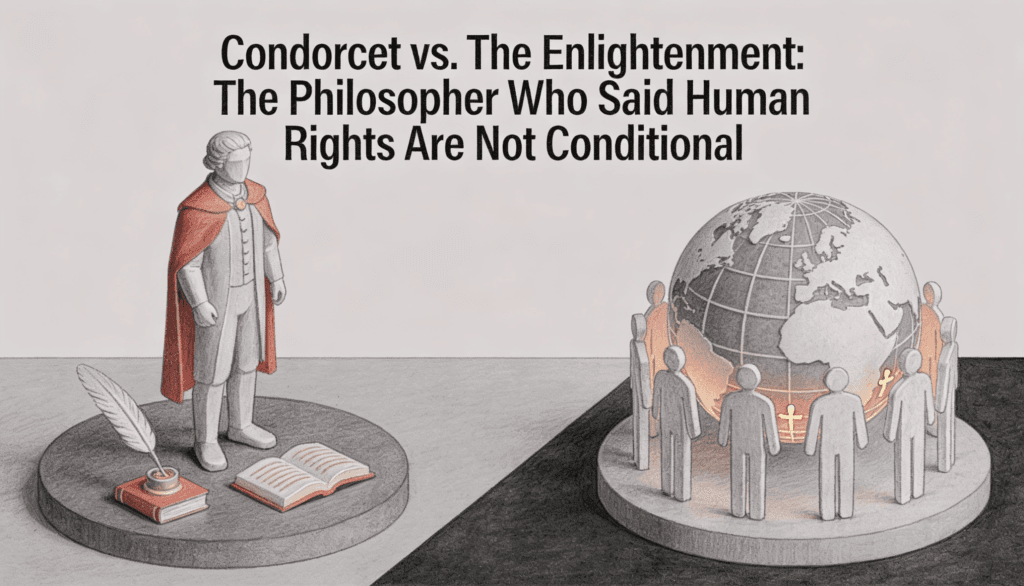
The Enlightenment was not a single movement with a single message. It was an argument. A loud, messy, contradictory argument between people who agreed on almost nothing except that they were smarter than the generation before them. And buried inside that argument was a fault line that most history courses skip right over. On one side stood the majority of Enlightenment thinkers, who believed that rights were real but conditional. On the other side stood Nicolas de Condorcet, who believed they were not.
That distinction might sound like a footnote. It is not. It is the entire ballgame.
The Enlightenment’s Dirty Secret
Here is what most Enlightenment thinkers actually believed when you strip away the soaring rhetoric: human beings possess natural rights, but not all human beings are ready to exercise them. Rights exist in theory. In practice, they need to be earned, or at least supervised.
Voltaire, the great champion of free speech, was perfectly comfortable with the idea that the masses were too ignorant to govern themselves. He wanted enlightened despots, not democracy. Montesquieu argued that different climates and cultures required different forms of government, a framework that conveniently allowed Europeans to conclude that other civilizations were not suited for liberty. Even Rousseau, who romanticized the natural goodness of humanity, designed a political system in which a mysterious “general will” could override individual choice, and anyone who disagreed with it could, in his chilling phrase, be “forced to be free.”
These were not stupid men. They were not evil men. But they shared a common assumption that ran so deep most of them never thought to question it: that rights were a destination you arrived at after sufficient civilization, education, and moral development. Rights were a reward for being the right kind of person.
If this sounds familiar, it should. This is the logic behind every system that has ever told a group of people they were not ready for freedom. Not yet. Maybe later. Once they have proven themselves.
Condorcet looked at this logic and rejected it completely.
The Mathematician Who Took Equality Seriously
Nicolas de Condorcet was not the most famous philosophe. He was not the most stylish writer. He did not have Voltaire’s wit or Rousseau’s emotional intensity. What he had was something rarer and, in the long run, more dangerous: consistency.
Condorcet was a mathematician by training, and mathematicians have an annoying habit. They follow premises to their conclusions. If you start with “all human beings possess natural rights,” a mathematician will ask you what “all” means. And if your answer is “well, all except women, and enslaved people, and the uneducated, and people from other continents,” a mathematician will point out that you do not actually believe what you said you believed.
This is precisely what Condorcet did. In a period when nearly every progressive thinker in Europe was willing to carve out exceptions, Condorcet refused. He argued for the full political rights of women in 1790, more than a century before most Western democracies granted them. He argued for the immediate abolition of slavery, not the gradual phase out that most abolitionists considered realistic. He argued for universal public education, not because education was a prerequisite for rights, but because education was itself a right.
The distinction matters enormously. Most of his contemporaries said: first we educate people, then we give them rights. Condorcet said: people have rights now, and one of those rights is education. The order is not negotiable.
Why His Own Side Hated Him
You might expect that Condorcet’s enemies were the forces of reaction: the monarchy, the church, the aristocracy. And they were. But the people who ultimately destroyed him were revolutionaries.
Condorcet was an early and enthusiastic supporter of the French Revolution. He drafted the Girondist constitution, a remarkably progressive document that would have established universal male suffrage, protections for individual rights, and a rational system of public education. He was, by any reasonable measure, one of the most committed republicans in France.
None of this saved him. When the Jacobins took power, Condorcet opposed the execution of Louis XVI. Not because he supported the king, but because he opposed the death penalty on principle. He also criticized the Jacobin constitution as insufficiently protective of individual rights. For this, he was condemned.
There is a brutal irony here that deserves attention. Condorcet was destroyed not by the enemies of the Enlightenment but by people who claimed to be its greatest champions. The Jacobins were Enlightenment thinkers. They believed in reason, progress, and the rights of man. They also believed that the revolution was more important than any individual, and that anyone who questioned the revolution’s methods was an enemy of the people.
Condorcet spent his final months hiding in a boardinghouse, writing his most famous work, the Sketch for a Historical Picture of the Progress of the Human Mind. It is one of the most optimistic books ever written, composed by a man who knew he was almost certainly going to die. He was arrested in March 1794 and died in prison two days later. Whether he was poisoned, committed suicide, or died of exhaustion remains unclear. The revolution he helped build killed him, and then, in a final act of absurdity, many of its heirs eventually adopted his ideas without crediting him.
The Condorcet Paradox (Not That One)
Most people who know Condorcet’s name know it because of the Condorcet paradox in voting theory: the mathematical proof that collective preferences can be cyclical and irrational even when individual preferences are perfectly rational. Three voters can prefer A to B, B to C, and C to A, creating an endless loop with no clear winner.
But there is a deeper paradox in Condorcet’s life and thought that voting theory only hints at. Condorcet believed more fervently than almost anyone in human progress. He believed that reason would eventually triumph, that education would spread, that prejudice would fade, and that humanity would march steadily toward justice. And yet he was also the thinker who most clearly demonstrated the structural problems with collective decision making. He proved mathematically that groups of rational people can produce irrational outcomes.
Most thinkers would see this as a reason for pessimism or at least caution. Condorcet saw it as a design problem. The fact that democracy could malfunction was not an argument against democracy. It was an argument for building better democratic institutions. This is the same logic that a software engineer applies when finding a bug: the bug does not mean the project is hopeless. It means you need a patch.
This engineering mindset set Condorcet apart from virtually every other political philosopher of his era. Rousseau, confronted with the messiness of actual human behavior, invented the general will as a kind of mystical override. Voltaire concluded that most people were too stupid for self governance. Condorcet said: here is the specific problem, here is why it happens, and here is how we might fix it.
Rights Without Conditions
The core of Condorcet’s philosophy can be stated simply, which is part of why it was so radical. Rights are not conditional on anything. They are not conditional on race, sex, education, property, religion, nationality, or the approval of the majority. A person does not need to demonstrate competence to possess rights. A person does not need to earn moral standing. Rights are the starting point, not the finish line.
This sounds obvious now. It was not obvious then. It is, if we are being honest, not entirely obvious now.
Consider how many contemporary arguments still follow the structure that Condorcet rejected. We still hear that certain populations are not ready for democracy. We still hear that rights must be balanced against security, stability, or economic development. We still hear that freedom of speech is fine in principle but dangerous in practice when exercised by the wrong people. We still hear that some groups need to be governed for their own good until they have developed the capacity for self governance.
Every one of these arguments assumes that rights are conditional. Every one of them would have been familiar to Condorcet. And every one of them would have received the same response: if rights are conditional, they are not rights. They are privileges. And privileges can be revoked.
The Education Question
One of the most interesting tensions in Condorcet’s thought concerns education, and it connects to debates that are very much alive today.
Condorcet believed passionately in universal public education. He designed an elaborate system of public schools that would be free, secular, and open to everyone regardless of sex or social class. He believed that education was essential for a functioning democracy and that an uneducated population was vulnerable to manipulation by demagogues and tyrants.
But he also insisted, as noted above, that the right to participate in political life could not be made contingent on education. You did not need to pass a test to vote. You did not need to demonstrate literacy to have political opinions worth hearing. Education was a right, not a gate.
This creates an apparent contradiction. If education is so important for democracy, why not require it as a condition for participation? The answer reveals something fundamental about Condorcet’s thinking. He understood that whoever controls the conditions for participation controls who participates. And whoever controls who participates controls the outcome.
This is not a hypothetical concern. Literacy tests were used in the American South for nearly a century to disenfranchise Black voters. Property requirements were used across Europe to exclude the working class from political life. Today, arguments about “low information voters” and “media literacy” sometimes carry the same underlying logic: some people’s participation in democracy is a problem to be managed rather than a right to be respected.
Condorcet saw this coming more than two hundred years ago. His solution was not to lower the importance of education but to refuse to weaponize it. Educate everyone. Exclude no one.
What Condorcet Got Wrong
It would be dishonest to write about Condorcet without acknowledging his blind spots. His faith in progress was, at times, naive to the point of being painful. Writing in hiding from the people who wanted him dead, he predicted that humanity was on an irreversible upward trajectory toward reason and justice. The twentieth century would have tested that prediction severely.
He also shared some of the Eurocentrism of his age. While he was far more inclusive than his contemporaries, his vision of progress still centered Europe as the engine of universal civilization. He imagined that education and reason would spread outward from Europe to the rest of the world, a framework that contains its own kind of condescension even when the intentions are good.
And his mathematical approach to politics, while powerful, sometimes underestimated the role of emotion, identity, and irrational attachment in human life. People are not probability functions. They do not always want what is reasonable. Condorcet knew this intellectually, but his proposed solutions often assumed a level of rationality that actual humans have consistently failed to deliver.
Why He Still Matters
Condorcet matters because the question he asked has never been answered to everyone’s satisfaction, and the wrong answer keeps producing the same catastrophes.
The question is simple: Are rights conditional or unconditional?
If they are conditional, then someone must decide the conditions. And whoever decides the conditions holds the power. This is true whether the conditions are set by a king, a party, a constitution, or an algorithm. The moment you accept that rights depend on meeting certain criteria, you have created a class of people who define the criteria and a class of people who must meet them. History suggests this arrangement does not end well for the second group.
If rights are unconditional, then you must accept that people you disagree with, people you find ignorant, people you consider dangerous, all possess the same rights you do. This is uncomfortable. It is supposed to be. Condorcet never promised that unconditional rights would produce comfortable outcomes. He argued that every alternative was worse.
The Enlightenment gave us the language of universal rights. Condorcet insisted that we actually mean it. Most of the time, we still do not. But the standard is there, written by a mathematician hiding from a revolution that had decided he was expendable, and it remains the most demanding and the most honest version of what human rights could look like if we ever decide to take them seriously.
He did not live to see any of it realized. He probably knew he would not. He wrote it down anyway.
That might be the most Enlightenment thing anyone ever did.