Table of Contents
Friedrich Hayek spent most of his career warning us about a specific kind of danger. Not the danger of bad ideas spreading. The danger of someone deciding which ideas are bad in the first place.
That distinction matters more than it might seem. Because the moment a society appoints itself a guardian of truth, it sets into motion a process that quietly, almost invisibly, dismantles the very thing it claims to protect. Hayek saw this clearly. Most of his contemporaries did not. And most people today still do not.
The logic feels intuitive on the surface. Misinformation is harmful. Lies can destabilize societies. Therefore, filtering out the wrong ideas should produce a healthier public conversation. It sounds reasonable. It sounds responsible. And according to Hayek, it is one of the most dangerous assumptions a free society can make.
The Knowledge Problem Nobody Talks About
Hayek is best known for his work in economics, but his most enduring insight was not really about markets. It was about knowledge itself.
In his famous 1945 essay, “The Use of Knowledge in Society,” Hayek made an argument that still unsettles central planners of every variety. No single person, committee, or institution can possess all the relevant knowledge needed to make decisions for an entire society. Knowledge is not a single block of granite sitting in a library somewhere. It is scattered across millions of minds, embedded in local contexts, shaped by individual experience, and constantly changing.
This was Hayek’s answer to the socialist calculation debate, but the implications reach far beyond economics. If no central authority can know enough to plan an economy, why would we assume a central authority can know enough to plan a discourse? If the price system works because it aggregates information no single planner could hold, then public debate works for exactly the same reason. It surfaces truths that no editorial board, no algorithm, no ministry of information could identify on its own.
Censorship, in Hayek’s framework, is not just morally questionable. It is epistemically catastrophic. It removes the mechanism by which truth gets discovered.
The Illusion of the Competent Censor
Here is where the paradox begins to bite. Every act of censorship assumes that the censor already knows the truth. Otherwise, how would they know what to suppress?
Think about that for a moment. The entire justification for filtering information rests on a prior claim to knowledge that, if it actually existed, would make the filtering unnecessary. If the truth were already so obvious and settled that a censor could reliably identify it, there would be no need to protect people from falsehood. They would recognize it themselves.
Hayek understood that truth is not a finished product handed down from above. It is a process. It emerges through argument, competition, error, correction, and the messy, uncomfortable collision of ideas that no reasonable person would have predicted in advance. Many of the ideas we now consider obviously true were, at the time of their introduction, considered dangerous nonsense. The germ theory of disease was ridiculed. Continental drift was dismissed. The suggestion that stomach ulcers were caused by bacteria and not stress was laughed out of conferences for over a decade.
Each of these ideas would have been a prime candidate for suppression under any well meaning regime of quality control. And that is precisely the problem. The censor is not just removing known falsehoods. The censor is, by definition, also removing unknown truths. Because unknown truths look exactly like dangerous nonsense until they do not.
When Protection Becomes the Threat
There is a pattern Hayek identified in political systems that applies with uncomfortable precision to information systems. He called it the road to serfdom. The basic mechanism is this: a government intervenes to solve a problem. The intervention creates new distortions. Those distortions are used to justify further intervention. Each step seems reasonable in isolation. The destination is not.
Censorship follows the same escalation logic. A platform removes clearly harmful content. Then it expands the definition of harmful. Then it starts making judgment calls about what is misleading. Then it begins suppressing ideas that are merely controversial. At each stage, the people making the decisions genuinely believe they are acting in the public interest. And at each stage, the sphere of permissible thought contracts a little further.
Hayek was not arguing that all ideas are equally valid. He was arguing something more subtle and more important. The process of sorting good ideas from bad ones cannot be outsourced to a central authority without destroying the very mechanism that makes sorting possible.
This is the paradox at its sharpest. You cannot protect the truth by controlling the conversation, because the conversation is how truth gets produced.
The Fatal Conceit Applied to Information
Late in his career, Hayek wrote a book called “The Fatal Conceit.” The title referred to the belief that human reason is powerful enough to design systems superior to those that evolved spontaneously over centuries. He was talking about economic systems, legal traditions, and moral frameworks. But the concept maps perfectly onto the information landscape.
The fatal conceit of the censor is the belief that a managed information environment will produce better outcomes than a free one. It is the assumption that the mess and noise and occasional ugliness of open discourse is a bug to be fixed rather than a feature to be preserved.
Consider how this plays out in practice. A committee decides that certain scientific claims are settled and that contradicting them constitutes misinformation. For a while, this might work. The consensus might be correct. But the moment it is not, the entire system collapses. Because the infrastructure built to enforce the consensus now prevents the very challenges that would correct it.
This is not a hypothetical scenario. It has happened repeatedly throughout history. Scientific orthodoxies have been enforced through institutional pressure, professional ostracism, and outright censorship. In almost every case, the orthodoxy eventually fell. But it fell later and at greater cost than it would have if dissent had been permitted to do its work.
The Marketplace of Ideas Is Not a Metaphor
People sometimes treat the phrase “marketplace of ideas” as a quaint figure of speech. Hayek would have objected to that characterization. For him, the analogy between markets and discourse was not decorative. It was structural.
In a functioning market, prices carry information. They tell producers what to make, consumers what to buy, and investors where to allocate resources. No one designs this system. It works because millions of individual decisions aggregate into signals that no central planner could replicate. When governments fix prices, they do not just create economic distortions. They destroy information. The signal disappears. And without the signal, rational coordination becomes impossible.
The same thing happens when you fix ideas. When certain conclusions are mandated and others are prohibited, you do not just limit speech. You destroy the information that free speech generates. You lose the ability to know what people actually think, what evidence actually suggests, and where the genuine uncertainties lie. You get a surface of consensus with no way to tell whether it reflects reality or merely compliance.
Hayek would have recognized this immediately in the modern context. When people are penalized for expressing certain views, they do not stop holding those views. They stop expressing them. The ideas go underground. They fester without challenge or refinement. And the public conversation becomes a performance rather than a process, a theater of agreement that tells you nothing about what anyone actually believes.
The Uncomfortable Relationship Between Freedom and Error
Here is the part that makes people most uncomfortable. Hayek’s framework requires tolerating a significant amount of error. You cannot have a free marketplace of ideas without bad ideas circulating alongside good ones. You cannot have a self correcting system without the errors that trigger the corrections.
This is genuinely difficult to accept. It means that protecting free discourse involves accepting real costs. People will be misled. False claims will gain traction. Harmful ideas will find audiences. These are not trivial consequences, and anyone who dismisses them is not taking the problem seriously.
But Hayek’s argument was never that free discourse is costless. His argument was that the alternative is worse. The costs of error in an open system are visible, identifiable, and correctable. The costs of censorship in a closed system are hidden, cumulative, and self reinforcing. You can see a false claim spreading online and mount a response. You cannot see the true claim that was never allowed to surface.
The Modern Temptation
We live in an era of unprecedented information abundance. The volume of content produced every day is staggering, and a significant portion of it is misleading, manipulative, or simply wrong. The temptation to impose order on this chaos is understandable. It is also, if Hayek was right, precisely the wrong response.
The solution to bad information is not less information. It is better tools for processing information. It is education, critical thinking, institutional transparency, and a culture that values intellectual honesty over intellectual comfort. These are slower, harder, less satisfying solutions than simply removing the offending content. They also happen to be the only solutions that actually work.
Hayek was deeply skeptical of solutions that feel satisfying. He understood that the most appealing interventions are often the most destructive, precisely because their costs are deferred and their benefits are immediate. Censorship delivers an instant sense of order. The degradation of public discourse that follows takes years to become visible. By the time anyone notices, the infrastructure of control is firmly in place, and dismantling it has become its own political problem.
What Hayek Would Say Now
If Hayek were alive today, he would probably be appalled by both sides of the censorship debate. He would reject the naive libertarianism that pretends misinformation has no consequences. And he would reject with equal force the technocratic confidence that assumes the right people with the right algorithms can curate public discourse without corrupting it.
His position would be, as it always was, that the question is not whether we trust the public to handle the truth. The question is whether we trust anyone else to handle it for them. And his answer, grounded in decades of studying how knowledge works and how power corrupts, would be an unequivocal no.
Not because the public is infallible. Not because free speech is without costs. But because every alternative requires concentrating a power that no human being and no institution can be trusted to wield. The power to decide what is true. The power to decide what others are allowed to know. The power to shape reality by controlling its description.
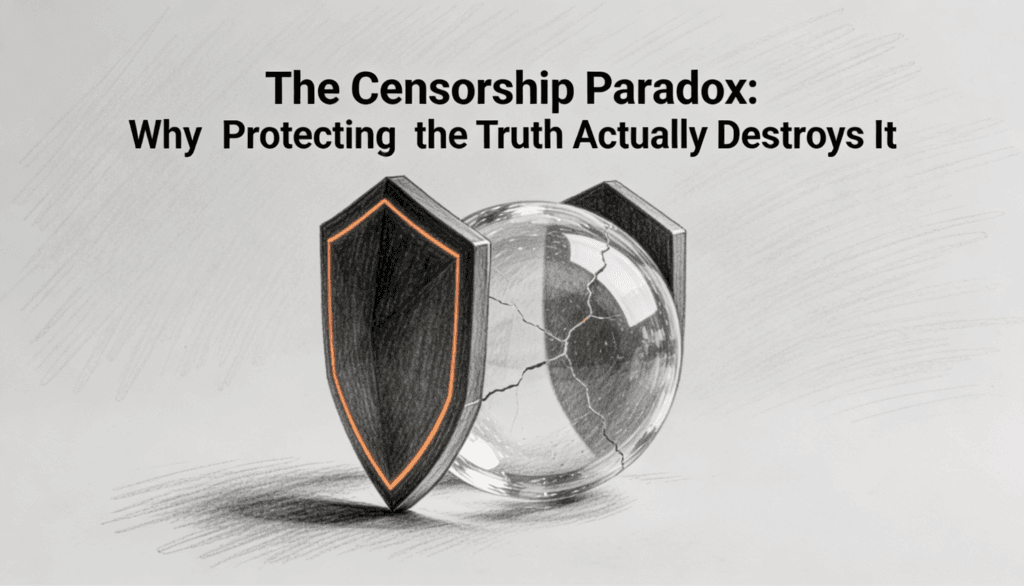
That is the censorship paradox in its fullest form. The act of protecting truth requires claiming an authority that, if valid, would make protection unnecessary. And if invalid, makes protection indistinguishable from the very thing it claims to oppose.
Hayek spent his life making this argument. The fact that it needs to be made again is, perhaps, the strongest evidence that he was right.