Table of Contents
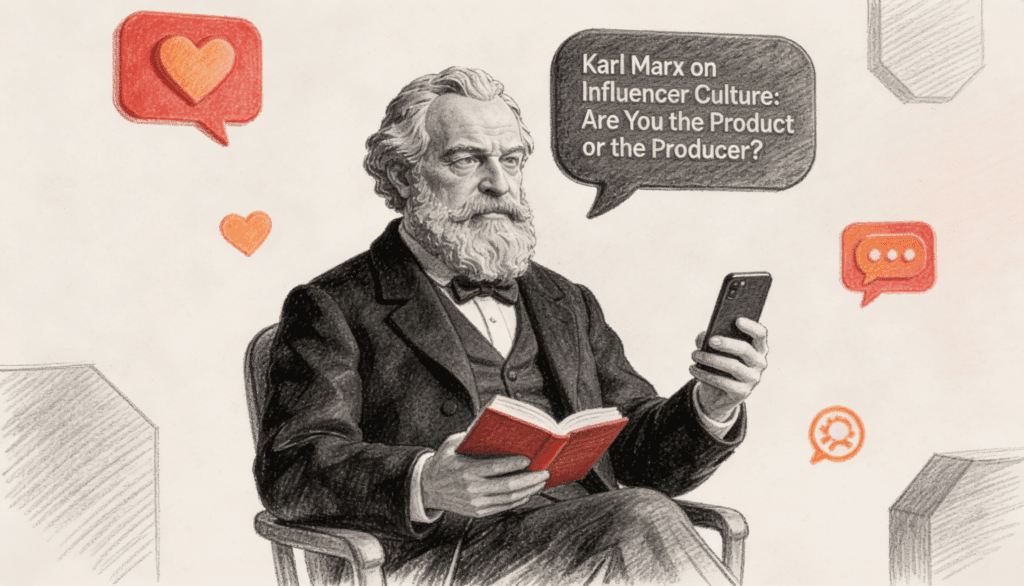
Karl Marx died in 1883. He never saw a ring light. He never watched someone unbox a package on camera while whispering about a discount code. He never encountered the phrase “link in bio.” And yet, if you sat him down in front of Instagram for fifteen minutes, he would probably nod slowly and say something like, “Yes, this is exactly what I was talking about.”
The strange truth about influencer culture is that it is not new. The packaging is new. The speed is new. The fact that it happens on a glowing rectangle in your pocket is new. But the underlying mechanics, the way value is created, extracted, and redistributed, would be deeply familiar to a nineteenth century philosopher who spent most of his life in a library thinking about who benefits from other people’s labor.
So let us take Marx seriously for a moment. Not as a political icon or a villain, depending on who you ask, but as an analyst. Someone who built a framework for understanding how economies turn human effort into profit. And let us point that framework directly at the creator economy to see what it reveals.
The Means of Production Fit in Your Pocket Now
One of Marx’s central ideas was that the people who own the means of production hold the real power. In the nineteenth century, that meant factory owners. They owned the machines, the buildings, the raw materials. Workers showed up, operated the equipment, and went home with wages that represented a fraction of the value they created. The factory owner kept the rest. Marx called that surplus value, and he considered it the engine of inequality.
Now consider the modern influencer. On the surface, the creator economy looks like a revolution Marx would have admired. The means of production have been democratized. You do not need a factory. You need a phone and decent lighting. Anyone can produce content, build an audience, and theoretically earn a living. The barriers to entry have collapsed. It looks like liberation.
But Marx would ask a follow up question. He always did.
Who owns the platform?
The influencer creates the content. The influencer builds the audience. The influencer responds to comments at midnight and films seventeen takes of a single video. But the platform decides who sees that content. The platform controls the algorithm. The platform collects the data generated by every interaction, every click, every second of watch time. And the platform sells that data, or uses it to sell advertising, which is where the real money lives.
So the influencer owns a ring light and maybe a tripod. Meta owns the infrastructure. The means of production did not get redistributed. They got rebranded.
You Are Not the Customer
There is a saying in technology circles that has become almost cliché: if you are not paying for the product, you are the product. It is usually applied to users of free platforms. But influencer culture adds a fascinating wrinkle to this formula. Influencers are not just users. They are also producers. They generate the content that keeps people on the platform, which generates the attention that gets sold to advertisers.
So what are influencers, exactly? They are not employees. They receive no benefits, no guaranteed income, no severance if the algorithm decides to stop showing their posts. They are not traditional business owners either, because they do not control the marketplace where their goods are sold. They exist in a category Marx did not have a word for, because it did not exist yet. But his framework still applies.
They are laborers who believe they are entrepreneurs. And that belief is not accidental. It is essential to the system’s functioning.
Marx wrote extensively about ideology, the stories a society tells itself to justify its economic arrangements. In his time, the story was that factory workers were free agents entering voluntary contracts with employers. Technically true. Practically misleading. The worker was “free” to accept low wages or starve. The choice was not much of a choice.
The modern version of this story is the narrative of the self made creator. Anyone can make it. Just be authentic. Just post consistently. Just find your niche. This narrative is not entirely false, which is what makes it so effective. Some people do build genuine careers. But for every influencer earning a living, there are thousands producing free content for platforms that profit from their labor without ever sending them a check.
The Alienation No One Talks About
Marx had another concept that translates uncomfortably well to the creator economy: alienation. He argued that industrial labor alienated workers from their own humanity. When you spend ten hours a day performing repetitive tasks in a factory, you become disconnected from the creative, social, expressive parts of yourself. Work becomes something you endure, not something you are.
Influencer culture was supposed to fix this. The whole premise is that you get to be yourself for a living. You share your authentic life, your real opinions, your genuine personality. It is the ultimate fusion of work and self.
But here is where it gets twisted.
When your personality is your product, the market starts to shape your personality. You learn which version of yourself gets the most engagement. You discover that vulnerability performs well on Tuesdays. You notice that a specific type of outrage generates more shares than nuanced analysis. Slowly, without anyone forcing you, you begin to optimize yourself for the algorithm.
The worker is not just alienated from the product of their labor. The worker is alienated from themselves. Except now, the product and the self are the same thing. You cannot clock out of being yourself.
There is a painful irony here. The creator economy promised authenticity as its core value. But the economic pressures of the system push relentlessly toward performance. What started as “just be yourself” becomes “be the version of yourself that converts.” The authentic self becomes a brand asset, managed and curated like any other commodity.
The Fetishism of the Follower Count
Marx wrote about commodity fetishism, the way market economies cause people to see relationships between things (prices, exchange rates) rather than relationships between people. A shirt is not a piece of fabric someone spent hours sewing. It is a $29.99 item on a rack. The human labor behind it becomes invisible.
Influencer culture has its own version of this. The follower count. The engagement rate. The CPM. These metrics become the measures of a person’s worth, and not just their professional worth. When your identity and your business are fused, a dip in followers feels like a personal rejection. A viral post feels like validation of who you are.
This creates a peculiar dynamic that Marx would find fascinating. The influencer is simultaneously the worker, the product, and the commodity being traded. Brands do not just purchase ad space. They purchase association with a person. The influencer’s identity has been fully commodified, turned into something that can be bought, sold, and marked down during a slow quarter.
And the metrics that govern this market are controlled entirely by the platform. Instagram can change its algorithm tomorrow. YouTube can alter its recommendation system. TikTok can shift what counts as a view. The influencer has no say in any of this. They are building a business on rented land, and the landlord can change the terms whenever they want.
The Reserve Army of Content Creators
One of Marx’s more striking ideas was the concept of the reserve army of labor. Capitalism, he argued, always needs a pool of unemployed workers. Not out of cruelty, although he was not opposed to pointing out the cruelty. The system needs unemployed people because their existence keeps wages low. If you complain about your pay, there are ten people behind you willing to do it for less.
The creator economy has its own reserve army, and it is enormous. Millions of people are creating content right now for free, hoping to eventually monetize. They are, in economic terms, performing unpaid labor that generates value for platforms. Every video uploaded to TikTok by someone with 200 followers still generates data, still keeps users on the app, still contributes to the ecosystem that makes TikTok valuable.
This oversupply of creators keeps the market favorable for platforms and brands. If one influencer asks for too much money, there are dozens of others with similar audiences willing to work for less. Or for free products. Or for “exposure,” which is the modern equivalent of being paid in company scrip.
The democratic nature of content creation, the fact that anyone can participate, is genuinely exciting. But it also functions as a mechanism that keeps the labor cheap and the power concentrated.
The Question You Should Actually Be Asking
The title of this article asks whether you are the product or the producer. But Marx would probably say that is the wrong question. The more important question is: who is accumulating the value you create?
If you post a video that gets a million views, you might earn a few hundred dollars from a creator fund. The platform earned significantly more from the advertising served against that video. The data generated by the viewers, their preferences, their behavior, their attention patterns, became an asset the platform owns permanently. Your creative labor was the input. Their profit was the output. You got a cut. They got the rest.
This does not mean you should stop creating. It does not mean the internet is a trap. It means you should be clear about the economic reality of the system you are participating in. Romantic notions about following your passion and building your personal brand are fine as motivation. They are dangerous as analysis.
Marx spent his career trying to help people see the difference between how an economic system describes itself and how it actually operates. The factory system described itself as freedom of contract. It actually operated as structured extraction. The creator economy describes itself as the democratization of opportunity. It actually operates as a system where millions of people generate value that flows upward to a small number of platform owners and investors.
The ring light is not a means of production. It is a prop. The means of production is the algorithm, the data infrastructure, the advertising marketplace. And you do not own any of it.
That is not a reason for despair. It is a reason for clarity. Marx did not want workers to feel hopeless. He wanted them to see the system clearly so they could make informed decisions about their place within it. Whether you are an influencer, a casual creator, or just someone scrolling through content at two in the morning, that clarity is worth having.
Because the first step to understanding any system is admitting who it was actually designed to serve.