Table of Contents
John Stuart Mill would have hated your smartphone.
Not because of the technology itself. Mill was no Luddite. He believed in progress, in science, in the expansion of human capability. What would have horrified him is what you do with it. Or more precisely, what it does with you.
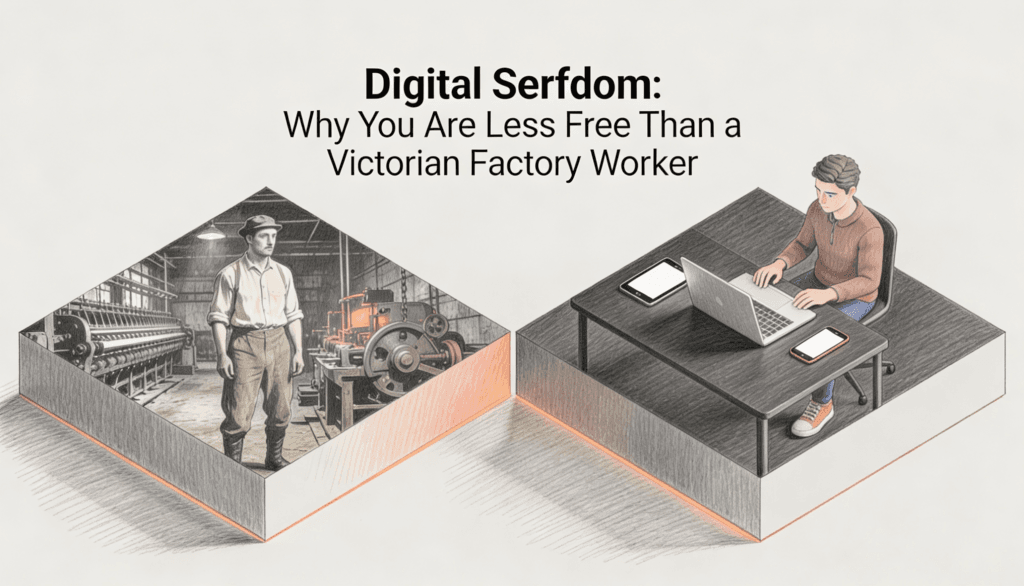
Because here is the uncomfortable truth that nobody in Silicon Valley wants you to think about too carefully: by almost every measure that Mill considered essential to human freedom, the average person scrolling through their phone in 2026 is less free than a fourteen year old working in a Manchester cotton mill in 1858.
That sounds absurd. It is meant to. But stay with me.
The Freedom Nobody Talks About
Mill published On Liberty in 1859, right in the middle of the Victorian industrial nightmare. Children worked sixteen hour days. Workers had no vote, no union protections, no safety regulations worth mentioning. Life was brutal and often short.
And yet Mill was not primarily worried about physical conditions. He was worried about something he considered far more dangerous: the tyranny of prevailing opinion. The soft, invisible pressure that makes people think what everyone else thinks, want what everyone else wants, and live how everyone else lives. He called it the “tyranny of the majority,” and he believed it was more enslaving than any chain or factory bell.
Mill argued that true freedom was not simply the absence of physical coercion. True freedom was the ability to form your own opinions through genuine reflection, to develop your individuality, to live as an experiment in living rather than a copy of your neighbor. He wrote that a person who lets the world choose their plan of life has no need of any faculty other than the ape like one of imitation.
Now look around. Then look at your screen time report.
The Victorian Worker Had Something You Do Not
Here is what the Manchester factory worker possessed that you probably do not: uncolonized mental space.
Yes, the work was grueling. Yes, the conditions were appalling. But when that factory bell rang at the end of the day, the worker walked out into a world that was not engineered, with billions of dollars and the most sophisticated behavioral science ever developed, to capture and hold their attention. There was no algorithm studying their eye movements. No notification system designed by former casino engineers to trigger dopamine responses at precisely calibrated intervals. No feed that knew, with mathematical precision, exactly which emotional buttons to press to keep them scrolling for another four minutes.
The Victorian worker went home to boredom. And boredom, Mill would have argued, is one of the most underrated preconditions for freedom. Boredom is the space where original thought begins. It is the silence in which your own voice can actually be heard.
You do not have boredom anymore. You have TikTok.
Mill’s Marketplace of Ideas vs. The Algorithmic Bazaar
Mill’s most famous argument was for the free marketplace of ideas. He believed that truth emerges from open debate, from the collision of competing viewpoints. Suppress an opinion, Mill warned, and you rob the human race of the opportunity to exchange error for truth or to deepen their understanding of truth through its contest with error.
The internet was supposed to be this marketplace perfected. Every voice could speak. Every idea could compete. The whole of human knowledge, accessible to anyone with a connection.
What actually happened is something Mill could not have predicted but would have instantly recognized as catastrophic for freedom. The marketplace was not just opened. It was captured, sorted, filtered, and re engineered by private companies whose profits depend not on the quality of ideas you encounter but on how long those ideas keep you engaged. And what keeps you engaged, as every platform has discovered, is not the thoughtful, the nuanced, or the challenging. It is the outrageous. The tribal. The stuff that makes you feel something intensely enough to keep scrolling, keep clicking, keep watching.
Mill wanted a marketplace. What we got is a slot machine wearing a marketplace costume.
The result is not the expansion of independent thought that Mill considered essential to liberty. The result is what he feared most: a population that mistakes consuming opinions for forming them. People who feel more opinionated than ever while being less capable of genuine independent reasoning. Mill wrote that even if an opinion is correct, if it is held as a dead dogma rather than a living truth, it might as well be a superstition. Scroll through any comment section and tell me you see living truths being worked out.
The Panopticon You Carry in Your Pocket
Jeremy Bentham, Mill’s intellectual godfather, designed the Panopticon: a prison where inmates could be watched at all times without knowing when they were being observed. The theory was that people who believe they might always be watched will regulate their own behavior. They become their own jailers.
Bentham imagined it as a building. We turned it into a consumer product.
Your phone tracks where you go. Your search history reveals what you think. Your social media posts are scanned and scored and filed. Every app collects data that is aggregated into profiles of such intimate detail that the companies who hold them often know you are pregnant before you do, know you are depressed before you recognize the symptoms yourself, know you are considering leaving your job before you have consciously admitted it.
The Victorian factory owner could control what you did for fourteen hours a day. He could not control what you thought about on your walk home. He could not map your desires, predict your vulnerabilities, or sell your inner life to the highest bidder. The modern data economy can and does all of these things. It does them so smoothly that you agreed to it. Somewhere in the twenty thousand words of a terms of service agreement you did not read.
Mill was clear that freedom requires a sphere of private life that remains beyond the reach of both government and social pressure. He would have been staggered to learn that millions of people voluntarily surrendered that sphere in exchange for the ability to share photos of their lunch.
The Paradox of Choice That Is Not Really Choice
There is a telling parallel with behavioral economics here. Barry Schwartz argued in The Paradox of Choice that more options do not make people freer. They make people more anxious, more prone to regret, and ultimately more likely to either choose nothing or defer to whatever is presented as the default.
The digital world offers infinite choice. You can watch anything, read anything, buy anything, become anything. But notice what happens in practice. Netflix has thousands of titles, and you spend forty five minutes browsing before rewatching something you have already seen. Spotify has a hundred million songs, and you listen to your Discover Weekly playlist, which an algorithm assembled for you. You can shop from millions of products, and you buy whatever has the most reviews or appears first in the search results.
Mill distinguished between higher and lower pleasures. He was not a snob about this, or at least he claimed not to be. His point was that a person who has experienced both the pleasures of independent thought and the pleasures of passive consumption and prefers independent thought is making a more reliable judgment about what constitutes a good life. His famous line: it is better to be Socrates dissatisfied than a fool satisfied.
The digital economy is a factory for producing satisfied fools. Not because people are stupid, but because the entire architecture is designed to route you toward lower pleasures with such frictionless ease that the higher pleasures cannot compete. Reading a difficult book requires effort. Scrolling requires a pulse.
The Employer Who Never Leaves
Consider one more dimension that Mill would have found chilling: the disappearance of the boundary between work and non work.
The Victorian factory worker was exploited during working hours. But “working hours” existed as a concept precisely because they had a beginning and an end. The factory was a place you went to and then left. Exploitation had a geography. It had a clock.
Now look at the professional who answers Slack messages at ten at night. Who checks email on vacation. Who carries the office in their pocket every waking moment and, because their phone sits on their nightstand, some sleeping moments too. The workspace is not a place anymore. It is a condition. It follows you into your kitchen, your bed, your bathroom.
Mill argued that the purpose of limiting the power of institutions over individuals was to preserve a domain of life where the person could develop freely, pursue their own conception of the good, and cultivate their individuality. That domain has been colonized so thoroughly that most people cannot remember what it felt like to be unreachable.
The Victorian worker was told when to start and when to stop. You are never told when to stop. And somehow this is called flexibility.
“But I Choose This Freely”
The strongest objection to everything I have written so far is obvious: nobody is forcing you to use any of this. You chose your phone. You chose your apps. You chose to accept the terms of service. This is all voluntary.
Mill would have had a sharp response to this argument. He spent considerable time analyzing what he called the “despotism of custom,” the way social pressures and habits could become so pervasive that people genuinely experienced their conformity as free choice. He wrote that the mind itself is bowed to the yoke. The person who never encounters alternatives, who is shaped from childhood by a particular set of assumptions and systems, experiences their compliance as preference. They are not choosing freely. They are choosing from within a cage they cannot see because its bars are made of habit and social expectation.
A child raised on screens from age two, whose social life is mediated by platforms, whose education requires constant connectivity, whose job application process is entirely digital, who has never known a world without algorithmic curation of their information environment: in what meaningful sense has this person chosen digital life? They have adapted to it. Adaptation is not freedom. A plant grows toward light. That does not mean it chose the sun.
The Freedom Test
Mill proposed a simple test for whether a society was truly free: could a person live in it according to their own conception of the good life, provided they did not harm others? Not whether they were technically permitted to. Whether the actual conditions of life made it genuinely possible.
Apply this test to the digital world. Can you opt out? Theoretically, yes. Practically, try functioning in modern society without a smartphone, without email, without a digital identity. Try getting a job, maintaining relationships, navigating a city, accessing government services. The “choice” to participate in the digital economy is about as free as the Victorian worker’s “choice” to accept factory conditions. The alternative is not a different kind of life. The alternative is destitution and isolation.
Mill would have recognized this immediately. The freedom that matters is not the freedom described in terms of service agreements. It is the freedom that exists in the actual texture of daily life. And by that measure, the mill worker who walked home through the smoke of Manchester to an evening that belonged entirely to himself, whose inner life was unmonitored, whose boredom was his own, whose opinions were formed in conversation with actual neighbors rather than assembled by an algorithm, that worker possessed something we have lost.
Something we did not even notice losing, because we were too busy scrolling.