Table of Contents
There is a comfortable story we like to tell ourselves. It goes something like this: all human beings are born wanting freedom, and the arc of history bends naturally toward liberty. It is a beautiful idea. It is also, according to Samuel Huntington, almost entirely wrong.
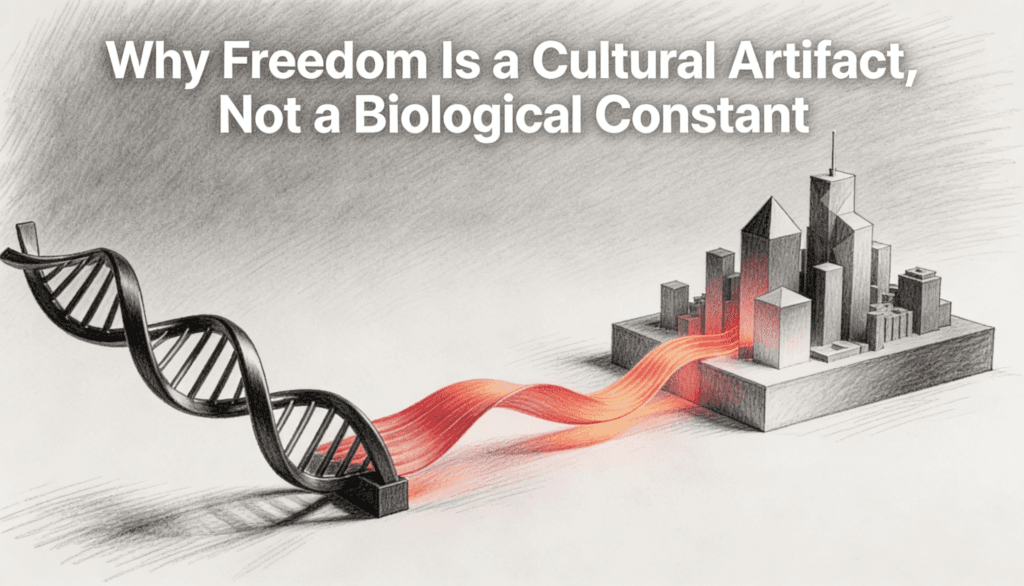
Huntington, the Harvard political scientist best known for The Clash of Civilizations, spent decades poking holes in the assumptions that Western intellectuals hold most dear. And perhaps none of his arguments irritated people more than this one: freedom, as we understand it in the West, is not a universal biological drive. It is a cultural product. It was made, not discovered. It has an address, a history, and a set of very specific parents.
This is not a comfortable thesis. But comfort was never really Huntington’s department.
The Myth of the Freedom Instinct
Let us start with the popular version of the story. In this version, every human being, regardless of where they are born, carries inside them a yearning for individual liberty. Oppressive governments are aberrations. Dictatorships are dams holding back a natural river. Remove the dam, and democracy floods in.
This narrative powered decades of Western foreign policy. It justified interventions, regime changes, and the confident export of democratic institutions to countries that had never asked for them. The assumption was always the same: deep down, everyone wants what we want. They just need a little help getting there.
Huntington looked at this assumption and saw not a universal truth but a very particular kind of arrogance. The idea that freedom is hardwired into human biology is not supported by the evidence. What is supported by the evidence is something far less flattering to Western self image: the concept of individual freedom as a political organizing principle emerged from a specific civilization, at a specific time, under specific conditions. It is not the default state of humanity. It is an invention.
And like all inventions, it did not have to happen.
Where Freedom Actually Came From
If freedom is not biological, then where did it come from? Huntington traced its origins to a confluence of forces unique to Western civilization. Not one cause, but several, braided together over centuries.
First, there was Christianity, and specifically Western Christianity. The separation of church and state, the idea that God and Caesar occupy different domains, created a conceptual space that simply did not exist in most other civilizations. In the Islamic world, in Confucian China, in Hindu India, the sacred and the political were far more tightly fused. But in the West, the tension between pope and emperor, between spiritual authority and temporal power, cracked open a gap. And in that gap, individual conscience found room to breathe.
Second, there was the peculiar feudal structure of medieval Europe. Feudalism was messy, decentralized, and often violent. But it also meant that power was distributed rather than concentrated. Kings had to negotiate with nobles. Nobles had to negotiate with towns. The Magna Carta was not a declaration of universal human rights. It was a deal struck between a desperate king and his angry barons. But it established a principle that would echo for centuries: even the sovereign is not above the law.
Third, there was the emergence of representative institutions. Parliaments, estates, councils. These were not born from abstract philosophy. They were born from practical necessity. Kings needed money. To get money, they needed consent. To get consent, they needed assemblies. Democracy, in its earliest forms, was less a noble ideal and more a fiscal arrangement.
None of this was inevitable. None of it was encoded in DNA. It was the product of accidents, negotiations, power struggles, and a civilization that happened to develop along lines that made individual liberty not just possible but, eventually, expected.
The Confusion Between Universal and Familiar
Here is where Huntington’s argument gets genuinely interesting, and genuinely uncomfortable. He suggested that the West has a persistent habit of confusing what is universal with what is merely familiar. We look at our own values, see that they feel natural and obvious, and conclude that they must be natural and obvious to everyone.
This is a cognitive error so common it barely registers. A fish does not notice the water it swims in. A Westerner does not notice the cultural scaffolding that makes individual freedom feel like common sense.
Consider the concept of rights. In the Western tradition, rights belong to individuals. You have the right to speak, to worship, to assemble, to be left alone. But in many other traditions, the fundamental unit is not the individual but the community, the family, or the state. The question is not “what are my rights?” but “what are my obligations?” This is not a failure of imagination. It is a different imagination entirely.
Huntington pointed out that Confucian societies, for example, have operated for millennia on principles of hierarchy, harmony, and collective responsibility. These are not oppressive distortions of some natural freedom instinct. They are coherent, sophisticated value systems that simply start from different premises. To call them deficient because they do not prioritize individual liberty is like criticizing a fish for not climbing trees.
The Democracy Export Business
This matters beyond the seminar room. It matters because the assumption that freedom is universal has had real, and often catastrophic, consequences.
The post Cold War era was drunk on the idea that liberal democracy was the final destination of all political development. Francis Fukuyama called it the end of history. Western governments acted accordingly. They toppled dictators and expected grateful populations to build Jeffersonian republics from the rubble.
It did not go well.
Iraq, Afghanistan, Libya. The pattern repeated itself with grim regularity. Remove the strongman, install democratic institutions, watch in confusion as the whole thing collapses into chaos. The diagnosis was always the same: not enough troops, not enough funding, not enough time. The possibility that the diagnosis itself was wrong, that freedom as the West understands it might not be universally desired or even universally understood, was rarely entertained.
The Software Analogy
Think of it this way. Huntington’s argument is not that non Western people are incapable of freedom. It is that freedom is software, not hardware. It does not come pre installed. It has to be written, debugged, and adapted to the local operating system.
The West wrote its version of this software over roughly a thousand years, through religious schisms, civil wars, philosophical revolutions, and a great deal of bloodshed. Other civilizations can write their own versions. But they have to write them. They cannot simply copy and paste the Western code and expect it to run without errors.
This is actually a more respectful position than the universalist one, if you think about it carefully. The universalist says: everyone should want exactly what we want, and if they do not, something is wrong with them. Huntington says: every civilization has the capacity to develop its own relationship with freedom, on its own terms, in its own time. The first position looks generous but is actually patronizing. The second looks cold but is actually more honest.
Why This Matters Now
We are living through a period that is making Huntington look uncomfortably visionary. The assumption that the world was converging on a single model of liberal democracy has been thoroughly demolished. China has built a superpower without it. Russia has retreated from it. Even within the West, freedom is being redefined, contested, and in some cases actively rejected by people who find it burdensome rather than liberating.
The rise of populist movements across Europe and America suggests that even in cultures where freedom has deep roots, it is not self sustaining. It requires maintenance, investment, and a population that understands why it matters. Freedom is not a gift that, once given, stays given. It is more like a garden. Stop tending it and it goes to seed.
This is perhaps the most important implication of Huntington’s thesis. If freedom is a cultural artifact, then it can be lost. Biological constants do not disappear. Gravity does not take a day off. But cultural achievements can erode, be forgotten, or be deliberately dismantled. The Romans had a republic. Then they did not. The Weimar Republic had a democracy. Then it did not.
Freedom is not the natural state from which we occasionally fall. It is the extraordinary achievement to which we occasionally rise. And the difference between those two framings is everything. One breeds complacency. The other demands vigilance.
The Final Thought
Huntington was not arguing against freedom. He was arguing against taking it for granted. He was saying that the most dangerous thing you can do with something precious is assume it is indestructible.
The instinct to believe that freedom is universal and permanent is understandable. It is comforting. It means we do not have to worry too much, because the arc of history is on our side. But arcs bend in all directions. History does not have a side. And the people who built the free societies we live in understood something we have largely forgotten: freedom is not free, and it is not inevitable.
It is a choice, made daily, embedded in institutions, reinforced by culture, and always at risk.