Table of Contents
You probably think power is simple. Someone has it, someone does not. The boss tells you what to do. The government passes a law. The rich guy buys what he wants. End of story.
Max Weber, the German sociologist who spent his career dissecting how societies actually work, would tell you that you are barely scratching the surface. Weber argued that power does not come in one flavor. It comes in three. And these three dimensions of power do not just coexist peacefully. They compete, overlap, contradict each other, and occasionally pretend the other two do not exist.
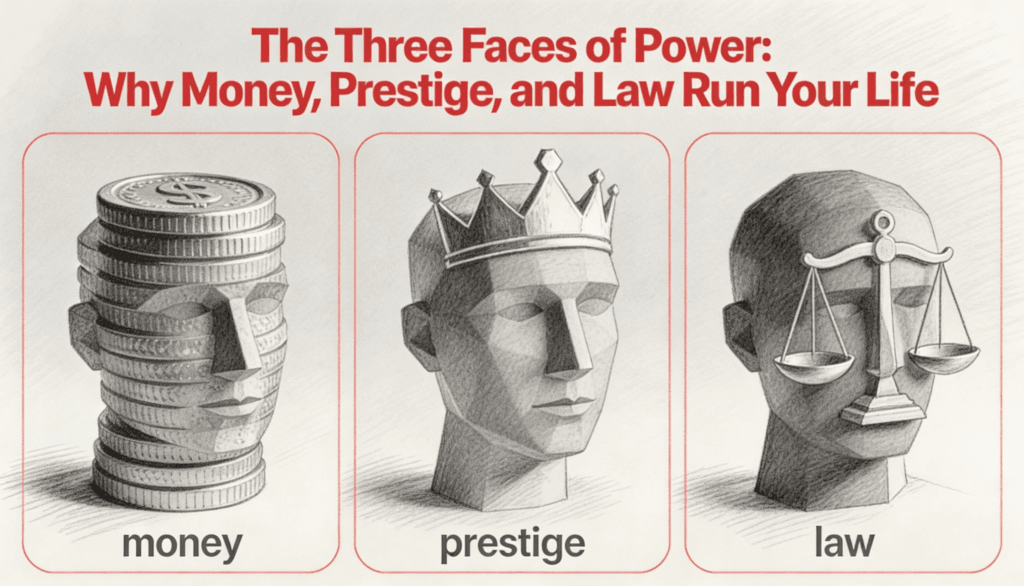
He called them class, status, and party. Or if you prefer less academic language: money, prestige, and organized political force. Together, they form a triangle that quietly governs almost everything about your life, from where you live to who respects you to what laws protect your interests.
The strange part? Most people only ever notice one of them at a time.
The First Face: Class, or Why Money Talks but Never Shuts Up
Weber’s concept of class is economic. It is about your position in the market. Not just how much money you have right now, but your life chances. That term matters. Life chances means the set of opportunities and limitations that your economic position creates for you. Two people can have the same bank balance today, but if one of them has a medical degree and the other has a warehouse job, their life chances are radically different.
This is where Weber quietly disagreed with Karl Marx, though he was too polite and too precise to make it a shouting match. Marx saw class as the whole game. Everything was about who owned the means of production and who did not. Capitalists versus workers. Two teams. Pick one.
Weber said that was too neat. Economic power is real and enormous, but it is not the only thing sorting people into hierarchies. A wealthy plumber and a broke aristocrat do not occupy the same social universe, even if their checking accounts briefly look similar. Money matters, obviously. But it is not the only currency.
Still, let us not be naive about what money does. Economic class determines your access to housing, education, healthcare, legal representation, and leisure. It determines whether a setback is an inconvenience or a catastrophe. Weber understood that markets are not neutral playing fields. They are arenas where people with different resources compete, and the rules of the arena tend to favor those who already have the most.
Here is the counterintuitive part. Weber noticed that people in the same economic class often do not act together. Factory workers in 1900 did not automatically form a unified political bloc just because they were all poor. They were divided by religion, ethnicity, region, skill level, and a dozen other things. Class position gives you shared interests in theory. In practice, people are far messier than that.
This observation remains strikingly relevant. Look at any modern democracy and you will find millions of people voting against their apparent economic interests. Commentators on every side find this baffling. Weber would not. He would simply point to the other two faces of power and say: you forgot about those.
The Second Face: Status, or The Invisible Ranking System Nobody Admits Exists
If class is about what you have, status is about what you are. Or more accurately, what other people think you are.
Weber used the German word Stand, which roughly translates to status group or social estate. A status group is a community of people who share a common lifestyle, a sense of honor, and a particular level of social respect. Members of a status group tend to associate with each other, marry each other, and quietly exclude everyone else.
This is where things get interesting, because status and class do not always line up. A university professor has enormous prestige in most societies but often earns less than a successful car dealership owner. A tech entrepreneur might have more money than a Supreme Court justice but would not receive the same deference at a diplomatic dinner. A soldier returning from combat might be celebrated as a hero while struggling to pay rent.
Weber saw this mismatch not as a glitch in the system but as a fundamental feature of how power works. Status groups actively resist being reduced to economic categories. In fact, one of the main things status groups do is draw boundaries that money alone cannot cross. Old money families look down on new money. Academics quietly disdain those who “sold out” to industry. Artists sneer at commercial success as though it were a moral failing.
The phrase “you cannot buy class” is not just a cliché. It is a status group defending its borders.
This connects to something the sociologist Pierre Bourdieu would later develop extensively with his concept of cultural capital. The idea that knowledge, taste, education, and manners function as a kind of invisible wealth. You can be rich and still be excluded from certain circles if you do not know the right references, use the right tone, or display the right sensibilities. Bourdieu built much of his work on foundations that Weber laid, extending the insight that social hierarchies operate on multiple tracks simultaneously.
What makes status power so effective is that it feels natural. Economic inequality is visible. You can point to numbers, wages, tax brackets. But status inequality hides inside culture. It lives in who gets interrupted in meetings, whose opinion is taken seriously without credentials being checked, who gets the benefit of the doubt from police officers, and whose neighborhood gets better infrastructure. Status is the ranking system that everyone participates in but almost nobody admits exists.
And here is the dark side Weber would want you to notice. Status groups are not just about feeling good. They are instruments of exclusion. Historically, they have been the mechanism behind caste systems, racial hierarchies, religious persecution, and gender oppression. When a group defines itself by honor and lifestyle, it necessarily defines others as outsiders. The warmth inside the circle requires a wall around it.
The Third Face: Party, or How Power Gets Organized and Dangerous
Weber’s third dimension is what he called “party,” and he meant it broadly. A party, in his sense, is any organized group that seeks to influence decision making. Political parties are the obvious example, but Weber included unions, lobbying organizations, religious movements, bureaucratic factions, and any collective that mobilizes to acquire or exercise power.
This is the dimension where power stops being passive and becomes active. Class gives you resources. Status gives you respect or contempt. But party is where people get together, make plans, and try to change the rules in their favor.
Weber was deeply interested in how organizations work internally, and what he found was not comforting. He developed the concept of the “iron cage” of bureaucracy, the idea that rational, rule based organizations tend to take on a life of their own. They become machines that serve their own survival and expansion, regardless of the purposes they were originally created to serve. The party that was supposed to represent workers starts representing its own leadership. The government agency designed to regulate an industry starts protecting it instead. The charity becomes more concerned with fundraising than with the cause.
This sounds cynical, but Weber was not being cynical. He was being observational. And his observations keep proving accurate. Modern democracies are filled with organizations that have drifted far from their stated missions, not because the people in them are uniquely corrupt, but because organized power follows its own logic.
The party dimension also reveals something crucial about how the other two faces of power translate into real world outcomes. Having money does not automatically get you favorable legislation. Having prestige does not automatically get your community protected from development or pollution. You need organization. You need people who show up, who know the procedures, who can navigate the bureaucracy, who can apply pressure at the right points.
This is why Weber’s framework matters practically, not just theoretically. It explains why some groups with enormous economic resources lose political battles, and why some groups with very little money manage to punch far above their weight. Organization is the multiplier. It is the bridge between having power in potential and exercising power in practice.
Where the Three Faces Collide
The real genius of Weber’s model is not in any single dimension. It is in the interactions between them.
Consider a scenario. A tech billionaire decides to enter politics. He has class power in abundance. But does he have status? That depends on the context. In Silicon Valley, he is royalty. In Washington, he is a newcomer who does not understand how things work. Among academics, he might be viewed as an overgrown engineer with no grasp of history. His money can buy attention and staff and advertising, but it cannot buy the kind of legitimacy that comes from decades of public service or intellectual authority.
Now consider the reverse. A well respected community leader, someone with enormous status in her neighborhood, tries to fight a development project. She has prestige but no money and no organization. Without the party dimension, without lawyers and lobbyists and a structured campaign, her status is just a warm feeling that the bulldozers will ignore.
Or think about how law itself operates. Laws are created by parties, enforced by bureaucracies, influenced by economic interests, and legitimized through status claims about justice and fairness. A law that protects property rights is simultaneously an expression of class power, a reinforcement of the status of property owners, and the product of organized political effort. All three faces are present in a single statute.
Weber would want you to see this complexity, because seeing it clearly is the first step toward understanding why power is so difficult to challenge. If you think power is only about money, you will miss the ways status hierarchies operate even among people with similar incomes. If you think it is only about prestige, you will be helpless when organized interests override cultural authority. If you think it is only about political organization, you will underestimate how much money and status shape who gets organized in the first place.
Why This Still Matters at Your Breakfast Table
You might think this is all very grand and sociological, relevant to political scientists and historians but not to your Tuesday morning. You would be wrong.
Weber’s three faces of power show up in your workplace, where your salary, your title, and your position in office politics represent three different kinds of leverage that do not necessarily correlate. The highest paid person in the room is not always the most respected. The most respected person is not always the one with organizational influence. And the person with the most political savvy might be neither the richest nor the most admired.
They show up in your social life, where you navigate overlapping hierarchies of income, cultural taste, and group membership without ever consciously naming what you are doing.
They show up in how you experience the legal system. Formally, the law treats everyone equally. In practice, economic resources determine the quality of your legal defense, social status influences how you are treated by police and judges, and organized political power determines which laws get written and which get enforced.
Weber was not optimistic about any of this. He did not think identifying the three faces of power would lead to some grand liberation. He thought modern life was becoming an increasingly rationalized iron cage, where bureaucratic efficiency replaced human meaning, and where the different forms of power would continue to stratify society in complex and often invisible ways.
But he also believed that understanding was better than ignorance. You cannot navigate a system you do not see. And you cannot change a system you do not understand.
The three faces of power are still running your life. The question Weber would pose, with characteristic German seriousness, is whether you are going to keep pretending they are not, or whether you are going to open your eyes and deal with all three at once.
Most people pick the first option. It is easier. But it is not smarter.