Table of Contents
Most people assume that totalitarian regimes rise because one exceptionally evil genius seizes power. A mad dictator hypnotizes millions, and the rest is tragedy. It is a comforting story. It is also wrong.
Hannah Arendt spent decades trying to understand how the worst political systems in human history actually worked. What she found was far more disturbing than a simple tale of villains and victims. She found a machine. A machine that did not require evil geniuses to operate. A machine that ran, quite efficiently, on ordinary people.
That is the part nobody wants to hear.
The Woman Who Watched Evil Up Close
Before we get into the recipe, it helps to know the chef. Arendt was a German Jewish philosopher who fled Nazi Germany in 1933, lived as a stateless refugee for nearly two decades, and eventually made it to the United States. She was not writing about totalitarianism from some comfortable academic distance. She had watched it consume her country, her friends, and nearly her own life.
Her major work, The Origins of Totalitarianism, published in 1951, was not just a history book. It was an autopsy. She wanted to cut open the corpse of the Nazi and Stalinist systems and figure out what made them tick. Not what made Hitler or Stalin tick. What made the systems tick. That distinction matters more than almost anything else she wrote.
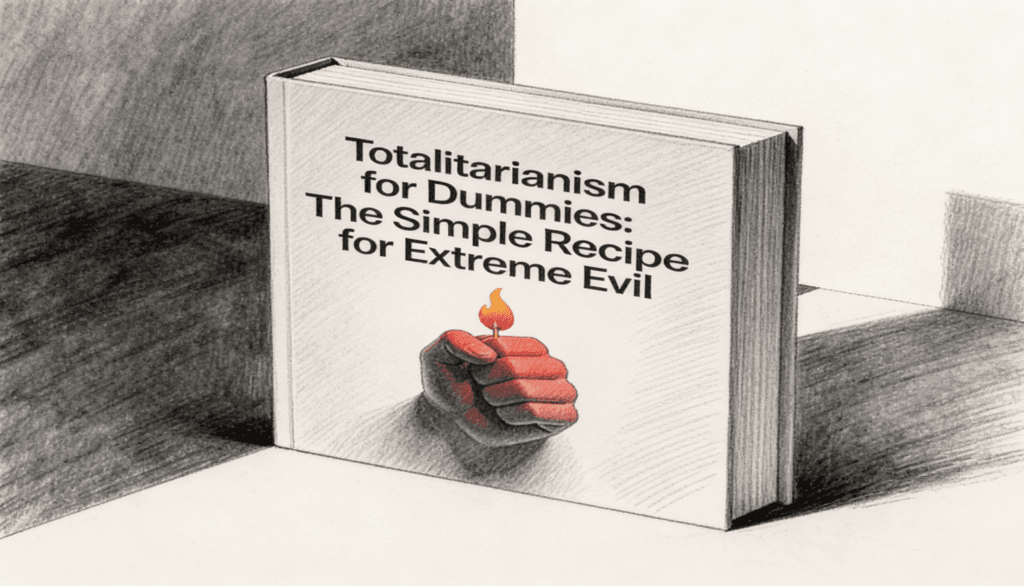
Arendt was not interested in demonology. She was interested in engineering. How do you build a political system so total, so all consuming, that it reshapes reality itself? Her answer, when you strip away the academic scaffolding, is shockingly practical. Almost like a recipe.
Step One: Atomize the Population
Every totalitarian movement begins with the same raw ingredient: loneliness. Not the romantic kind where you stare out rainy windows. The political kind. The kind where people feel completely disconnected from each other, from institutions, from any sense of shared purpose.
Arendt noticed that totalitarian movements did not rise in societies with strong civic bonds. They rose in societies where those bonds had already been shattered. Weimar Germany was not a place of tight communities and robust civil society. It was a place of mass unemployment, social dislocation, and millions of people who felt they belonged nowhere and to nothing.
This is the first counterintuitive insight: totalitarianism does not succeed by attacking strong societies. It succeeds by filling the vacuum in broken ones. It is not a disease that strikes the healthy. It is an infection that targets the already wounded.
The lonely, atomized individual is the perfect recruit. Not because they are stupid. Not because they are inherently cruel. But because they are desperate for belonging. And totalitarian movements offer belonging with an intensity that no democratic institution can match. You do not just join the party. You become the party. Your identity dissolves into something larger. The relief of that dissolution, for someone who has felt utterly alone, is almost narcotic.
Think of it this way. If you have ever watched someone join an extreme online community and wondered how a seemingly normal person could start believing increasingly unhinged things, you have watched a miniature version of this process. The mechanism is identical. Isolation first. Then the offer of total belonging. Then the gradual surrender of independent judgment. Arendt described this in 1951. Social media just gave it new infrastructure.
Step Two: Destroy Facts
Once you have your lonely crowd, you need to do something about reality. Specifically, you need to kill it.
Arendt was fascinated by the totalitarian relationship with truth. Totalitarian regimes do not just lie. Ordinary dictatorships lie. Totalitarian regimes do something far more ambitious: they make the very concept of truth irrelevant.
This works through sheer volume and shamelessness. You do not just tell one lie and defend it. You tell a thousand lies, contradict yourself constantly, and then deny that you contradicted yourself. The goal is not to make people believe the lies. The goal is to make people give up on the idea that truth can be known at all.
Arendt pointed out that once citizens reach that point of exhaustion, where they believe nothing and everything simultaneously, they become perfectly malleable. If nothing is true, then anything is possible. Including the most monstrous things.
This is the second counterintuitive insight. The danger is not that people believe propaganda. The danger is that people stop believing anything. The cynic and the fanatic are not opposites. They are the same person at different stages. Today’s “nothing matters, everyone lies, who even knows what is real” is tomorrow’s “well, if nothing is true anyway, maybe the leader’s vision is as good as anything else.”
It is a brilliant and terrifying strategy. You do not have to convince people you are right. You just have to convince them that nobody is right. After that, power is the only remaining currency.
Step Three: Replace Reality with Ideology
Nature abhors a vacuum, and so does the human mind. Once you have destroyed people’s connection to facts, you need to fill the void. This is where ideology enters.
But Arendt meant something specific by ideology. She did not mean a political platform or a set of policy preferences. She meant a total explanation of the world. A single idea that claims to explain everything: past, present, and future. The Nazi racial theory was not just racism. It was a complete cosmology. History was the story of racial struggle. Every event, every person, every institution could be explained through this one lens. The same was true of Stalinist historical materialism. One idea to rule them all.
The appeal of total ideology is that it eliminates uncertainty. And uncertainty, for the atomized and disoriented individual, is unbearable. A total explanation is like a warm blanket in a blizzard. It does not matter if the blanket is made of barbed wire. It still feels like warmth when you are freezing.
Arendt argued that ideology in the totalitarian sense has a peculiar logical structure. It starts with one premise and then deduces everything else with iron consistency. The logic is flawless. The premise is insane. But once you accept the premise, the conclusions follow with a kind of terrible inevitability. If you accept that one race is subhuman, then the camps follow logically. If you accept that one class is the enemy of history, then the purges make perfect sense.
This is why arguing with true believers using facts and evidence rarely works. You are attacking the conclusions. They are operating from the premise. And the premise is not an empirical claim that can be tested. It is an article of faith wearing the costume of science.
Step Four: Terror as a Governing Principle
Here is where the recipe gets truly dark. Most people think of terror as a tool totalitarian regimes use to stay in power. Arendt argued it was something much worse: terror was the essence of totalitarian government.
In a normal tyranny, terror has a rational purpose. You terrorize your enemies. You terrorize potential opponents. There is a logic to who gets targeted. In a totalitarian system, terror becomes random and universal. It targets enemies, friends, loyal party members, and random bystanders with equal enthusiasm.
This seems irrational. It is not. Random terror accomplishes something that targeted repression never can: it destroys all human bonds. When anyone can be denounced at any time for any reason, trust becomes impossible. You cannot confide in your spouse. You cannot joke with your colleague. You cannot even think freely in your own mind, because the habits of self censorship become so deep that they colonize your inner life.
The concentration camp, in Arendt’s analysis, was not an aberration. It was the central institution of totalitarianism. Not because it killed people, though it did that with industrial efficiency. But because it proved that anything was possible. The camps demonstrated that human beings could be made entirely superfluous. They could be stripped of legal status, then of moral status, then of individuality itself, until they were reduced to bundles of reactions. Not humans. Not animals. Something that had never existed before.
This was the experiment at the heart of the system. Not a byproduct. Not an excess. The experiment.
Step Five: The Banality of Evil
Arendt’s most famous and most misunderstood idea came later, when she covered the trial of Adolf Eichmann in Jerusalem in 1961. Eichmann was one of the chief architects of the Holocaust. Arendt expected a monster. She found a bureaucrat.
Eichmann was not a fanatic driven by antisemitic hatred. He was a careerist driven by the desire to do his job well, follow procedures, and advance in the organization. He did not think about what he was doing in moral terms. He did not really think at all. He processed. He administered. He optimized logistics.
This is the phrase that launched a thousand arguments: the banality of evil. Arendt was not saying that evil is trivial. She was saying something far more alarming. She was saying that the worst evil in human history was carried out largely by people who never made a conscious decision to be evil. They just stopped thinking.
Thinking, for Arendt, was not intelligence. Plenty of intelligent people served the regime. Thinking was the internal dialogue where you examine your actions and their meaning. It was the quiet conversation you have with yourself about whether what you are doing is right. Eichmann had no such conversation. The machinery of his mind was fully occupied with questions of efficiency. The question of morality simply never came up.
This is perhaps the most uncomfortable idea in all of political philosophy. We want evil to be dramatic. We want it to wear a cape. Arendt told us it wears a gray suit and fills out forms. The production of evil, at its most devastating scale, is not a passion project. It is a desk job.
Why This Still Matters
It would be reassuring to treat Arendt as a historian. Someone who explained a terrible past that we have safely moved beyond. But her analysis was never really about the past. It was about the conditions that make the past repeatable.
Look at her checklist. Social atomization. The erosion of shared truth. The appeal of total explanations. The creeping normalization of cruelty. These are not extinct conditions. They are active forces in contemporary life. Every time someone says “post truth era” with a shrug, Arendt’s ghost should tap them on the shoulder.
This does not mean we are on the brink of totalitarianism. Arendt herself was careful about false equivalences. But she would insist, and she would be right, that the ingredients are always available. The recipe is always known. The question is whether societies maintain the structures and habits that keep those ingredients from combining.
What structures? Arendt’s answer was deceptively simple. Plurality. The recognition that the world contains many perspectives, many truths, many ways of being human, and that this multiplicity is not a problem to be solved but the basic condition of political life. Totalitarianism is, at bottom, an assault on plurality. It wants one truth, one identity, one movement, one leader, one will. Every time we reduce complexity to a single narrative, every time we treat our opponents as not just wrong but illegitimate, every time we prefer the comfort of certainty over the difficulty of thinking, we take one small step in a direction Arendt would recognize.
The good news, if there is any, is that she also believed thinking itself was a form of resistance. Not academic thinking. Not expert thinking. The basic, human act of stopping to ask yourself: what am I doing? What does this mean? Is this right?
Eichmann could not do that. Or would not. The distinction, Arendt suggested, may not matter much in the end.
The recipe for totalitarianism is simple. That is the whole point. It does not require extraordinary evil. It requires ordinary thoughtlessness at extraordinary scale. The antidote is equally simple, and equally difficult: never stop thinking. Even when, especially when, the machinery around you makes thoughtlessness the path of least resistance.
That is Arendt’s final lesson. Evil is not a mystery. It is a choice we make by failing to choose at all.