Table of Contents
You probably think freedom means doing whatever you want, whenever you want. No restrictions. No obligations. Just pure, unfiltered choice stretching out in every direction like an open field with no fences.
Ludwig Wittgenstein, one of the most difficult and brilliant philosophers of the twentieth century, would tell you that this picture is not just wrong. It is incoherent. It is like saying you want to play chess but refuse to follow any of the rules. You can flip the board, scatter the pieces, declare yourself the winner. But you have not played chess. You have not even played a game. You have just made a mess.
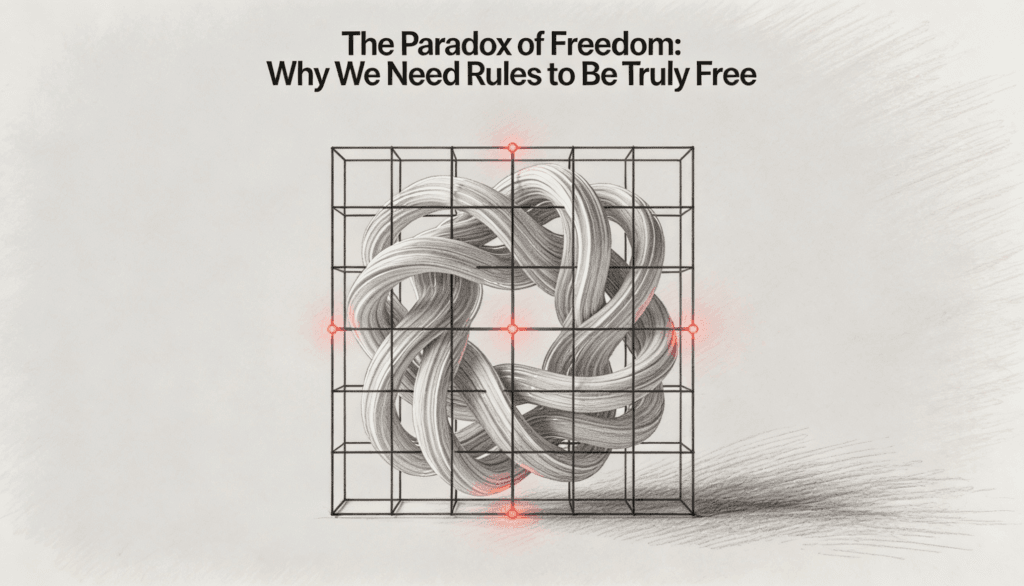
This is the paradox at the heart of Wittgenstein’s thinking, and it touches everything from language to politics to the way you decide what to have for breakfast. True freedom does not come from the absence of rules. It comes from the presence of the right ones.
Let us unpack that.
The Cage That Sets You Free
Wittgenstein spent much of his career thinking about language. Not in the way a grammarian does, obsessing over commas and dangling modifiers. He was interested in something deeper: how words mean anything at all. His answer, especially in his later work, was that meaning comes from use. Words do not carry little packets of meaning inside them like envelopes. They get their meaning from the way people use them, in specific contexts, according to shared rules.
He called these contexts “language games.” Not because language is trivial, but because games are the best analogy for how rule governed activities actually work. Think about football. Eleven players per side. You cannot pick up the ball with your hands unless you are the goalkeeper. Offside exists whether you like it or not. These rules do not limit football. They create it. Without them, you just have twenty two people running around a field kicking something. That might be fun for about three minutes, but it is not football.
Language works the same way. The rules of grammar, syntax, and shared meaning are not obstacles to communication. They are the very thing that makes communication possible. When you say “pass the salt,” everyone at the table knows what you mean because you are all playing the same language game. Remove the rules, and the sentence becomes noise.
Here is where it gets interesting. The same principle applies to freedom itself.
Freedom Without Rules Is Not Freedom
Imagine a world with absolutely no rules. No laws, no social norms, no expectations, no traffic lights. You are free to do anything. Sounds liberating for about five seconds, until you realize that everyone else is also free to do anything. Including things you would rather they did not do. Your freedom to walk down the street peacefully depends on other people following the rule that says they should not attack strangers. Your freedom to own property depends on everyone agreeing that theft is wrong. Your freedom to speak your mind depends on a shared understanding that words have meanings and conversations have structures.
Total freedom, it turns out, is a kind of prison. When nothing is predictable, nothing is possible. You cannot plan, you cannot trust, you cannot build. You spend all your energy defending yourself rather than living.
This is not a new observation. Thomas Hobbes made a version of this argument in the seventeenth century when he described life without government as “solitary, poor, nasty, brutish, and short.” But Wittgenstein’s insight goes deeper than politics. He is not just saying we need a social contract to prevent chaos. He is saying that the very concept of freedom is meaningless without a framework of rules to give it shape.
Think of it this way. A river without banks is not a river. It is a flood. The banks do not restrict the river. They give it direction, power, purpose. They turn formless water into something that can carve canyons.
The Language Game of Liberty
Wittgenstein never wrote a political treatise. He was not interested in telling people how to organize society. But his ideas about language games have profound implications for how we think about freedom, and most people miss them entirely.
Consider the word “freedom” itself. It means different things in different contexts. Political freedom means something different from financial freedom, which means something different from creative freedom, which means something different from the existential freedom that kept Jean Paul Sartre up at night. These are all different language games, and each one operates according to its own rules.
The mistake people make is assuming that “freedom” has one essential meaning, some pure core that all these uses share, and that this core meaning is simply “the absence of constraint.” Wittgenstein would call this a philosophical superstition. Words do not work that way. There is no hidden essence lurking behind the word. There is only the way we use it, in practice, in real life, surrounded by rules and expectations.
When an artist says she needs creative freedom, she does not mean she wants to abandon her medium entirely. A painter who rejects canvas, paint, brushes, color, form, and composition has not achieved creative freedom. She has achieved creative paralysis. Real creative freedom means mastering the rules of your craft so thoroughly that you can bend them, break them selectively, and make something new within or against a tradition. Picasso could paint like a Renaissance master before he started deconstructing faces. The freedom came after the discipline, not instead of it.
Jazz musicians understand this intuitively. Improvisation, the most free form of musical expression, only works because every musician on stage shares a deep knowledge of harmony, rhythm, and song structure. They know the rules so well that they can play with them, around them, and through them. A jam session with musicians who do not know the rules is not free expression. It is noise. Magnificent, enthusiastic, well intentioned noise, but noise all the same.
The Tyranny of Infinite Choice
There is a psychological dimension to this paradox that Wittgenstein did not explore directly, but that fits perfectly with his framework. Modern research on decision making has shown that more options do not always lead to better outcomes or greater satisfaction. Barry Schwartz documented this phenomenon extensively. When people face too many choices, they often become anxious, indecisive, and ultimately less happy with whatever they pick.
Walk into a restaurant with three hundred items on the menu and you will spend twenty minutes agonizing over what to order, then wonder if you made the right choice. Walk into a restaurant with eight carefully curated dishes and you will choose quickly, enjoy your meal, and never look back. The constraint liberated you.
This is not a failure of human psychology. It is a feature. Our minds work best within structures. We need frameworks, categories, and limits to make sense of the world and act within it. Unlimited freedom is cognitively overwhelming. It is like being handed a blank page and told to write anything. Most people stare at that blank page for a very long time. Give them a prompt, a form, a constraint, and the words start flowing.
Rules do not just enable social cooperation. They enable thought itself. You cannot think without language, and you cannot have language without rules. The scaffolding is not separate from the building. It is part of the architecture.
Rules Are Not All Created Equal
Now, before this turns into an argument for authoritarianism, let us be clear about something. Wittgenstein’s insight is not that all rules are good. It is that rules are necessary for freedom to exist. There is an enormous difference.
Some rules enable freedom. Traffic laws let millions of people navigate complex cities without constant collisions. Grammar lets strangers communicate across vast distances. Musical scales let composers create beauty that moves people to tears.
Other rules destroy freedom. Censorship laws that silence dissent. Social norms that punish people for who they are. Bureaucratic requirements designed not to organize but to control. These are not enabling structures. They are cages pretending to be architecture.
The question is never whether we should have rules. The question is always which rules, designed by whom, enforced how, and for whose benefit. Wittgenstein gives us the framework for asking these questions, even if he does not give us the answers. A good rule is like a good grammar: it enables expression. A bad rule is like a bad grammar: it makes certain thoughts impossible to articulate.
This distinction matters enormously in an era when people tend to fall into one of two camps. On one side, you have those who see any rule as an infringement on personal liberty. On the other, you have those who believe more regulation is always the answer. Both are wrong, and they are wrong in mirror image ways. The first group forgets that freedom without structure collapses into chaos. The second group forgets that structure without purpose collapses into oppression.
The Musician and the Prisoner
Consider two people. One is a concert pianist who has spent thirty years mastering scales, theory, technique, and the works of composers who came before her. The other is someone locked in a cell with a piano, ordered to play specific notes at specific times, punished for any deviation.
Both are operating within rules. But one is free and the other is not. The difference is not the presence or absence of rules. It is the relationship between the person and the rules. The pianist has internalized her discipline. It has become part of who she is. The rules do not constrain her. They are the foundation on which her expression stands. The prisoner, by contrast, has rules imposed on him externally, without his participation, without his understanding, and with no room for interpretation or creativity.
Wittgenstein would say these are two entirely different language games. They look similar from the outside, but their internal logic is completely different. One produces mastery and expression. The other produces obedience and silence.
This has implications for education, parenting, management, and virtually every domain where one person sets rules for another. Rules that are understood, internalized, and embraced become tools. Rules that are imposed, unexplained, and enforced through threat become chains. The form looks the same. The function could not be more different.
So What Does This Mean for You?
If Wittgenstein is right, and the evidence from linguistics, psychology, music, art, and political theory suggests he is, then the pursuit of total freedom is self defeating. You do not become more free by rejecting all constraints. You become more lost.
Real freedom requires choosing your constraints wisely. It means finding the rules, disciplines, and structures that align with what you want to do and who you want to be, then mastering them so thoroughly that they become second nature. The writer who learns grammar deeply enough can break it beautifully. The entrepreneur who understands market dynamics can disrupt them. The citizen who knows the law can change it.
This is uncomfortable advice in a culture that worships spontaneity and treats any form of discipline as oppression. We like the idea of the untrained genius, the rebel who never studied the system, the free spirit who follows no rules and succeeds anyway. These people exist in movies. In real life, the people who change the rules are almost always the ones who learned them first.
Wittgenstein himself is the perfect example. He mastered the most rigorous philosophical and logical systems of his time, then spent the rest of his career dismantling them. He could not have done the dismantling without the mastering. The freedom came from the discipline, not from its absence.
The Final Move
Here is the deepest irony in all of this. Wittgenstein, the man who showed us that rules make meaning possible, was also one of the most rule breaking thinkers who ever lived. He abandoned a massive fortune. He left academia to work as a gardener, a schoolteacher, and a hospital porter. He wrote philosophy in a style that no one had ever seen before, aphoristic, fragmented, deliberately incomplete.
But he could only break the rules so effectively because he understood them so completely. His rebellion was not random. It was precise. It was the rebellion of someone who knew exactly which walls to knock down and which ones were load bearing.
That might be the most useful takeaway from this entire paradox. Freedom is not the absence of walls. It is knowing which walls matter.
The next time someone tells you that true freedom means no rules, no obligations, no structure, ask them to play you a song. Then watch them reach for an instrument they spent years learning.
That is freedom. Disciplined, structured, rule governed, and entirely, beautifully free.