Table of Contents
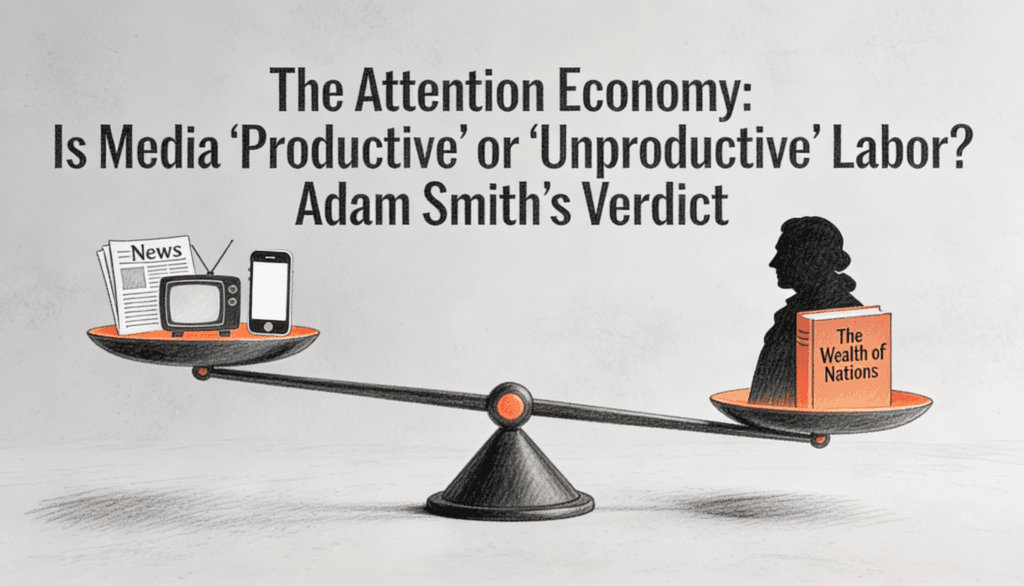
Adam Smith died in 1790. He never saw a YouTube thumbnail, never scrolled past a clickbait headline, never lost forty minutes to a video essay about why a cartoon from 1997 was secretly about capitalism. And yet, if you drag his ideas into the present, they have something uncomfortably sharp to say about the entire media industry.
Smith divided labor into two categories in The Wealth of Nations: productive and unproductive. Productive labor, in his framework, adds value to a physical object. It creates something tangible, something that persists after the work is done. A carpenter builds a chair. A weaver produces cloth. The labor is embedded in the product, and the product can be sold, stored, or traded. Unproductive labor, by contrast, vanishes the moment it is performed. It might be useful. It might even be essential. But it does not leave behind a material thing that holds exchangeable value.
His go to example of unproductive labor was striking. He pointed to servants, soldiers, lawyers, churchmen, and, most relevant for our purposes, performers. “The work of all of them perishes in the very instant of its production,” he wrote. An actor delivers a monologue. The audience applauds. Then the monologue is gone. Nothing remains that can be resold. The labor was consumed in real time.
Now hold that thought and look at the modern attention economy.
The Factory Floor of the Mind
Today, media is one of the largest industries on the planet. The global entertainment and media market is worth about three trillion dollars. Millions of people wake up every morning and go to work producing content: articles, podcasts, videos, social media posts, newsletters, streaming shows, TikToks that last eleven seconds, documentaries that last four hours. The sheer volume of creative output has never been greater in human history.
And by Adam Smith’s original definition, almost none of it counts as productive labor.
This sounds absurd. It is meant to. The absurdity is the point, because it reveals something important about how our economic categories were built and what breaks when you apply them to an economy that runs on attention instead of grain.
Smith was writing for a world in which wealth meant physical stuff. Land, livestock, linen, iron. The productive worker was the one who turned raw materials into finished goods. The unproductive worker might be delightful, even necessary, but did not contribute to the nation’s stock of tangible wealth. A great opera singer and a great blacksmith might earn the same wage, but only the blacksmith left behind something you could point to and say: that is where the value went.
Media, in Smith’s time, fit neatly into the unproductive box. A theatrical performance existed only in the moment. A speech dissolved into air. Even a published book, while technically a physical object, derived its value not from the paper and ink but from the arrangement of ideas, which is precisely the sort of intangible thing Smith’s framework struggled with.
Fast forward to 2026, and the awkwardness becomes almost comic. A single viral video can generate millions of dollars in advertising revenue. A podcast can build a business empire. A newsletter writer working alone from a kitchen table can out earn a small factory. Is this labor really “unproductive”? If it is, then the word has lost any useful meaning.
Where Smith’s Framework Cracks
The first crack is obvious: media today is not ephemeral. A YouTube video does not perish in the instant of its production. It sits on a server, accumulating views, generating revenue for years. A well written article can drive traffic to a website for a decade. A song recorded in a studio in 1975 still earns royalties every time someone streams it. The whole premise of Smith’s distinction, that the performance vanishes while the chair endures, collapses when the performance is recorded, duplicated, and distributed at near zero marginal cost.
This is not a small technical aspect. It strikes at the foundation of the productive versus unproductive divide. Smith assumed that durability was a proxy for real economic contribution. If something lasted, it was wealth. If it disappeared, it was consumption. But digital media lasts indefinitely while costing almost nothing to store. A TikTok video has more permanence than a loaf of bread.
The second crack runs deeper. Smith measured productivity in terms of contribution to a nation’s physical stock of goods. But in the attention economy, the scarce resource is not material. It is human attention. Media producers are not transforming iron into nails. They are competing for minutes of your waking life. And whoever wins that competition captures enormous economic value, not because they made a thing, but because they redirected a flow.
This is where the attention economy performs a quiet inversion of Smith’s entire model. In the eighteenth century, goods were scarce and attention was abundant. People had far fewer things to look at, listen to, or read. The bottleneck was production. Today, goods are abundant, at least in wealthy economies, and attention is the bottleneck. We are drowning in stuff but starving for time. The economy has flipped, and the person who can command attention is doing something that looks, by any functional measure, enormously productive.
The Servant Problem
There is a counterargument worth taking seriously, and Smith himself would probably have made it. You could argue that media producers are, in economic terms, servants of the audience. They do not create independent wealth. They service the desires of consumers. The money flows from advertisers or subscribers, and what is purchased is not a durable good but an experience. The content creator is, in Smith’s language, maintained by the revenue of their patrons, not by capital directed toward productive enterprise.
This is not as outdated as it sounds. Think about the influencer economy. A beauty influencer with ten million followers earns a living by holding attention and directing it toward products made by others. The influencer does not manufacture anything. They perform, and the performance drives consumption of goods produced elsewhere. Strip away the technology, and the structure is not so different from an eighteenth century entertainer retained by a wealthy household to amuse guests who might then be persuaded to do business.
Smith would look at this and say: the real productive labor is happening at the cosmetics factory. The influencer is a conduit, not a producer.
A significant share of the attention economy is, functionally, a marketing apparatus. It exists not to create value in itself but to redirect spending toward goods and services produced elsewhere. Advertising supported media is, by its own logic, a cost center for the companies that fund it. The ad is not the product. The ad is the expense incurred to sell the product. By this accounting, a huge portion of modern media labor is not creating wealth at all. It is creating demand for wealth created by someone else.
The Paradox of Intangible Wealth
But Smith’s framework has a blind spot large enough to drive a modern economy through. He could not have anticipated that intangible goods would become the primary source of economic value.
Consider software. Microsoft does not produce a physical product in any meaningful sense. Its value comes from code, from the arrangement of logical instructions that coordinate human activity. By Smith’s standard, the programmer who writes an operating system is engaged in something suspiciously close to unproductive labor. The code is not a tangible object. It does not add value to raw materials. Yet Microsoft is one of the most valuable companies in history.
The same logic applies to media, or at least to the fraction of media that does more than sell ads. Educational content, for instance, builds human capital. A well made tutorial on welding techniques makes the viewer a better welder. The labor that produced the tutorial is, in practice, as productive as the labor of a teacher in a trade school. The fact that it was delivered through a screen rather than a classroom changes nothing about its economic effect.
Or consider investigative journalism. A reporter who uncovers corporate fraud is not producing a tangible good. But the information they generate can redirect billions of dollars in investment, alter public policy, and prevent economic harm on a massive scale. Calling this unproductive requires a definition of productivity so narrow that it becomes useless.
Smith himself seemed to sense this tension. He acknowledged that some forms of unproductive labor were more valuable to society than some forms of productive labor. He was not a fool. He knew that a great philosopher contributed more to civilization than a mediocre pin maker. But his framework did not have a place for that intuition, so it sat awkwardly beside his main argument, acknowledged but unresolved.
Attention as Raw Material
Here is a way to reconcile Smith with the modern economy, or at least to update him without betraying his core insight.
What if attention is the raw material?
In Smith’s world, productive labor transformed raw materials into finished goods. Cotton became cloth. Iron became tools. The laborer added value by reshaping physical matter into a more useful form. What if media producers are doing something analogous, only with human attention as the input?
A filmmaker takes ninety minutes of your attention, raw and unstructured, and transforms it into an experience that might inform your worldview, refine your taste, or alter your behavior. A journalist takes your scattered curiosity about current events and transforms it into understanding. A podcaster takes your idle commute time and transforms it into engagement with ideas you would not have encountered otherwise.
In each case, the “raw material” is time and attention, and the “finished product” is a changed mind. The value does not reside in a physical object. It resides in the cognitive transformation of the consumer.
This framing would make media labor productive in a way Smith could have recognized, if he had been willing to expand his notion of raw material beyond the physical. The chair sits in your living room. The article sits in your head. Both have been produced. Both have value. The difference is only that one can be weighed on a scale.
What Smith Would Actually Say About TikTok
If you could somehow resurrect Adam Smith and sit him down with a smartphone, he would probably spend the first hour horrified and the next several years fascinated.
He would notice, first, that the attention economy has an enormous waste problem. Most content produced is never consumed in any meaningful way. Millions of videos are uploaded that no one watches. Articles are published that no one reads. This is not productive or unproductive labor. It is failed labor. Smith, who was deeply interested in efficiency, would find this troubling.
He would notice, second, that the platforms themselves, the Googles and Metas, have positioned themselves as the landlords of the attention economy. They do not produce content. They own the infrastructure through which content flows, and they extract rent from every transaction. Smith had very strong opinions about landlords, and none of them were flattering. He would recognize the platform economy as a modern form of rent seeking, and he would disapprove.
He would notice, third, that the most “productive” media labor, the content that actually builds human capital, informs citizens, or advances knowledge, is often the least profitable, while the most profitable content is frequently the most trivial. This inversion would confirm his suspicion that market value and social value do not always align. He said as much about diamonds and water.
But most importantly, he would probably revise his categories. Smith was, above all, an empiricist. He built his theories by observing how economies actually worked, not by imposing abstract categories from above. If he observed an economy in which intangible goods accounted for a majority of GDP, in which attention was the binding constraint on growth, and in which media labor generated trillions of dollars in measurable economic activity, he would not stubbornly insist that all of it was unproductive. He would update his framework.
That is what separates a great thinker from a rigid one. Smith gave us categories that were useful for the world he could see. The attention economy is a world he could not see. The interesting question is not whether he was right or wrong. It is what his method of thinking can still teach us about an economy that would have astonished him.