Table of Contents
There is a recurring fantasy in democratic politics. It goes something like this: somewhere out there, a small group of extraordinarily wealthy people are sitting on mountains of cash, and if we could just reach into those mountains and redistribute the gold, most of our collective problems would dissolve. Schools would be funded. Healthcare would be universal. Roads would stop crumbling. The fantasy is appealing because it is simple. It asks nothing of the majority and everything of the few.
But Jean Baptiste Say, a French economist writing in the early 1800s, saw something that most people then and now prefer not to see. Wealth that sits in the hands of productive people is not sitting at all. It is moving. It is doing things. And when you tax it heavily, you are not skimming off the top of a static pile. You are slowing down a machine that builds the future.
This idea is uncomfortable because it sounds like a defense of the rich. It is not. It is a defense of understanding what capital actually does before we decide how much of it to seize.
Say’s Insight: Production Creates Its Own Demand
Say is most famous for what became known as Say’s Law, often simplified to the phrase “supply creates its own demand.” This simplification has caused more confusion than clarity over two centuries, so let us slow down.
What Say actually argued was that production is the source of purchasing power. When someone produces goods or services, they generate the income that allows them to buy other goods and services. The economy is not a zero sum game where one person’s gain is another person’s loss. It is a generative process. The act of creating value is what funds the ability to consume value.
This means that the people who produce the most, who build factories, develop technologies, organize complex enterprises, are not just accumulating wealth for personal enjoyment. They are generating the purchasing power that ripples through the entire economy. The factory owner who reinvests profits into a new production line is not hoarding. He is creating the jobs and goods that become other people’s incomes and other people’s purchases.
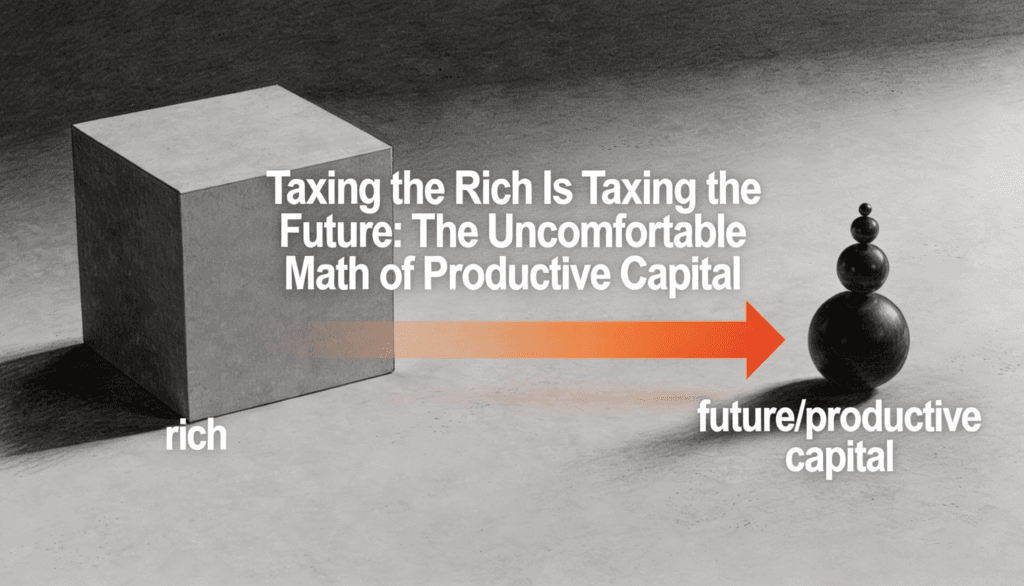
Say understood something that modern political discourse often ignores: the rich, insofar as they are productively rich, are economic engines. Tax the engine too aggressively and you do not just take from the wealthy. You reduce the economy’s capacity to generate wealth for everyone.
The Difference Between Productive and Idle Capital
Now, this is where the conversation gets interesting, because not all wealth is created equal. Say himself would have drawn a sharp distinction between productive capital and idle wealth. A billionaire who pours money into research and development, supply chains, and new ventures is doing something fundamentally different from a billionaire who parks money in a vault or speculative financial instruments that produce nothing tangible.
The trouble with most tax policy debates is that they treat all wealth as if it were the same substance. A dollar earned by a tech entrepreneur reinvesting in artificial intelligence research and a dollar earned through rent seeking on monopoly privileges get taxed under the same framework. Say would have found this absurd. The first dollar is building the future. The second dollar is extracting value from the present.
This distinction matters enormously. When critics of wealth taxation argue that taxing the rich hurts innovation, they are partially right but only about the productive portion. When advocates of wealth taxation argue that extreme concentration of wealth is socially destructive, they are also partially right but only about the unproductive portion.
The honest position, and the one nobody in politics wants to take because it is too nuanced to fit on a bumper sticker, is that we should think carefully about what kind of wealth we are taxing and what that wealth is doing at the moment we take it.
The Uncomfortable Math
Let us talk numbers for a moment, because the math behind taxing productive capital reveals something that most people find deeply counterintuitive.
Imagine a business owner earns ten million dollars in a year. The popular narrative frames this as ten million dollars that could be redistributed. But Say’s framework asks a different question: what was that ten million dollars about to do?
If the business owner was going to reinvest eight million of it into expanding operations, hiring workers, and developing new products, then taxing away five million does not just transfer five million from one pocket to another. It cancels the economic activity that five million would have generated. The new hires that would have been made. The suppliers that would have received orders. The products that would have reached consumers. The wages those new workers would have spent in their local economies.
Economists call this the multiplier effect, and it runs in both directions. Capital deployed productively multiplies its impact through the economy. Capital removed from productive deployment subtracts not just its face value but its downstream effects.
This does not mean the rich should pay nothing. It means we should be honest about the cost. Every dollar taken from productive capital has a price tag that exceeds one dollar. The question is whether the government’s use of that dollar generates more value than the productive capitalist’s use of it would have. Sometimes it does. Public infrastructure, education, and basic research are areas where government spending can generate enormous returns. But often, and this is where the math gets uncomfortable, it does not.
Government spending frequently goes toward consumption rather than investment. Transfer payments, while morally defensible and often necessary, do not build productive capacity. They sustain demand in the short term without creating the supply that would sustain an economy in the long term. Say would have pointed out that you cannot consume your way to prosperity. Someone, somewhere, has to produce.
Why This Idea Makes People Angry
There is a reason Say’s argument provokes hostility. It violates a deep moral intuition that most people hold: that extreme wealth in the presence of extreme poverty is inherently unjust, and that taking from those who have too much to give to those who have too little is simply the right thing to do.
Say does not disagree with the moral premise. He disagrees with the method. His argument is not that the poor should remain poor so the rich can remain rich. His argument is that the fastest way to make the poor less poor is to let productive capital do what it does best, which is produce. Production creates goods, jobs, incomes, and opportunities. Redistribution, taken too far, consumes the very capacity that produces those things.
This is why his ideas land so poorly in populist discourse. They require patience. They require accepting that the indirect route, letting productive people produce and then taxing moderately, generates more long term prosperity than the direct route of heavy redistribution. People in economic distress do not want to hear about long term prosperity. They want relief now. And that is entirely understandable. But understanding a position and agreeing with it are two different things. Say asks us to understand the tradeoff even if we ultimately decide the immediate relief is worth the future cost.
What Would Say Think Today?
If Jean Baptiste Say could observe the modern economy, he would likely be horrified by two things simultaneously.
First, he would be horrified by the degree to which supposedly “productive” capital has become financialized. So much modern wealth is generated not by producing goods and services but by trading financial instruments, extracting rents from intellectual property monopolies, and gaming regulatory systems. This is not the productive capital Say championed. This is parasitic wealth masquerading as entrepreneurship. He would have no objection to taxing it heavily.
Second, he would be horrified by the inefficiency of government spending. The sheer volume of resources that pass through public institutions without generating proportional productive output would strike him as a catastrophic waste. He lived in post revolutionary France, where he saw firsthand how bureaucratic systems consume resources meant for public benefit.
His prescription today would probably be unfashionable on both sides of the political spectrum. To the left, he would say: stop treating all wealth as equivalent. Learn to distinguish between the entrepreneur who builds and the rent seeker who extracts. Tax the extractor, protect the builder. To the right, he would say: stop pretending all government spending is wasteful. Public goods like education, infrastructure, and basic research are the foundation on which productive capital operates. Starve the foundation and the whole structure collapses.
The Real Question
The debate over taxing the rich is ultimately a debate about time horizons. In the short term, redistributing wealth from the top can alleviate suffering and reduce inequality. In the long term, depleting productive capital can reduce the total amount of wealth available to everyone.
Say’s contribution was to insist that we look at the long term, not because the short term does not matter, but because ignoring the long term guarantees that short term solutions become permanent problems. A society that repeatedly consumes its productive capital to fund immediate needs is like a farmer who eats his seed corn. The harvest this year might be enough. But next year’s field will be empty.
The uncomfortable math of productive capital is this: the wealth we are most tempted to seize is often the wealth that is most actively building the future we all want to live in. That does not mean we should never seize it. It means we should understand what we are giving up when we do.
Jean Baptiste Say did not argue for a world without taxes. He argued for a world where people understood the true cost of taxation, not just the dollars collected but the production foregone. Until we take that cost seriously, every debate about taxing the rich will remain a shouting match between moral intuition and economic reality. And in shouting matches, nuance always loses.