Table of Contents
You probably know someone like this. Straight A student. Top of the class. Could solve differential equations before breakfast and quote Nietzsche at dinner. They launched a business. It collapsed within eighteen months.
Meanwhile, the kid who barely scraped through high school is running a company worth millions. He cannot spell “entrepreneurship” but he is living it.
This is not an accident. It is not luck. And it is not some motivational poster nonsense about “street smarts beating book smarts.” There is a serious intellectual framework that explains exactly why this happens, and it was developed by an economist most people have never heard of.
His name is Israel Kirzner. And his idea is quietly one of the most important contributions to understanding how wealth actually gets created.
The Economist Who Noticed What Everyone Else Missed
Israel Kirzner spent most of his career at New York University, working in the tradition of Austrian economics. He was not flashy. He did not win a Nobel Prize, though many economists argue he deserved one. What he did was something deceptively simple: he asked a question that mainstream economics had been stepping over for decades.
The question was this: if markets tend toward equilibrium, who actually moves them there?
Standard economic models had a peculiar blind spot. They assumed that all relevant information was already known, or at least knowable through rational calculation. In these models, the economy was basically a giant math problem. Feed in the right data, apply the right formulas, and optimal outcomes emerge. The people in these models were not really people at all. They were calculators with legs.
Kirzner looked at this and saw something absurd. If everyone already knows everything, then there is nothing left to discover. And if there is nothing to discover, then there are no opportunities. And if there are no opportunities, then entrepreneurship does not exist.
But entrepreneurship obviously does exist. So something in the model was broken.
Alertness: The Quality Nobody Teaches
Kirzner’s answer was a concept he called “entrepreneurial alertness.” It is not intelligence. It is not knowledge. It is not even creativity in the way most people use that word. It is something stranger and more specific.
Alertness is the ability to notice opportunities that other people overlook. Not to calculate them. Not to deduce them from first principles. Just to see them, the way you might notice a $20 bill on the sidewalk that a hundred people already walked past.
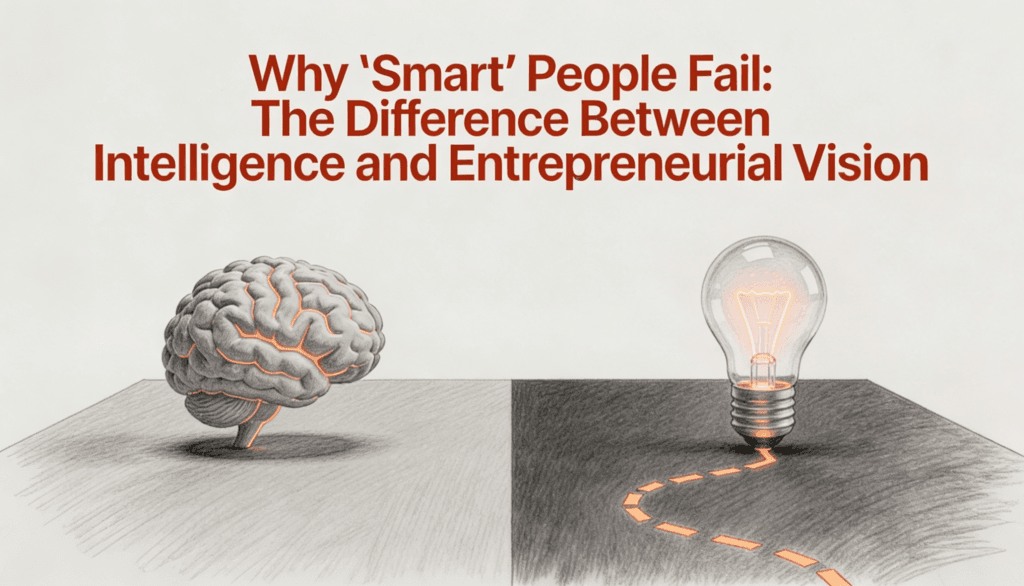
This distinction matters enormously. Intelligence helps you solve problems that are clearly defined. Alertness helps you notice problems and opportunities that nobody has defined yet. These are fundamentally different cognitive acts. One operates within a known framework. The other operates at the edges of what is known, in the gaps and blind spots and mismatches that saturate every economy at every moment.
Think about it this way. A brilliant engineer at Kodak in 1995 could optimize the chemical process of film development better than anyone alive. That is intelligence applied with extraordinary skill. But the entrepreneur who looked at the same moment in history and saw that digital photography would make film irrelevant was exercising something entirely different. That person was not solving Kodak’s problems. That person was seeing a future that Kodak’s smartest people were trained to ignore.
Why Education Can Actually Make This Worse
Here is where things get counterintuitive, and perhaps a little uncomfortable.
Formal education, at its core, is a process of teaching people to solve known problems using established methods. You learn calculus. You learn case studies. You learn frameworks and models and best practices. You are rewarded for applying the right technique to the right problem. This is genuinely valuable. Society needs people who can do this well.
But this training comes with a hidden cost. It teaches you to look where everyone else is looking. It rewards you for mastering the existing map of reality, not for noticing that the map has blank spots. After enough years of this, your attention becomes domesticated. You see what the curriculum taught you to see. You stop seeing everything else.
Kirzner would say that formal education often sharpens intelligence while dulling alertness. The more you are trained to operate within established frameworks, the less likely you are to notice that a completely different framework is needed.
This is why so many MBAs struggle as founders. They have been trained to analyze markets. They can build beautiful financial models and conduct rigorous competitive analyses. But the opportunities that create the most value are usually ones that do not show up in any existing model, because they exist in spaces the models were not designed to map.
The dropout who builds a billion dollar company is not succeeding despite a lack of education. In some cases, that person is succeeding partly because of it. Without a pre installed framework for how things “should” work, they remain free to notice how things actually do work, and more importantly, how they could work differently.
The $20 Bill on the Sidewalk
Kirzner used a thought experiment that is worth sitting with. Imagine a $20 bill lying on a busy sidewalk. Dozens of people walk past it. Economists from certain schools would tell you this is impossible. If the bill were really there, someone would have already picked it up. The market is efficient, after all.
But Kirzner’s whole point is that the bill is there. It is there all the time, everywhere, in every market. The question is not whether opportunities exist. The question is why most people do not see them.
The answer is not that they are stupid. Many of them are extraordinarily intelligent. The answer is that they are not alert. Their attention is directed elsewhere. They are busy solving the problems they already know about, applying the skills they already have, optimizing the systems they already understand. The bill is beneath their feet and they are staring at the horizon, looking for something that matches their mental model of what an opportunity should look like.
This is one of the most humbling ideas in all of economics. You do not need to be the smartest person in the room. You need to be the most awake.
The Profit Problem
Kirzner also had a distinctive view on profit itself, one that challenges how most people think about it.
In standard economics, profit is a return on investment, a reward for deploying capital effectively. Kirzner argued that entrepreneurial profit is something quite different. It is the reward for noticing what others missed. It is not a payment for doing something difficult. It is a payment for seeing something that was invisible to everyone else.
This reframes the entire moral conversation around profit. The entrepreneur does not earn profit by exploiting others or by having more resources. The entrepreneur earns profit by correcting an error in the market, by realizing that something is undervalued here and overvalued there, or that a need exists that no one is addressing.
In Kirzner’s world, the entrepreneur is not a predator. The entrepreneur is a corrective mechanism. And profit is not extracted from the economy. It is generated by making the economy work better than it was working before.
This is a deeply optimistic view, and it carries a sting for those who assume that financial success must be zero sum. According to Kirzner, the purest form of entrepreneurial profit creates value that did not previously exist. It is not taken from someone else’s plate. It is a new plate entirely.
Why This Matters Now More Than Ever
We live in a period of extraordinary informational abundance. The average person today has access to more knowledge than a university professor had thirty years ago. And yet entrepreneurial alertness has not increased proportionally. If anything, it may have decreased.
Why? Because more information does not mean more alertness. It often means more noise. When you are drowning in data, your attention narrows. You focus on processing what is in front of you rather than noticing what is absent. You become a better calculator and a worse noticer.
Social media accelerates this. It trains your attention to follow what everyone else is paying attention to. It creates a gravitational pull toward consensus perception. Whatever is trending becomes visible. Whatever is not trending becomes invisible. The algorithm is a machine for destroying entrepreneurial alertness, because alertness requires seeing what is not being seen.
Kirzner could not have predicted TikTok, but his framework predicts its effect with eerie accuracy. A world in which everyone is looking at the same things is a world in which $20 bills pile up on every sidewalk, untouched.
The Uncomfortable Truth About “Failure”
So why do smart people fail at entrepreneurship? It is not because they lack skill, knowledge, discipline, or work ethic. It is because they are solving the wrong problem.
They think entrepreneurship is about having the best idea and executing it flawlessly. It is not. It is about noticing something that others have not noticed, and acting on that perception before the window closes. The execution matters, of course. But the perception comes first. Without it, you are executing brilliantly in the wrong direction.
This is why so many well funded startups with brilliant teams and impeccable business plans collapse, while scrappy founders with no plan at all somehow stumble into massive success. The scrappy founder was not smarter. The scrappy founder was alert. They noticed a gap, a mismatch, an unmet need that the sophisticated analysis completely missed.
And this is also why the most successful serial entrepreneurs often struggle to explain how they do what they do. Alertness is not a method. It cannot be reduced to a checklist or a process. It is a quality of attention. You either have it or you do not, and the cruel twist is that many of the things we do to become “smarter” are exactly the things that erode it.
What Kirzner Leaves Us With
Israel Kirzner did not write self help books. He did not give TED talks. He wrote dense academic papers that most people outside economics will never read. But his core insight is one of those ideas that, once you understand it, rearranges how you see the world.
Intelligence is a tool. A powerful one. But it is a tool for operating within a known landscape. Entrepreneurial alertness is something else entirely. It is the ability to see a landscape that nobody else realizes is there.
The smartest person in the room can tell you everything about the world as it is. The most alert person in the room can show you the world as it could be. And if you look at the history of how fortunes are made, how industries are born, how economies actually move forward, it is the second kind of vision that matters more.
This does not mean you should drop out of school or stop learning. Knowledge is a prerequisite, not a disqualification. But it does mean you should be suspicious of your own expertise. The more you know about how things work, the harder it becomes to imagine them working differently.
Kirzner’s lesson is paradoxical but vital. The greatest obstacle to seeing the opportunity right in front of you might be everything you already know. The $20 bill is on the sidewalk. The question is whether you have trained yourself to look down.