Entrepreneurship

Every founder eventually hits a question that no business book can answer. Why does success feel empty? Why do smart people build stupid systems? Why does the market reward people who take risks but punish the ones who fail? Intellectual Prestige writes about entrepreneurship at the level where economics meets philosophy – where Say’s theory of production meets Seneca’s advice on resilience, and where the difference between a good founder and a great one is not a skill set but a worldview.

Why You Should Stop Trying to Be a Leader and Start Being an Administrator

Why You Should Stop Trying to Be a “Leader” and Start Being an “Administrator”

There is a peculiar disease spreading through modern business culture. It lives in keynote speeches, bestselling books, and corporate retreats held at places with too many glass windows. The disease is this: everyone wants to be a “leader.” Nobody wants to be an “administrator.” Say the word “leader” in a room full of professionals and […]

Why You Should Stop Trying to Be a “Leader” and Start Being an “Administrator” Read More »

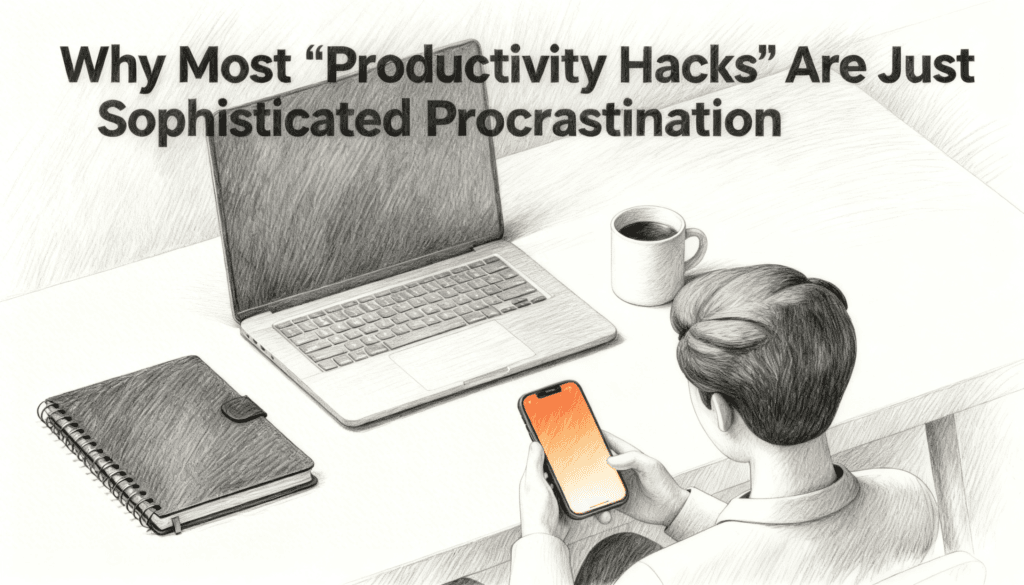
Why Most Productivity Hacks Are Just Sophisticated Procrastination

Why Most “Productivity Hacks” Are Just Sophisticated Procrastination

There is a particular kind of person who has read every productivity book, installed every task management app, and color coded their calendar down to the minute. They can tell you about time blocking, the Pomodoro technique, Eisenhower matrices, and at least three different ways to process an inbox. They are also, almost always, behind

Why Most “Productivity Hacks” Are Just Sophisticated Procrastination Read More »

The Intellectual Class vs. The Entrepreneur- The Eternal Cold War

The Intellectual Class vs. The Entrepreneur: The Eternal Cold War

There is a peculiar war that has been raging for centuries. It does not involve armies or territories. No shots are fired. No treaties are signed. Yet its consequences shape economies, cultures, and the very fabric of how societies organize themselves. This is the war between the intellectual class and the entrepreneur. And the man

The Intellectual Class vs. The Entrepreneur: The Eternal Cold War Read More »

The Intellectual Entrepreneur- Why Ideas Are the Raw Materials of the 21st Century

The Intellectual Entrepreneur: Why Ideas Are the Raw Materials of the 21st Century

In 1803, a French economist named Jean-Baptiste Say made a claim that most people ignored for about two hundred years. He argued that the entrepreneur’s real job was not to own land or accumulate capital. It was to combine knowledge, judgment, and imagination into something the world did not yet know it needed. He called

The Intellectual Entrepreneur: Why Ideas Are the Raw Materials of the 21st Century Read More »

Content Overload? Why J.B. Say Proves There Is No Such Thing as Too Much Content

Content Overload? Why J.B. Say Proves There Is No Such Thing as “Too Much Content”

Every week, someone publishes a think piece about how we are drowning in content. Too many podcasts. Too many newsletters. Too many blogs saying the same thing in slightly different fonts. The internet, we are told, has become an ocean of noise where nothing meaningful can survive. It sounds reasonable. It even sounds wise. But

Content Overload? Why J.B. Say Proves There Is No Such Thing as “Too Much Content” Read More »

Clausewitz the Minimalist- Why the Best Strategy is the One You Can Explain in Three Words

Clausewitz the Minimalist: Why the Best Strategy is the One You Can Explain in Three Words

Carl von Clausewitz wrote a book so dense that most people who quote it have never finished it. “On War” runs over 600 pages of Prussian military theory, nested clauses, and ideas that fold into themselves like origami made of fog. It is, by almost any measure, the opposite of minimalism. And yet the man’s

Clausewitz the Minimalist: Why the Best Strategy is the One You Can Explain in Three Words Read More »