Table of Contents
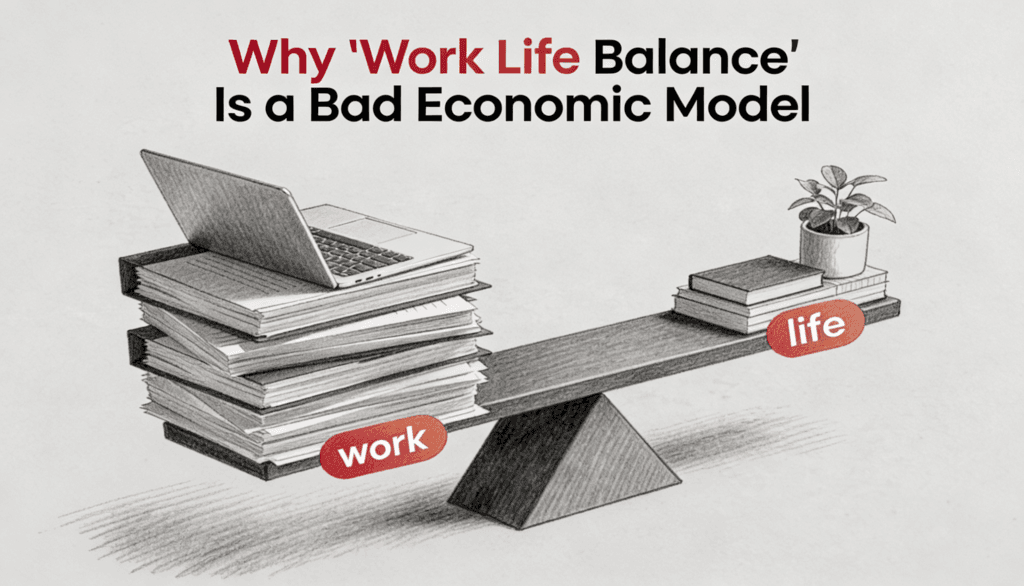
There is a phrase that floats around corporate retreats and LinkedIn posts like a benevolent ghost. Work life balance. Say it slowly and it almost sounds like wisdom. It suggests a scale, two neat sides, one labeled “work” and the other labeled “life,” and all you need to do is keep them even. Simple. Elegant. And, according to one of the most original economists of the twentieth century, almost entirely wrong.
Gary Becker never wrote a viral blog post about morning routines. He never sold a course on how to unplug from your inbox. What he did was spend decades applying economic reasoning to decisions that most economists considered beneath them: marriage, children, discrimination, crime, how people spend their time. He won the Nobel Prize in 1992 for extending economic analysis into domains that had previously belonged to sociologists and psychologists. And buried in his work is a demolition of the very idea that work and life sit on opposite ends of a scale.
To understand why, you have to forget almost everything the wellness industry has taught you and start thinking about time the way an economist does.
The Hidden Economy Inside Your House
Becker’s most radical move was refusing to treat the household as a black box. Classical economics had a clean story. Firms produce goods. Consumers buy goods. Markets clear. The household was just the place where paychecks arrived and spending decisions happened. Becker looked at that story and found it absurdly incomplete.
In his framework, the household is itself a tiny factory. It does not just consume goods. It produces what Becker called “commodities,” the actual experiences and outcomes that people value. A meal is not just groceries purchased at a store. It is groceries plus the time spent cooking plus the skill of the cook plus the kitchen equipment plus the conversation at the table. Health is not just a doctor visit. It is medical care plus exercise time plus knowledge about nutrition plus sleep plus stress management. A child’s education is not just tuition. It is school plus parental time plus books plus the neighborhood plus a thousand bedtime conversations about why the sky is blue.
This reframing matters enormously because it reveals something the balance metaphor completely hides. Work and life are not two separate accounts you draw from. They are inputs into the same production process. The money from your job buys the groceries. The time away from your job lets you cook them. Your energy, your knowledge, your mood, your relationships, they all feed into every “commodity” your household produces. Splitting them into two categories and trying to equalize them is like telling a chef to use equal amounts of salt and flour in every recipe. The proportions depend on what you are making.
Time Is Not What You Think It Is
One of Becker’s key insights, developed in his 1965 paper on the allocation of time, was that time and money are not just related. They are fundamentally substitutable. Every activity you engage in has both a direct cost and a time cost, and as your earning potential changes, the real price of your time changes with it.
Consider something as ordinary as mowing your lawn. If you earn fifteen dollars an hour, the time cost of mowing is relatively low. If you earn two hundred dollars an hour, spending Saturday behind a push mower has become an extremely expensive hobby. This is not about laziness or status. It is about the actual economic cost of time, what economists call opportunity cost, shifting as your circumstances change.
Here is where the balance model falls apart most visibly. It assumes that an hour of “life” is always worth the same thing regardless of context. Becker showed that it is not. The value of an hour spent with your children changes depending on what else you could be doing with it, what resources you have already invested, and what stage of life you are in. The value of an hour at work changes depending on whether that hour leads to a promotion, builds a skill, or simply keeps the lights on. Treating all hours of work as identical and all hours of non work as identical is a kind of accounting error that would get you fired from any actual accounting job.
This is also where Becker’s thinking intersects in unexpected ways with the psychology of flow states, a concept developed by Mihaly Csikszentmihalyi. People do not experience their best moments during passive leisure. They experience them during challenging, absorbing activities that demand skill and concentration. Sometimes that happens at work. Sometimes it happens while building a treehouse with your kid. The category label, work or life, tells you almost nothing about the quality of the experience. What matters is the match between challenge and ability, not the location on some imaginary balance beam.
The Efficiency Trap Nobody Talks About
Becker introduced another concept that makes the balance conversation even more uncomfortable: household production efficiency. Just as firms can be more or less efficient at turning inputs into outputs, households can be more or less efficient at turning time and money into wellbeing.
This means that two families with identical incomes and identical hours at work can have wildly different outcomes depending on how well they combine their resources. One family might spend three hours on a Sunday creating a rich, memorable experience with their children. Another might spend the same three hours in a state of distracted semi presence, scrolling through phones while technically being “available.” The balance model counts both of those as equivalent. Three hours on the “life” side. Becker’s framework says they are completely different because the output, the actual commodity produced, is completely different.
This has an uncomfortable implication that the wellness industry tends to avoid. The problem for most people is not that they spend too many hours at work. The problem is that they are inefficient producers of the things they actually care about. They do not lack time. They lack production technology. They lack the skills, habits, systems, and self knowledge that would let them turn their available time into something valuable.
Telling someone to “work less” without addressing their household production efficiency is like telling a struggling restaurant to buy fewer ingredients. It might lower costs, but it will not make the food any better.
Why Becker Would Have Found the Four Day Workweek Debate Amusing
The current enthusiasm for shorter workweeks provides a perfect case study in the limitations of balance thinking. Advocates present it as almost self evidently good. Less work, more life, balance restored. But Becker’s framework asks a question that rarely gets asked: what will people actually produce with the extra time?
If someone uses their new free day to invest in a skill, deepen a relationship, improve their health, or pursue a project that generates meaning, the extra day is genuinely valuable. The marginal utility of that time is high. But if the extra day becomes another eight hours of passive consumption, another rotation through the same streaming platforms and social media feeds, the actual welfare gain might be close to zero.
Becker was not making a moral judgment here. He was making an economic one. Time has no inherent value. It is an input. Its value depends entirely on what you combine it with and what you produce from it. A society that gives everyone an extra day off without giving them the capabilities to use it well has not actually made anyone richer in any meaningful sense. It has just rearranged the furniture.
The Specialization Problem Your Therapist Will Not Mention
Becker also applied the economic concept of specialization to households, and this remains one of his most controversial contributions. In traditional economic terms, if one partner has a comparative advantage in market work and the other has a comparative advantage in household production, the household maximizes its total output when each specializes.
Now, before anyone sets this article on fire, note the word “traditional.” Becker himself acknowledged that this model described a historical pattern more than it prescribed a permanent arrangement. As women’s market wages rose, as household technology improved, as social norms shifted, the economics of specialization changed. But the underlying logic, that households face real tradeoffs about how to allocate time and talent, did not disappear. It got more complicated.
The balance model handles this complexity by ignoring it entirely. It treats each individual as a self contained unit seeking their personal equilibrium. Becker treated the household as an interconnected system where one person’s time allocation directly affects what the other person can produce. A parent who works late is not just losing “life” hours for themselves. They are changing the production function of the entire household. The other parent picks up more domestic production, the children get a different input mix, the household output shifts.
None of this shows up when you think in terms of balance. All of it shows up when you think in terms of production.
What Actually Works Instead
If the balance model is broken, what replaces it? Becker’s framework suggests something less poetic but more useful: optimization under constraints.
You have a fixed amount of time. You have a certain earning capacity. You have skills, relationships, knowledge, and energy that fluctuate over the course of your life. You are trying to produce the things you actually value: health, connection, meaning, security, pleasure, growth. The question is not “am I balanced?” The question is “am I combining my inputs well?”
This reframing changes almost everything about how you approach decisions. Instead of asking “am I working too much?” you ask “what is the marginal return on my next hour of work versus my next hour of something else?” Instead of feeling guilty about working on a Saturday, you ask whether that specific Saturday work session produces something valuable enough to justify what it costs in other outputs. Instead of treating all leisure as equally good for you, you start distinguishing between restorative activities that improve your future productivity and passive activities that simply fill time.
It is less comforting than “find your balance.” It does not fit on a poster. But it has the significant advantage of actually matching how life works.
The Uncomfortable Conclusion
Gary Becker died in 2014, just as the work life balance industry was reaching full bloom. He did not live to see the explosion of wellness apps, the corporate mindfulness programs, the infinite LinkedIn discourse about “boundaries.” But his work anticipated the fundamental error at the heart of all of it.
The error is treating work and life as opposing forces to be kept in equilibrium. They are not opposing forces. They are complementary inputs. They interact, they substitute for each other, they combine in complex ways that change across your life. Managing them well is not a matter of finding the right ratio. It is a matter of continuous, intelligent optimization.
This sounds cold. It sounds like reducing your family dinner to a spreadsheet. But the irony is that Becker’s economic framework actually takes your personal life more seriously than the balance metaphor does. The balance metaphor says your personal life is just the stuff that is not work. Becker says your personal life is a productive enterprise of enormous complexity, worthy of real strategic thought, genuine investment, and the same rigorous attention you would give to any important project.
The wellness industry sells you a scale. Becker offers you something less attractive but more honest: a production function. And the difference between those two things might be the difference between a life that looks balanced on Instagram and a life that actually works.
You do not need balance. You need better economics.