Table of Contents
Most parents treat boredom like a house fire. The moment a child sighs, stares at the ceiling, or utters those dreaded words – “I have nothing to do” – the rescue mission begins. Tablets appear. Activities get suggested. Snacks materialize. We have become so terrified of our children sitting with nothing that we have turned entertainment into a basic utility, right up there with electricity and running water.
Jean-Jacques Rousseau would have found this hilarious. And then deeply troubling.
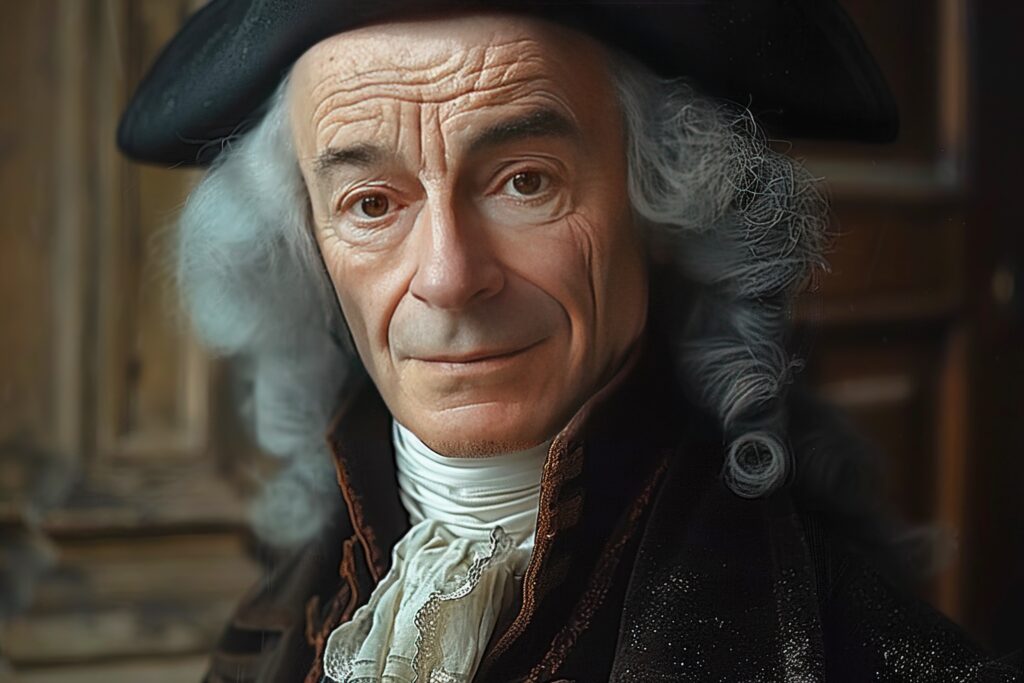
In 1762, Rousseau published Emile, or On Education, a book that was immediately banned, publicly burned, and got him chased out of France. Which, if you think about it, is quite a reaction to a parenting manual. But Rousseau was not writing a guide on how to get your toddler to sleep through the night. He was making an argument so radical it still unsettles people today: that the best thing you can do for a child is to stop doing so much.
The book follows the fictional Emile from infancy to adulthood, raised by a tutor who spends most of his time doing something unusual. He does almost nothing. He does not lecture. He does not hover. He does not rush in with answers. Instead, he arranges the world so that Emile discovers things on his own, stumbles into his own problems, and – here is the part that makes modern parents sweat – figures them out without help.
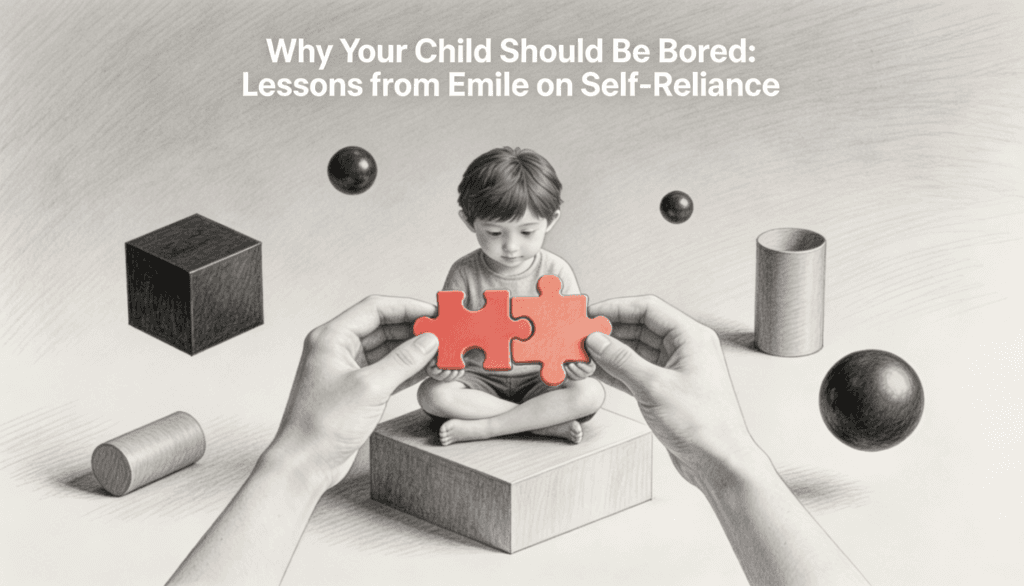
Boredom is not a flaw in this system. It is the engine.
The Productive Emptiness
Rousseau understood something that neuroscience would not confirm for another two centuries: an unstimulated mind does not shut down. It starts building. When a child has nothing handed to them, the brain does not go dark. It lights up. It begins generating. It asks questions no one prompted. It invents games out of sticks and mud. It wanders into curiosity the way water finds cracks in pavement.
This is not romantic nostalgia for some barefoot childhood that never existed. This is a description of what actually happens when you remove constant stimulation. The mind, left to itself, becomes resourceful. It has no choice. And that resourcefulness is the foundation of what Rousseau called natural education – the kind that does not come from books or instructions but from direct engagement with the world.
In Emile, Rousseau makes a distinction that most of us have completely forgotten. There is a difference between being educated and being taught. Teaching is something done to a child. Education, real education, is something that happens within them. And it cannot happen if every moment is pre-filled, pre-structured, and pre-approved by an adult who is terrified of silence.
Think of it this way. A child who is always given answers becomes good at receiving. A child who is left to find answers becomes good at searching. These are not the same skill. One produces a competent follower. The other produces a thinker.
Why We Cannot Stop Filling the Void
So if boredom is so productive, why do we treat it like a disease?
Part of the answer is economic. There is an enormous industry built on the premise that children must be constantly engaged. Apps, classes, enrichment programs, educational toys that claim to boost cognitive development while doing little more than making noise. The market for children’s entertainment does not profit from a kid staring at clouds. It profits from parents who feel guilty when their kid stares at clouds.
But the deeper answer is psychological, and Rousseau nailed it without ever using the term. We project our own discomfort onto our children. Adults in modern life have largely lost the ability to sit with emptiness. We reach for our phones the moment a line is too long or a conversation pauses. We have trained ourselves to interpret stillness as waste. And so when we see a child doing nothing, we do not see possibility. We see failure. Ours.
Rousseau argued that adults corrupt children not through malice but through anxiety. We rush to fill the void because we cannot tolerate it ourselves. We schedule every hour because unscheduled time feels like negligence. We answer every question immediately because we confuse speed with quality. And in doing so, we rob children of the one experience that would actually make them stronger: the experience of not knowing what to do and having to invent the answer.
There is a strange irony here. The generation that talks most about resilience is also the generation most committed to ensuring children never need to use it.
Rousseau’s Tutor Does Less, Achieves More
The tutor in Emile is one of the most counterintuitive figures in the history of educational thought. He is deeply invested in the child’s development. He thinks about it constantly. He plans meticulously. And yet his primary strategy is restraint. He holds back. He watches. He lets Emile fail.
When Emile breaks something, the tutor does not replace it. When Emile wants something he cannot have, the tutor does not explain why in a long, patient monologue. He simply lets the wanting sit there, unresolved, until Emile either finds a way to get it himself or learns to live without it. There are no gold stars. There are no time-outs. There are consequences, and they come not from the tutor but from reality itself.
This is what Rousseau called “negative education.” The phrase sounds wrong, almost negligent. But the idea is precise. Instead of filling a child with information and rules, you remove the obstacles that prevent them from learning on their own. You do not teach them that fire is hot. You let them get close enough to feel the heat. Not close enough to be burned. But close enough to understand something no lecture could deliver.
The distinction matters because it changes what education is for. In the conventional model, education is about accumulation. The child is an empty container, and the adult’s job is to fill it. In Rousseau’s model, the child is already full – full of instinct, curiosity, and natural intelligence. The adult’s job is to stop getting in the way.
The Muscle That Atrophies
There is a concept in exercise science called the principle of disuse. If you do not use a muscle, it weakens. Not overnight, but steadily, reliably, until what was once capable becomes fragile. The same thing happens with self-reliance.
Every time a parent solves a problem a child could have solved, the muscle weakens slightly. Every time a screen fills a gap that imagination could have filled, the muscle weakens slightly. Every time boredom is treated as an emergency and eliminated on contact, the child loses a small opportunity to exercise the one capacity that will matter more than any other in adult life: the ability to generate motivation from within.
Rousseau did not use the language of muscle atrophy, but his argument runs along the same lines. He believed that dependence – on others, on entertainment, on external validation – was the root of most human misery. Not because other people are bad, but because relying on them for your sense of purpose is fragile. Other people leave. Entertainment gets stale. Validation is fickle. But the person who has learned to sit with emptiness and build something from it is operating from a source that does not run dry.
This is not an argument against community or connection. Rousseau valued both. It is an argument about sequence. First, the child must become a self. Then that self can meaningfully connect with others. You cannot share what you have not built. And you cannot build what you have never been left alone long enough to discover.
The Uncomfortable Comparison
Here is where things get awkward. Consider what we actually know about highly creative people. Research on creative achievement consistently points to one childhood factor that shows up again and again: unstructured time. Not music lessons. Not coding camps. Not curated educational experiences. Just time. Open, empty, sometimes boring time in which the child had no choice but to entertain themselves.
The biographies of inventors, writers, scientists, and artists are littered with the same detail. Long afternoons with nothing to do. Wandering. Tinkering. Daydreaming that adults dismissed as laziness but that was, in fact, the mind rehearsing possibilities. Einstein did not discover relativity because someone gave him a worksheet on physics. He spent years turning ideas over in his head, alone, unbothered, with no one telling him to do something more productive.
Rousseau could not have known the research, but he grasped the principle. A mind that is always fed never learns to hunt. And a mind that never learns to hunt will always be dependent on whoever is doing the feeding.
This does not mean you should lock your child in an empty room and wait for genius to emerge. That is neglect, and Rousseau was not advocating for neglect. He was advocating for trust. Trust that the child is capable. Trust that boredom is not dangerous. Trust that the discomfort of having nothing to do is not a crisis but a doorway.
The Part Nobody Wants to Hear
Here is the real challenge of Rousseau’s argument, and the reason it still meets resistance. It is not actually about the child. It is about the parent.
Letting a child be bored requires the parent to tolerate something deeply uncomfortable: the feeling of not helping. In a culture that measures parental worth by how much you do for your child, doing less feels like a moral failure. Stepping back feels like stepping away. And so parents keep intervening, keep scheduling, keep filling – not because the child needs it, but because the parent needs to feel needed.
Rousseau saw this clearly. He warned that the greatest danger to a child’s education was not ignorance or poverty or even cruelty. It was the well-meaning adult who could not stop meddling. The parent who answers before the child has finished wondering. The teacher who corrects before the student has finished trying. The caregiver who removes every discomfort before the child has learned that discomfort is survivable.
What Boredom Actually Teaches
Strip away the philosophy and the history and the arguments, and what you are left with is a simple observation. A child who experiences boredom regularly learns several things that no curriculum can teach.
They learn that discomfort is temporary. That not every moment needs to be pleasant to be valuable. That they are capable of generating their own engagement with the world. That silence is not emptiness but space. That they do not need permission to be interested in something. That the answer to “what should I do” can come from inside rather than from an adult, a screen, or a schedule.
These are not small lessons. These are the foundations of autonomy, creativity, and emotional resilience. And they are available for free, without an app, without a class, without a subscription. All they require is something most of us find almost impossible to give.
Nothing.
A Gentle Suggestion, 264 Years Old
Rousseau was not a perfect man. He abandoned his own children to foundling homes, a fact that makes his parenting advice land with a certain dark comedy. But the ideas in Emile have outlived every criticism of their author for a reason. They describe something true about how children develop. Something that does not depend on century, culture, or technology.
Children grow strongest in the space between stimulation and boredom. Not in the stimulation itself. Not in the boredom itself. But in the crossing. In the moment when the mind, finding nothing given to it, begins to generate on its own. That crossing is where self-reliance is born. It is where creativity lives. It is where the child stops being a consumer of experience and starts becoming an author of it.
You do not need to read all five books of Emile to apply this. You just need to do something that will feel, at first, like the hardest thing in the world.
The next time your child says, “I have nothing to do,” try not saying anything at all. Sit with the silence. Let it stretch. Watch what happens.
Rousseau would bet on the child. And 264 years later, the evidence suggests he was right.