Table of Contents
There is a peculiar moment in every argument when you realize you are wrong. It arrives quietly, like a guest you did not invite. Your stomach tightens. Your brain, that magnificent organ you trust to keep you alive, does something remarkable: it pretends the moment never happened. You keep arguing. You argue harder. You would rather lose a friend than lose the point.
Dan Ariely has spent decades studying this exact phenomenon. The behavioral economist, famous for his work on irrationality, has shown repeatedly that humans do not process facts the way we think we do. We do not weigh evidence, update our beliefs, and move forward like rational creatures navigating reality. Instead, we treat facts like uninvited guests at a dinner party. If they agree with us, they get the best seat. If they do not, we pretend they never showed up.
This is not a flaw in a few stubborn people. This is the operating system.
The Cost of Being Right
Consider what it actually costs to admit you are wrong about something. Not in some abstract philosophical sense, but in the immediate, visceral, social reality of a Tuesday afternoon argument with your neighbor about property lines or politics or whether the school board is making the right call.
When you concede a point, you are not just updating a spreadsheet of beliefs. You are performing a social act. You are telling everyone watching, including yourself, that your judgment failed. That the version of you who held that belief was, in some meaningful way, deficient. Ariely’s research suggests that this is not a minor inconvenience for the human brain. It is an existential threat.
The brain treats beliefs the way the immune system treats pathogens. Anything foreign gets attacked. Anything that belongs gets protected. It does not matter if the foreign object is a virus or a verifiable truth. If it threatens the existing system, the defenses go up.
This is why you can show someone a peer reviewed study, a photograph, a signed confession, and watch them dig in deeper. The evidence is not the problem. The evidence was never the problem. The problem is what accepting the evidence would mean about who they are.
Ariely’s Mirror
Ariely’s work, particularly in books like Predictably Irrational and The Honest Truth About Dishonesty, reveals something both obvious and deeply uncomfortable. We are not occasionally irrational. We are systematically irrational. And the systems that drive our irrationality are not random. They are predictable, consistent, and remarkably resistant to correction.
One of his most cited findings involves what he calls the “IKEA effect.” People value things more when they have built them, even if the result is objectively terrible. A wobbly bookshelf you assembled yourself feels more valuable than a perfect one someone else built. This applies to furniture. It applies with devastating force to beliefs.
When you construct a belief, when you build it from your experiences, your social group, your identity, you do not hold it lightly. You built that thing. You sweated over it. The fact that it leans slightly to the left and cannot support the weight of actual evidence is beside the point. It is yours.
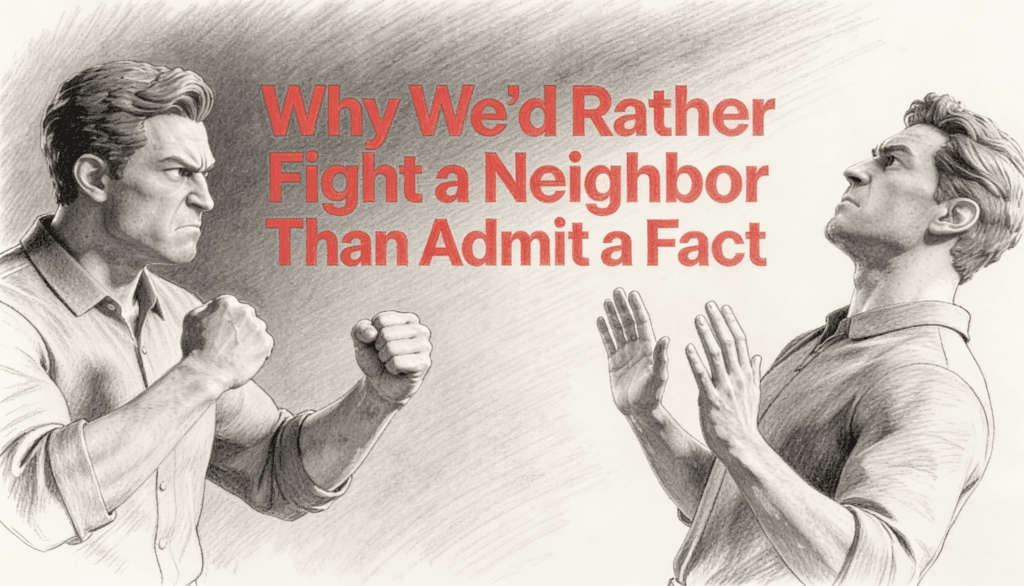
This is why arguments between neighbors escalate faster than arguments between strangers. The neighbor is not just challenging your opinion. They are challenging something you built in the context of your shared community. They are telling you that the bookshelf you are so proud of is garbage. And they are doing it from their yard, which you have to look at every single day.
The Identity Tax
There is a concept in psychology called identity protective cognition. It was formalized by Dan Kahan at Yale, but it runs directly through Ariely’s work on motivated reasoning. The idea is straightforward and brutal: people do not process information to find the truth. They process information to protect their identity.
This means that the smarter you are, the worse the problem gets. Intelligent people are not better at evaluating evidence. They are better at constructing sophisticated arguments for why the evidence does not apply to them. Give a sharp mind a threatening fact, and it will not surrender. It will build a fortress.
In experiments where people were presented with data that contradicted their political beliefs, the subjects who scored highest on numeracy tests were actually the worst at interpreting the data correctly, but only when the data threatened their political identity. When the same data was presented in a politically neutral frame, the smart people performed exactly as you would expect. They read the numbers, drew the right conclusions, and moved on.
The implication is staggering. Intelligence is not a defense against bias. It is a weapon in its service.
Why the Neighbor Gets It Worse
Here is where the social dimension turns everything up to eleven. Ariely’s research on social norms versus market norms helps explain why disputes between neighbors are uniquely vicious.
In market relationships, the rules are clear. You pay, you receive. If the product is bad, you return it. There is no emotional residue. But neighborly relationships operate on social norms. They run on reciprocity, trust, and the unspoken agreement that we will all pretend to be reasonable people living reasonable lives.
When a factual disagreement enters this space, it does not behave like a market transaction. It behaves like a betrayal. Your neighbor is not just saying you are wrong about when trash day is. They are violating the social contract. They are introducing market logic, the cold logic of facts and correctness, into a space that was supposed to run on warmth and mutual tolerance.
This is why people will spend thousands of dollars on property line disputes that involve inches of land worth almost nothing. The land is not the point. The principle is not the point, despite what everyone claims. The point is that someone in your social world told you that you were wrong, and your brain has classified this as an act of war.
The Emotional Accounting
Ariely’s work on emotional accounting shows that humans keep mental ledgers that have nothing to do with reality. We track fairness, reciprocity, and respect on internal spreadsheets that would make an actual accountant to learn a thing or two.
When someone presents you with a fact that contradicts your position, your brain does not record it as “new information received.” It records it as a debit in the respect column. Someone just withdrew from your account. And now you need to balance the books.
This is why people respond to factual corrections with personal attacks. It looks irrational from the outside, but it is perfectly rational within the brain’s accounting system. You took something from me (my sense of being right), so now I need to take something from you (your sense of being a decent person). The ledger must balance.
This also explains a pattern anyone who has used social media will recognize. The intensity of an argument is almost never proportional to the importance of the topic. People will fight to the death over things that affect their lives not at all. Because the fight was never about the topic. It was about the ledger.
A Strange Parallel in Economics
There is an interesting connection here to the sunk cost fallacy, which is usually discussed in the context of business decisions but maps perfectly onto belief persistence. The sunk cost fallacy says that people continue investing in failing projects because they cannot bear to write off what they have already spent.
Beliefs work the same way. The longer you have held a position, the more you have invested in it. You have argued for it. You have selected friends who share it. You have maybe voted based on it, raised children around it, organized your understanding of the world to accommodate it. Admitting it is wrong does not just mean updating one line in your mental database. It means writing off years of investment. It means every argument you won based on that belief was not actually a win. It means the bookshelf was always wobbly.
What Actually Works
If the picture seems bleak, it is because the picture is bleak. But Ariely’s work does point toward some interventions, though none of them are as satisfying as we might hope.
First, the most effective way to change someone’s mind is to make the new belief feel like it was their idea. This sounds manipulative because it is, mildly. But it works because it sidesteps the identity threat. If you are not losing a belief but discovering one, the brain does not trigger its defenses.
Second, reducing the social stakes helps enormously. Arguments in private are more productive than arguments in public. When there is no audience, there is no performance. The ledger has fewer entries. People can afford to concede because the cost of concession drops when nobody is watching.
Third, and this is Ariely’s most underappreciated insight, the frame matters more than the facts. The same piece of evidence, presented as a threat to your identity, will be rejected. Presented as a tool to help you achieve your goals, it will be embraced. People do not resist truth. They resist humiliation.
So why do we fight the neighbor instead of admitting the fact? Because the neighbor is right there. Because the fact threatens our identity and the neighbor threatens our standing. Because our brains evolved to manage social hierarchies, not to pursue abstract truth. Because being right feels like survival, and being wrong feels like death, even when the stakes are a fence that is four inches over the property line.
Ariely’s work does not offer a cure for this. Nobody’s work does. What it offers is a diagnosis. And diagnoses are valuable because they change the question. Instead of asking “why is this person so stubborn?” you start asking “what is this person protecting?” Instead of presenting more evidence, louder, you start asking what it would cost them to accept it.
The most important fact about facts is that they are almost never the issue. The issue is what accepting them would require us to become. And becoming someone new, even someone better, even someone right, is a price most people are not willing to pay.
At least not when the neighbor is watching.