Table of Contents
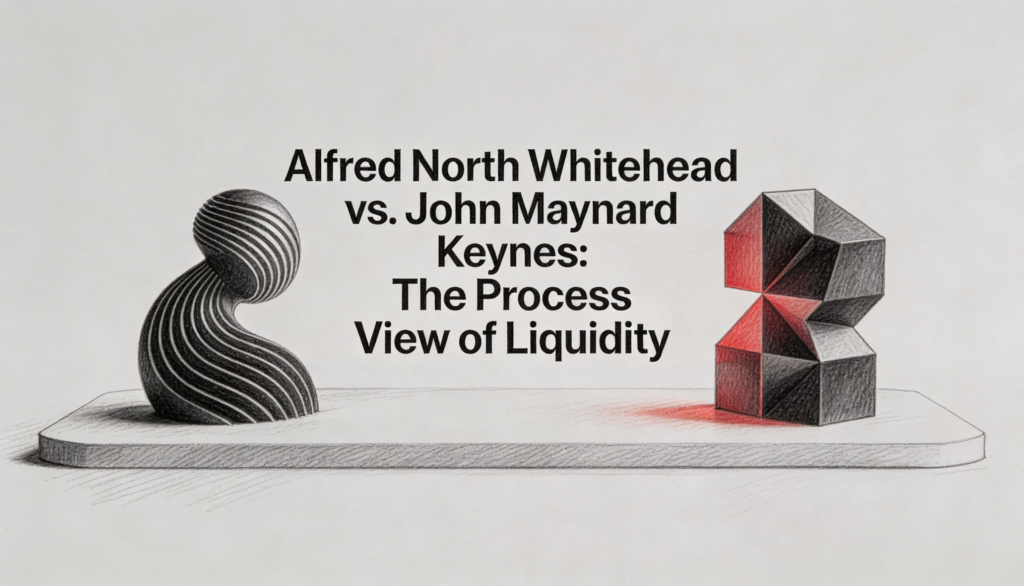
Most people think of liquidity as a simple idea. You either have cash or you do not. Your assets either sell quickly or they sit there gathering dust. But two of the twentieth century’s sharpest minds saw something far stranger lurking inside this concept. One was a mathematician turned philosopher. The other was an economist who reshaped how governments think about money. And the strange part is that they were colleagues at Cambridge, walking the same halls, breathing the same intellectual air, yet arriving at overlapping insights from completely different directions.
Alfred North Whitehead never wrote a treatise on finance. John Maynard Keynes never published a systematic metaphysics. But when you place their ideas side by side, something clicks. Liquidity stops being a dry financial term and starts looking like a window into how reality itself behaves.
The Philosopher Who Saw Everything as Process
Whitehead had one of those careers that makes everyone else feel like an underachiever. He co-authored Principia Mathematica with Bertrand Russell, one of the most ambitious works in the history of logic. Then, apparently bored with having revolutionized one field, he moved to Harvard and reinvented metaphysics.
His big idea was process philosophy. The core claim is deceptively simple. Reality is not made of things. It is made of events. What we call objects, whether atoms or chairs or people, are actually patterns of activity that hold together for a while. Nothing just sits there being itself. Everything is always becoming.
This sounds abstract until you notice how often our ordinary language betrays us. We say “the river” as if it were a fixed object, when obviously it is water flowing. We say “the economy” as though it were a machine sitting in a room somewhere, when it is actually millions of decisions happening every second. Whitehead thought this confusion between static things and dynamic processes was the deepest error in Western philosophy. He even had a name for it: the fallacy of misplaced concreteness. We take something fluid and treat it as solid. Then we wonder why our predictions go wrong.
The Economist Who Saw Uncertainty Everywhere
Keynes, meanwhile, was wrestling with a different problem. Classical economics assumed that markets naturally find equilibrium. Supply meets demand, prices adjust, everything settles into a nice tidy balance. Keynes looked at the Great Depression and thought this was, to put it politely, nonsense.
His insight was that economic actors do not operate with complete information. They operate with radical uncertainty. Not the kind of uncertainty you can calculate with probability tables, but genuine not knowing. The future is not a set of risks you can price. It is a fog.
This matters because it changes what money means. In the classical view, money is just a medium of exchange. A neutral tool. You use it to buy things. In the Keynesian view, money is something else entirely. It is a hedge against the unknown. People hold cash not because they are irrational but because the future is genuinely unknowable, and cash gives you options. It keeps your choices open.
This is what Keynes called liquidity preference. And it is far more radical than it sounds.
Where the Two Ideas Collide
Here is where things get interesting. Whitehead says reality is process, not substance. Keynes says economic value is fluid, not fixed. Both are making the same structural argument in different languages.
Think about what liquidity actually means when you strip away the textbook definitions. A liquid asset is one that can become something else quickly. Cash can become a house, a stock, a meal, a plane ticket. It has not committed to being any particular thing yet. It is pure potential.
Now listen to Whitehead describing what he calls “actual occasions,” the basic units of reality in his philosophy. Each occasion is a moment of becoming that absorbs influences from the past and decides how to respond. Before the decision is made, multiple possibilities are alive. After the decision, they collapse into something definite.
Cash behaves exactly like a Whiteheadian actual occasion before it decides what to be. It is full of potential. The moment you spend it, you have made a decision. Potential collapses into actuality. The money becomes a specific thing, a car, an investment, a pair of shoes. And that decision is irreversible. You cannot unspend money without entering a new transaction, a new process.
Liquidity, in this light, is not a property of an asset. It is a measure of how much becoming is still available to it. How many futures it can still access.
The Paradox of Holding Nothing
This creates a genuinely counterintuitive situation. In classical economics, holding cash is wasteful. Money sitting in your pocket is not earning returns. It is not being productive. A rational actor should always be fully invested.
But Keynes understood something that classical economists missed. Sometimes the most rational thing you can do is nothing. Holding cash is not idleness. It is a strategic preservation of optionality. You are keeping your future selves free to act when circumstances change. And circumstances always change.
Whitehead would have appreciated this deeply. In process philosophy, premature determination is a kind of death. When an entity locks itself into a fixed form too early, it loses its capacity to respond to new information. It becomes rigid. And rigid things, in a world defined by flux, tend to break.
When Liquidity Becomes a Trap
Keynes also identified the dark side of this insight. If uncertainty becomes extreme enough, people hoard cash so aggressively that no amount of interest rate reduction can coax them into spending or investing.
Read through Whitehead, and the liquidity trap looks like a philosophical crisis, not just an economic one. It is what happens when the process of becoming stalls out. Potential refuses to actualize. Everyone is holding options, and nobody is exercising them. The system freezes, not because it lacks resources but because it lacks the confidence to commit.
This is a profoundly weird state of affairs. The economy is not broken in the way a machine breaks, with parts snapping and gears grinding. It is broken the way a person breaks when paralyzed by indecision. Everything is technically functional. The money exists. The workers exist. The factories exist. But the process of becoming, the willingness to convert potential into actuality, has seized up.
Central bankers since Keynes have spent decades trying to solve this problem with interest rate policy. Whitehead would probably have told them they were committing his favorite fallacy. They were treating the economy as a thing that could be adjusted rather than a process that needed to be encouraged. You do not fix a frozen river by adjusting its parts. You change the temperature.
The Role of Confidence
Both thinkers, in their different ways, point toward the same hidden variable: confidence. Or, to use a word Keynes made famous, animal spirits.
In Keynes, animal spirits are the irrational exuberance or despair that drives economic decisions beyond what any rational calculation would justify. Entrepreneurs do not start businesses because they have calculated the expected return to three decimal places. They start businesses because they feel like something is possible. That feeling is not a bug in the system. It is the engine.
Whitehead has his own version of this. He calls it creativity, the ultimate principle by which the many become one and are increased by one. Creativity is not a thing or a force. It is the basic fact that novelty happens. New combinations emerge. The universe does not just rearrange existing pieces. It generates genuinely new patterns.
Economic growth, seen through this dual lens, is not just about resources or technology or policy. It is about the willingness of a system to generate novelty. To try things. To convert liquid potential into concrete experiments. And that willingness is not something you can manufacture with spreadsheets.
What Wall Street Gets Wrong
Modern finance has an uncomfortable relationship with liquidity. On one hand, markets worship it. Liquid markets are efficient markets. Assets that trade easily are priced more accurately. The entire architecture of modern finance, from stock exchanges to derivatives markets, is designed to maximize liquidity.
On the other hand, the 2008 financial crisis demonstrated that liquidity is not a permanent feature of anything. It is a social phenomenon. It exists because people believe it exists. When confidence evaporated in 2008, assets that had been “liquid” for decades became impossible to sell at any price. Mortgage backed securities did not change their physical composition overnight. What changed was the collective willingness to trade them.
Whitehead would recognize this instantly. The fallacy of misplaced concreteness again. Wall Street treated liquidity as a fixed property of certain assets, like weight or color. But liquidity is relational. It depends on context, on other actors, on the state of the whole system. It is a process property, not a thing property.
Keynes saw this too, though he described it with his characteristic blend of precision and weariness. In the General Theory, he compared the stock market to a beauty contest where judges are not picking the most beautiful face but guessing which face other judges will pick. The value of a stock is not about the company. It is about what everyone believes everyone else believes about the company. It is beliefs all the way down.
Final Notes
Whitehead spent his later career arguing that the universe is fundamentally creative and that any philosophy which denies this creativity is lying about reality. Keynes spent his career arguing that economic actors face genuine uncertainty and that any economics which denies this uncertainty is lying about markets.
They were both right. And the fact that we keep building financial models that assume fixed properties and calculable risks suggests that we have not yet absorbed the lesson. Liquidity is process. Value is process. The economy is process. And process, by its very nature, does not sit still long enough to be pinned down by equations.
The best we can do is pay attention, stay flexible, and resist the urge to mistake our models for reality. Which, if you think about it, is pretty good advice for everything else in life too.