Table of Contents
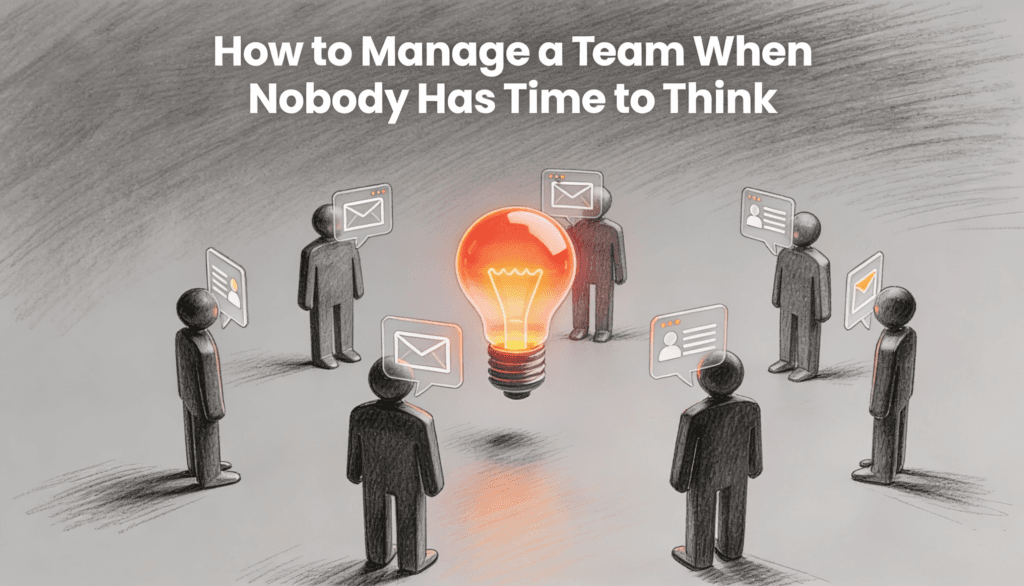
Here is something strange about modern work. We have more tools than ever to save time, and yet nobody has any. Your team is drowning in Slack messages, sprint reviews, status updates, and “quick syncs” that are never quick. Everyone is busy. Nobody is thinking.
Herbert Simon saw this coming. He was an economist, a political scientist, a cognitive psychologist, and one of the few people to win a Nobel Prize while also making foundational contributions to artificial intelligence. The man did not specialize. He thought across boundaries, which is exactly why he noticed something that specialists kept missing.
He said that a wealth of information creates a poverty of attention. Read that again. It was not a throwaway line in some forgettable paper. It was a diagnosis of a disease that had not yet fully arrived. Simon was describing your Monday morning before your Monday morning existed.
If you manage a team today, you are not really managing people. You are managing their attention. And you are probably doing it badly. Not because you are incompetent, but because almost everything about how organizations operate is designed to shatter attention into pieces too small to be useful.
The Bottleneck Is Not Talent. It Is Attention.
Most managers think their job is to allocate tasks. Assign the right work to the right people, monitor progress, remove blockers, repeat. This is the assembly line theory of management, and it made sense when the work itself was mechanical. But knowledge work is not mechanical. It requires sustained thought, and sustained thought requires something that has become almost impossibly scarce: uninterrupted time.
Simon understood decision making better than almost anyone in the twentieth century. His concept of bounded rationality changed how economists think about human behavior. The basic idea is that people do not optimize. They cannot. The world is too complex, information is too abundant, and cognitive resources are too limited. So instead of finding the best possible option, people find one that is good enough. Simon called this “satisficing,” a word he invented by combining satisfy and suffice.
Now apply this to your team. Every person on your team is satisficing all day long. They are not producing their best work. They are producing work that clears the bar just enough to move on to the next demand. It is a rational response to an irrational environment. When you have fourteen things competing for your attention, you do not give any of them the deep focus they deserve. You give each one just enough to survive.
The uncomfortable implication for managers is this: adding more tasks to someone’s plate does not just reduce the quality of the new task. It reduces the quality of everything else they are already doing. Attention is not a bucket you fill. It is a lens you focus. And you cannot focus a lens on fourteen things at once.
Why Your “Open Door Policy” Is Part of the Problem
There is a beloved management cliché that goes something like this: “My door is always open.” It sounds generous. Collaborative. Human. It is also a disaster for deep work.
When your door is always open, you are telling your team that interruption is not just acceptable but encouraged. You are creating an environment where the cost of asking a question is nearly zero for the person asking, and enormously high for the person being asked. Every interruption forces a context switch.
Multiply that across a team of eight people in an open office with a chat tool that pings every forty seconds, and you begin to see the scale of the problem. Your team is spending the majority of its cognitive energy not on the work itself but on recovering from interruptions to the work.
Simon would have recognized this immediately. He wrote extensively about the architecture of complexity, about how complex systems are built from stable subsystems. An organization full of constant interruptions has no stable subsystems. It is just noise all the way down.
The Counterintuitive Move: Less Communication, Better Outcomes
Here is where things get uncomfortable. The standard management advice of the last two decades has been to increase communication. More standups. More check ins. More transparency. More alignment meetings. The theory is that communication prevents misunderstanding, and misunderstanding is expensive.
This is true up to a point. Beyond that point, communication becomes the thing that prevents work from getting done. And most teams blew past that point years ago.
Simon’s framework suggests a different approach. Instead of maximizing information flow, you should be optimizing for attention allocation. The question is not “does my team have enough information?” The question is “does my team have enough uninterrupted time to actually use the information they already have?”
This means doing things that feel wrong. It means canceling meetings that seem important. It means not responding to messages immediately and not expecting others to either. It means creating blocks of time where nobody is allowed to contact anyone else for anything short of an actual emergency. It means trusting people to work without being watched.
For many managers, this feels like losing control. And that is exactly the point. The illusion of control that comes from constant communication is just that. An illusion. Your team is not more productive because you can see what they are doing at every moment. They are less productive, because they know you are watching.
Satisficing as a Management Strategy
Here is where Simon’s ideas get really interesting for team leadership. Most managers try to push their teams toward optimal outcomes. The best possible product. The most elegant solution. The perfect strategy. Simon would argue that this is not just unrealistic but actively harmful.
When you demand perfection from people who do not have the cognitive bandwidth to deliver it, you get one of two results. Either they burn out trying, or they quietly lower their standards anyway but feel guilty about it. Neither outcome is good.
A better approach is to embrace satisficing deliberately. This does not mean accepting sloppy work. It means being honest about which decisions truly matter and which ones do not. It means telling your team, explicitly, that some things deserve deep thought and other things deserve a quick decision that is good enough.
The practical application looks like this. For any given project, identify the two or three decisions that will have lasting consequences. These are the decisions that deserve real attention, deep analysis, and protected time. Everything else should be decided quickly and without agonizing. The color of the button on the landing page does not need a committee. The architecture of the database probably does.
This is, in a sense, the opposite of what most management frameworks teach. Most frameworks treat all decisions as equally important, which means all decisions get the same inadequate slice of attention. Simon’s insight is that intelligent resource allocation, giving disproportionate attention to the things that matter most, is the only way to produce genuinely good outcomes under real world constraints.
What Chess Can Teach You About Team Management
Expert chess players do not evaluate more possible moves than beginners. They evaluate fewer. Their expertise allows them to instantly recognize patterns and ignore irrelevant options. They are not thinking harder. They are thinking less, but about the right things.
This is a powerful analogy for management. The best managers are not the ones who think about everything. They are the ones who have developed the judgment to know what deserves their attention and what does not. They have pattern recognition for organizational problems, and they use it to filter out noise before it ever reaches their conscious analysis.
You can build this kind of pattern recognition on your team too. It starts with creating shared frameworks for decision making. When everyone on the team understands which kinds of decisions can be made independently, which ones need consultation, and which ones need full team input, you eliminate an enormous amount of unnecessary communication. People stop asking permission for things that do not need permission. They stop escalating decisions that do not need escalation. The cognitive load drops, and suddenly there is room to think.
The Meeting Paradox
There is a paradox at the heart of organizational life that Simon’s work helps explain. Meetings exist to facilitate collective thinking. But the more meetings you have, the less time anyone has to do the individual thinking that makes collective thinking valuable.
You have probably experienced this. You walk into a meeting where a decision needs to be made. Nobody has had time to prepare because they were in other meetings all morning. So the group spends forty five minutes thinking out loud about something that one person could have resolved in twenty minutes of focused solo work. The meeting does not produce a decision. It produces another meeting.
The solution is not to eliminate meetings. It is to treat them as an expensive resource rather than a free one. Every meeting has a cost that is calculated by multiplying the number of attendees by the duration by their effective hourly rate, and then adding the opportunity cost of the deep work they could have been doing instead. When you do this math honestly, most recurring meetings are revealed to be spectacularly wasteful.
Simon understood that organizations develop routines and habits just like individuals do. Meetings become habits. Nobody questions why they exist because they have always existed. Breaking this pattern requires someone to ask the uncomfortable question: what would happen if we just stopped doing this? The answer, more often than managers expect, is nothing bad.
What to Actually Do About This
So what does Simon inspired management look like in practice? It is simpler than you might expect, though not easy.
First, audit your team’s attention. Track how much uninterrupted time each person gets in a typical week. If the answer is less than four hours a day, you have a structural problem that no amount of motivation or talent can fix.
Second, rank your team’s work by consequentiality. Identify the small number of tasks and decisions where quality truly matters, and protect those ferociously. Everything else gets satisficed.
Third, make interruptions expensive. Not financially, but socially. Create norms where interrupting someone’s focused work requires a real justification, not just convenience. Batch questions. Use asynchronous communication as the default, not the exception.
Fourth, cut meetings ruthlessly. Keep only the ones that produce decisions which could not have been made any other way. For the rest, a shared document and thirty minutes of individual reading will accomplish more than an hour of group discussion.
Fifth, and this is the hardest one, resist the urge to monitor. Trust that if you have given people the right priorities, the right information, and the right environment, they will do good work without you watching. Simon showed that humans are remarkably effective decision makers when you give them the right constraints. Your job is to set those constraints, not to hover.
The Wealth That Costs You Everything
Simon’s observation about information wealth and attention poverty is more relevant now than when he first made it over fifty years ago. The information has gotten wealthier. The attention has gotten poorer. And most organizations have responded by pouring more information into systems that were already overflowing.
Managing a team when nobody has time to think is not a problem you solve with better tools or more processes. It is a problem you solve by doing less. By protecting the scarcest resource your team has. By being the person who says no, not yet, and not everything at once.
That is not a popular message in a business culture obsessed with speed and output and doing more with less. But Herbert Simon did not become one of the most influential thinkers of the twentieth century by telling people what they wanted to hear. He told them what was true. And the truth is that your team does not need more information, more meetings, or more management.
They need time to think. Give it to them.