Table of Contents
Everyone has a theory about why divorce rates climbed so dramatically in the second half of the twentieth century. The usual suspects get rounded up every time: declining moral values, the sexual revolution, secularism, feminism, social media, dating apps. Pick your villain. The story practically writes itself, and it always ends with a nostalgic sigh about how people just do not commit like they used to.
But what if the real explanation has almost nothing to do with commitment? What if people in the 1950s were not more virtuous, just more trapped? And what if the rise in divorce is not a sign of moral decay but a perfectly rational response to a world where the economic math of marriage changed?
That is the argument Gary Becker made. And it is one of the most uncomfortable, clarifying ideas in modern social science.
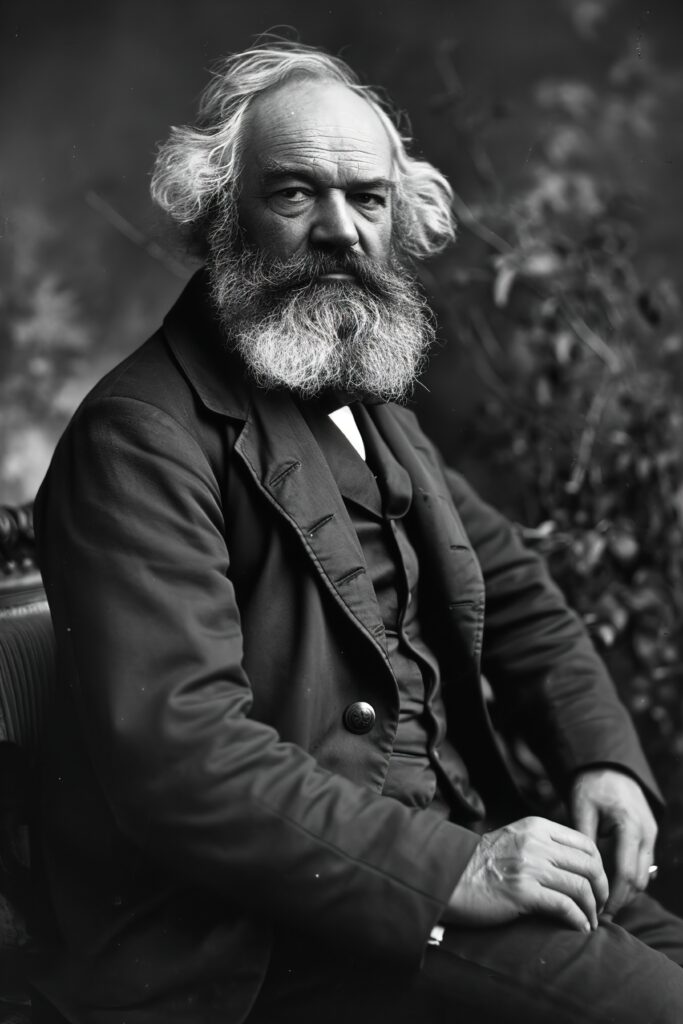
Becker was an economist at the University of Chicago who did something that made his colleagues in sociology and psychology deeply uneasy. He applied the tools of economics – supply, demand, cost, benefit, incentive – to the most intimate corners of human life. Marriage. Children. Discrimination. Crime. He won the Nobel Prize in 1992 for this work, and to this day, people are still not sure whether to thank him or resent him for it.
His core insight about marriage was deceptively simple. People marry when the expected gains from marriage exceed the expected gains from staying single. And they divorce when that calculation flips.
No sermons. No guilt. Just math.
Marriage as a Firm
To understand Becker’s argument, you have to first understand how he saw marriage. Not as a sacred covenant. Not as a romantic union. As a production partnership.
This sounds cold. It is meant to. Becker was not saying that love does not matter. He was saying that love alone does not explain the patterns. If love were the primary driver, divorce rates would be roughly constant across time and place. People have always fallen in and out of love. What changed was not the human heart. What changed was the economy.
In Becker’s framework, marriage is essentially a small firm where two people pool resources to produce things neither could produce as efficiently alone. Those “goods” include children, household services, companionship, risk sharing, and what economists politely call “household production.” When you specialize – one partner in market work, the other in domestic work – you create what economists call gains from trade. The same principle that makes international commerce work between nations also makes marriage work between two people.
Here is where the story gets interesting. The gains from this specialization depend on how different the two partners are in their economic roles. When one person has a strong advantage in earning income and the other has a strong advantage in managing the household, the surplus from pairing up is large. Marriage, in economic terms, is a great deal.
But when both partners have similar earning capacity and similar domestic skills, the surplus shrinks. The deal is less compelling. You can do most of it yourself.
This is not a theory about what marriage should be. It is a theory about what makes marriage stable. And it predicts, with uncomfortable accuracy, exactly what happened in the second half of the twentieth century.
The Disappearing Surplus
The most important economic fact of the last seventy years, from the perspective of marriage, is the dramatic rise in women’s labor force participation and earning power.
In 1950, about a third of American women were in the workforce. By 2000, it was over sixty percent. Women gained access to higher education, professional careers, and independent income at a pace that would have been unthinkable a generation earlier. This was, by any reasonable measure, a triumph of justice and human potential.
It also quietly dismantled the economic logic of traditional marriage.
When women could earn their own income, the gains from specialization within marriage declined. A woman with a law degree and a six figure salary does not need a husband to provide financial security. A man who can cook, clean, and manage a household does not need a wife to handle domestic production. The mutual dependency that once made marriage an economic near necessity softened into something more like a preference.
Becker’s model predicts that as the gains from specialization fall, the marriage rate should decline and the divorce rate should rise. Both happened, almost exactly on schedule. It is the kind of prediction that makes a theory hard to ignore, even if you find it philosophically distasteful.
The critics, of course, arrived on time. Many pointed out that Becker’s model seemed to imply that gender equality was bad for marriage. Becker himself was careful to avoid that normative leap. He was describing a mechanism, not prescribing a social order. The fact that equality reduced the economic surplus of marriage did not mean equality was wrong. It meant that marriage had to find new sources of value – and that the old model, built on rigid specialization, was not coming back.
The Exit Cost Revolution
But the declining surplus is only half the story. Becker also understood that marriage stability depends not just on the gains from staying married but on the costs of leaving.
Think of it like a job. You might be mildly dissatisfied with your position, but if quitting means financial ruin, social ostracism, and losing custody of your children, you stay. The “exit costs” keep you in the arrangement even when the arrangement is not great. This is not loyalty. It is arithmetic.
For most of human history, the exit costs of marriage were enormous, especially for women. A divorced woman in 1920 faced financial catastrophe, social stigma, and often the loss of her children. Divorce was not just emotionally painful. It was economically suicidal. So women stayed in bad marriages, and society congratulated itself on its strong family values.
What changed? Almost everything.
No fault divorce laws, beginning with California in 1969 and spreading across the country, reduced the legal costs of divorce. Women’s rising incomes reduced the financial costs. Shifting social norms reduced the stigma costs. The welfare state and social safety nets provided a floor that had not existed before. Each of these changes, individually, nudged the exit costs downward. Together, they transformed the landscape.
Becker’s framework makes this brutally clear. The marriages that survived in earlier eras were not necessarily better marriages. They were marriages where leaving was too expensive. When you lower the price of exit, people exit. This is not moral failure. It is the same thing that happens when you lower the price of anything.
There is a parallel here to what happened in the labor market during the same period. Economists have long studied how “switching costs” affect worker behavior. When it is difficult and expensive to change jobs – because of pensions, seniority systems, or lack of alternatives – turnover is low. When those barriers fall, turnover rises. Nobody calls this a decline in work ethic. They call it labor market flexibility. But when the same dynamic plays out in marriage, suddenly it is a crisis of values.
The inconsistency is revealing.
The Children Calculation
Becker’s analysis of children within marriage is perhaps his most provocative contribution. He treated the decision to have children as an investment decision. Parents invest time, money, and emotional energy in children, and they receive returns in the form of satisfaction, social status, and (in some societies) old age support.
This framework explains something that baffles traditionalists. As marriage became less stable, people had fewer children. The standard narrative blames selfishness or materialism. Becker’s explanation is more mechanical. Children are what economists call “marriage specific capital.” Like a factory built to serve a single client, children have enormous value within the marriage but create enormous complications outside it. They tie you to your partner long after the romantic connection fades. They make divorce messier, more expensive, and more painful.
When people sense – even unconsciously – that marriage is less stable, they invest less in marriage specific capital. They have fewer children, or they have them later. This is not selfishness. It is risk management. You do not build a factory for a client who might cancel the contract.
The data supports this almost too neatly. Countries with higher divorce rates tend to have lower birth rates. Regions with more economic uncertainty tend to see delayed marriage and delayed childbearing. People are not abandoning family values. They are responding to incentives, just as Becker said they would.
What the Critics Get Wrong (and Right)
The most common objection to Becker’s framework is that it reduces love to a transaction. This misses the point in a way that is almost impressive. Becker never denied that love exists or that it matters. He argued that love is not a sufficient explanation for marriage patterns at the population level. Millions of people fall in love every year. Whether they marry, stay married, or divorce depends on the institutional and economic context around them.
A more serious critique comes from sociologists who argue that Becker overweights economic factors and underweights cultural ones. There is something to this. The rise of individualism, the emphasis on personal fulfillment, the therapeutic culture that encourages people to leave relationships that do not serve their growth – these are real forces. But notice something curious. These cultural shifts themselves can be explained, at least partly, through Becker’s lens. When the economic costs of independence fall, cultures tend to develop ideologies that celebrate independence. The ideas follow the incentives, not the other way around.
This is the kind of argument that makes humanists uncomfortable. It suggests that our most cherished beliefs about freedom and self expression are not purely the products of philosophical enlightenment but are partly downstream of economic conditions. It does not make those beliefs wrong. It just makes their origins less flattering.
The Modern Marriage Market
If Becker were analyzing marriage today, he would likely point to several trends that his framework illuminates.
First, the rise of assortative mating. High earning people increasingly marry other high earning people. In Becker’s model, this makes sense. When the gains from specialization are low, people seek partners who are similar to themselves. They are not looking for someone to fill a complementary role. They are looking for someone who matches their lifestyle, values, and ambitions. Marriage shifts from a production partnership to a consumption partnership. You do not marry someone because together you can produce more. You marry someone because together you can enjoy more.
Second, the growing marriage gap between classes. Wealthy, educated people still marry at high rates and divorce at relatively low rates. Lower income people marry less and divorce more. This is the opposite of what you would expect if marriage were purely about values, since religious observance and stated commitment to traditional family structures are often higher in lower income communities. But it is exactly what Becker’s model predicts. Wealthier couples have more surplus to share. They have more to lose from divorce. The institution works better when there is more on the table.
Third, the paradox of choice in modern dating. With dating apps offering what feels like infinite options, the search costs of finding a partner have plummeted. But Becker would note that lower search costs also mean lower commitment to any particular match. When you can always find someone else, the incentive to invest deeply in the current relationship weakens. This is the same paradox that behavioral economists have documented in consumer markets. More options sometimes lead to less satisfaction, not more.
The Uncomfortable Truth
The hardest part of Becker’s analysis is not the math. It is the implication.
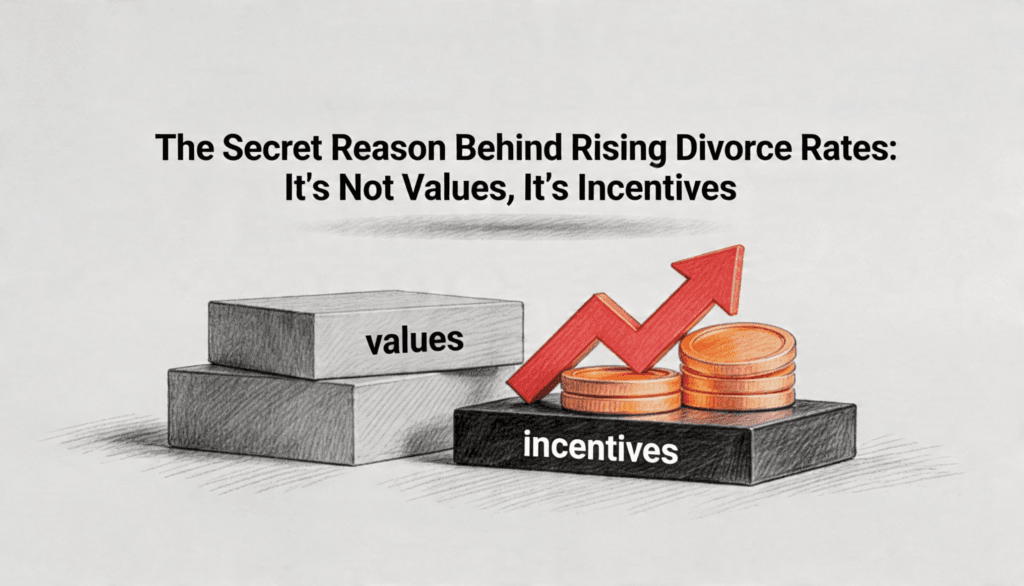
If divorce is driven primarily by incentives rather than values, then moralizing about it is mostly useless. You can preach commitment from every pulpit in the country, and it will not change the divorce rate if the underlying economics continue to push in the other direction. This does not mean values are irrelevant. It means they are weaker than we like to believe.
It also means that the “golden age” of marriage was not golden for the reasons people think. Low divorce rates in the 1950s reflected not superior virtue but limited options, especially for women. Celebrating that era as a model of family stability is a bit like celebrating low employee turnover in a company town where the factory is the only employer. The numbers look great until you ask whether anyone actually wanted to be there.
Becker’s work does not tell us what marriage should be. It tells us why marriage is what it is. The difference matters. If you want to strengthen marriage as an institution, his framework suggests that sermons about commitment are less effective than policies that increase the gains from partnership. Shared economic projects. Joint investments. Structures that make the whole genuinely greater than the sum of the parts.
The secret reason behind rising divorce rates is not that we have become worse people. It is that the world changed, and the old deal stopped making sense. People did not abandon marriage. They responded to incentives. Gary Becker saw this clearly, decades before the rest of us were ready to hear it.
Whether we like what he said is, of course, a separate question entirely.