Table of Contents
There is a particular kind of ambition that looks noble from a distance but turns dangerous up close. It is the ambition to unite everyone under a single agreement, a single set of rules, a single moral framework. The people who hold this ambition usually mean well. They talk about cooperation, shared values, and the common good of humanity. They want to scale the social contract to the size of the planet.
Jean-Jacques Rousseau would have found this terrifying.
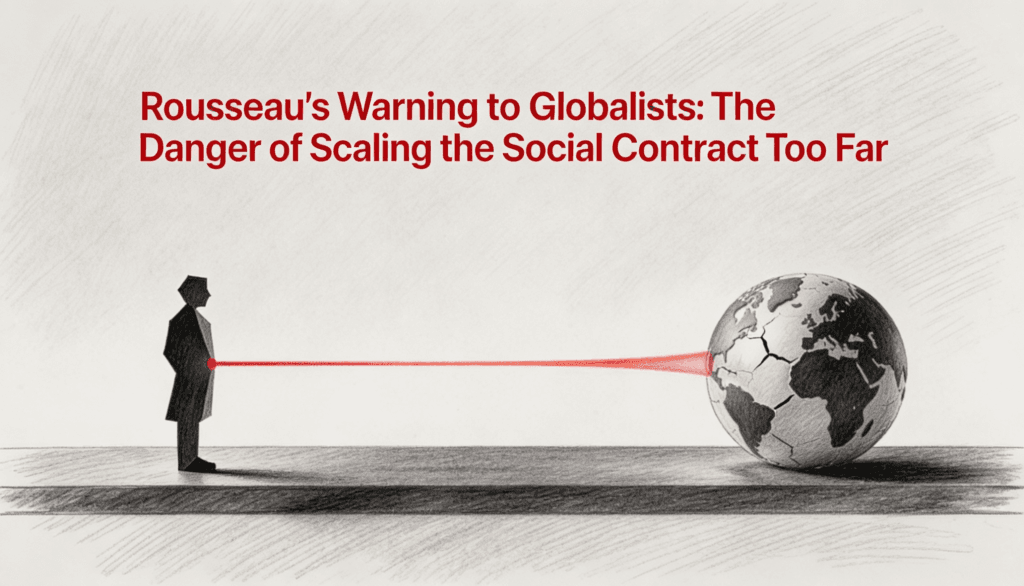
Not because he was against cooperation. Not because he was some 18th century isolationist. But because he understood something that most modern political thinkers prefer to ignore: the social contract only works when it is small enough for people to actually feel it. Stretch it too thin and it stops being a contract at all. It becomes a leash.
The Social Contract Was Never Meant to Be Global
Rousseau published The Social Contract in 1762, and it remains one of the most misunderstood texts in political philosophy. People quote the famous opening line about man being born free and everywhere in chains, then proceed to use Rousseau to justify whatever large scale political project they happen to favor. But Rousseau was not writing a blueprint for world governance. He was writing about the conditions under which a political community could be legitimate. And those conditions were ruthlessly specific.
The whole architecture of Rousseau’s thought depends on the concept of the general will. This is not majority rule. It is not what most people happen to want on a Tuesday afternoon. The general will is the shared interest of a community, the thing that binds people together not as a crowd but as a body. For the general will to exist, people need to actually know each other. They need to share a way of life, a set of concerns, a felt connection to the same place and the same problems. Rousseau was explicit about this. He admired small republics. He thought Geneva, with its modest population and direct participation, was closer to the ideal than any empire could ever be.
The reason is not sentimental. It is structural. When a political body grows too large, the individual citizen becomes invisible. Their voice does not count. Their participation becomes symbolic rather than real. And when participation becomes symbolic, the social contract is no longer a contract. It is a fiction that powerful people maintain because it serves them.
Why Size Is Not Just a Detail
Modern political thinking treats scale as a logistical problem. How do we build institutions big enough to handle global challenges? How do we coordinate across borders? These are reasonable questions. But Rousseau would say they skip over the more fundamental question: at what point does scaling a political community destroy the thing that made it a community in the first place?
Think of it this way. A dinner party with eight people is a conversation. A dinner party with eight hundred people is an event. The food might be the same. The location might be the same. But the experience is completely different, because the relationship between each person and the whole has changed beyond recognition. You cannot have a general will at a banquet for eight hundred. You can have entertainment. You can have logistics. You can have a really impressive cheese board. But you cannot have the kind of mutual recognition that Rousseau thought was essential to legitimate politics.
This is not a problem you can solve with better technology or more efficient voting systems. It is a problem of human psychology. Rousseau understood that people are capable of genuine solidarity, but only within limits. Push past those limits and solidarity curdles into abstraction. You do not feel a bond with seven billion people. You might say you do. You might post about it. But the feeling is not the same as what you feel toward your neighbors, your town, the people whose faces you recognize at the market.
The General Will Cannot Be Manufactured at Scale
Here is where Rousseau’s critique cuts deepest into the globalist project. The general will is not something that can be engineered from above. It emerges from below, from the lived experience of a community that shares enough in common to genuinely deliberate about its future. When international institutions claim to represent the will of humanity, they are performing a kind of philosophical magic trick. They are using the language of democratic legitimacy without the substance of it.
Consider the European Union, which is perhaps the most sophisticated attempt in human history to scale the social contract across national boundaries. It has a parliament. It has elections. It has courts and regulations and an anthem. But ask the average citizen in Portugal what they share, in Rousseau’s sense, with the average citizen in Finland, and the answer gets thin very quickly. They share certain economic arrangements. They share some bureaucratic procedures. But do they share a general will? Do they participate in a common political life in any meaningful way?
Rousseau would argue that what they share is not a social contract but an administrative structure. And there is nothing inherently wrong with administrative structures. They can be useful. They can coordinate trade, manage disputes, and prevent wars. But they should not be confused with legitimate political communities. The confusion is where the danger lies.
When an administrative structure dresses itself in the language of democratic consent, it gains a kind of authority it has not earned. It can impose rules on populations that never genuinely agreed to them, while claiming that the process was democratic because someone, somewhere, voted for something. This is not the social contract. This is its corpse, propped up and made to dance.
Rousseau and the Problem of Representation
One of Rousseau’s most controversial positions was his deep skepticism of representative government. He argued that the moment you hand your political will to a representative, you lose it. You are no longer a citizen. You are a subject. The English, he wrote, think they are free, but they are only free during the election of members of Parliament. As soon as the vote is cast, they are enslaved again.
Now imagine what Rousseau would say about a system of global governance where citizens do not even elect their representatives directly. Where decisions are made by appointees, technocrats, and diplomats whose names most people could not recall if their lives depended on it. The distance between the individual and the decision maker is not just geographic. It is existential. The citizen of a global order is not a citizen in any sense Rousseau would recognize. They are a data point. A managed population.
This is not a left wing or right wing criticism. It is a structural one. Rousseau was not arguing against cooperation between nations. He was arguing that cooperation and political community are different things, and that pretending they are the same leads to a very specific kind of tyranny: the tyranny of institutions that nobody chose, enforcing rules that nobody debated, in the name of a general will that does not exist.
The Paradox of Universal Values
There is a deeper irony in the globalist project that Rousseau helps illuminate. The people who advocate for global governance typically ground their arguments in universal values. Human rights. Dignity. Equality. These are presented as self evident truths that transcend culture and context.
But Rousseau would point out a strange inversion at work here. Universal values, by definition, belong to no particular community. They are abstract. And because they are abstract, they cannot generate the kind of passionate attachment that holds a political community together. You do not feel patriotic about a UN declaration. You might respect it intellectually. But it does not move you the way your own community’s traditions and shared struggles move you.
This creates a paradox. The more universal your political framework, the less it can rely on genuine consent and shared feeling. So it must rely instead on something else: bureaucratic authority, economic pressure, or cultural conditioning. In other words, the more universal the system, the more coercive it has to become, precisely because it lacks the organic legitimacy that only a real community can provide.
Rousseau saw this clearly. He understood that a political order held together by force or manipulation is not a contract. It is a cage with better marketing.
What Software Engineering Accidentally Confirmed
There is a strange echo of Rousseau’s insight in a completely different field. In software development, there is a well known principle that communication complexity grows exponentially with team size. Add one person to a team of five and you do not get a small increase in coordination costs. You get a dramatic one. This is sometimes called Brooks’s Law, after Fred Brooks who observed that adding more people to a late software project makes it later.
The same logic applies to political communities. Every additional member does not add a proportional amount of shared understanding. It adds exponential complexity. The number of relationships that need to be maintained, the number of competing interests that need to be reconciled, the sheer volume of communication required to sustain anything resembling a general will: all of it scales in ways that quickly become unmanageable.
Rousseau did not have the mathematical language for this, but he grasped the principle intuitively. He knew that political communities have an optimal size, and that exceeding it does not just make governance harder. It changes the nature of governance itself. Beyond a certain threshold, you are no longer doing politics. You are doing management. And management, however competent, is not the same thing as self governance.
The Uncomfortable Conclusion
None of this means that international cooperation is bad or unnecessary. Climate change does not respect borders. Pandemics do not check passports. There are genuine problems that require coordination beyond the nation state, and Rousseau would not have denied this.
But coordination is not the same as a social contract. A trade agreement is not a community. A climate accord is not a general will. And the mistake of the globalist project is to treat these administrative necessities as though they were the foundation of a new political order. They are not. They are tools. Useful, important tools, but tools nonetheless.
Rousseau’s warning is that when you confuse tools with foundations, you end up building a political order that looks legitimate on paper but feels hollow in practice. And hollow political orders are not just ineffective. They are dangerous. Because when people feel that the system governing their lives has nothing to do with them, when they sense that the social contract is a fiction maintained by elites for their own benefit, they do not respond with polite disagreement. They respond with rage.
The populist uprisings of the past decade, from Brexit to the rise of nationalist movements across Europe and beyond, are not anomalies. They are exactly what Rousseau would have predicted. They are the predictable result of stretching the social contract past its breaking point and then acting surprised when it snaps.
What Rousseau Would Have Us Remember
Rousseau was not a utopian. He was, if anything, a pessimist about human institutions. He believed that most governments were corrupt, most societies were unjust, and most people were trapped in systems they had never consented to. His political philosophy was not a plan for perfection. It was a set of constraints, a list of conditions that had to be met before any political order could claim legitimacy.
The most important of those conditions was that citizens must be genuine participants in their own governance. Not passive recipients of policy. Not consumers of political content. Participants. And participation, real participation, requires a community small enough to know itself.
This does not mean we should abandon all forms of international cooperation. It means we should stop pretending that international cooperation is the same thing as political community. It means we should be honest about the limits of large scale governance and stop treating skepticism of global institutions as ignorance or bigotry. Sometimes the people who resist the expansion of distant authority are not motivated by fear. They are motivated by an instinct Rousseau would have recognized immediately: the instinct that something essential is being lost when decisions about your life are made by people who have never met you and never will.
The social contract is a powerful idea. But its power comes from its intimacy. Scale it to the size of the planet and you do not get a bigger contract. You get a smaller citizen.
Rousseau tried to tell us this. We should probably start listening.