Table of Contents
There is a particular kind of power that does not announce itself. It does not wear a crown or sit on a throne. It sends emails. It schedules meetings. It builds org charts and performance review frameworks. It speaks in the careful, bloodless language of “alignment,” “stakeholder engagement,” and “strategic prioritization.” And it runs nearly everything.
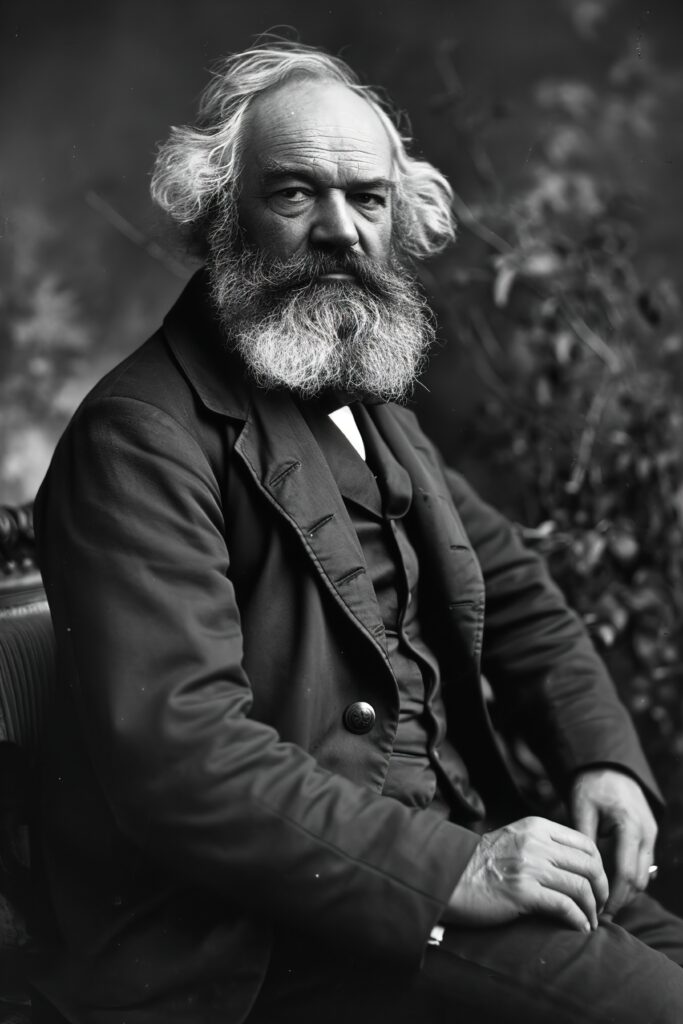
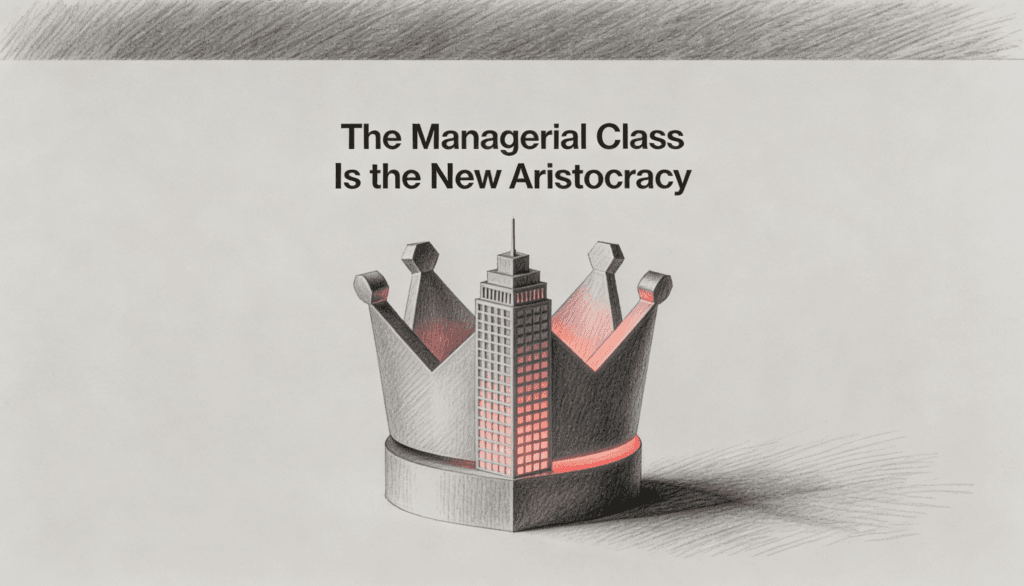
Thorstein Veblen, the strange and brilliant Norwegian American economist writing at the turn of the twentieth century, would not have been surprised. He spent his career studying the mechanics of social prestige and unproductive power. He gave us the concept of “conspicuous consumption” and the idea of a “leisure class” that maintained its dominance not through work but through the visible avoidance of it. What he also gave us, less famously, was a framework for understanding something we are only now fully reckoning with: the rise of a managerial aristocracy that functions almost identically to the old landed gentry, just with better jargon and worse fashion.
Veblen and the Leisure Class, Briefly
To understand how we got here, you need to understand what Veblen was actually arguing in The Theory of the Leisure Class, published in 1899. His central observation was deceptively simple. In any society that produces a surplus, a class emerges whose primary function is not production but consumption. This class does not justify itself through usefulness. It justifies itself through display. The more visibly unproductive you are, the higher your status.
Veblen noticed that the old European aristocracy did not simply happen to be idle. Idleness was the point. Working with your hands was degrading. Managing an estate was acceptable. Hunting was noble. Farming was for peasants. The entire social order was organized around a single, quietly absurd principle: the people who do the least useful work should receive the most reward and respect.
He was writing about the Gilded Age robber barons and their wives dripping in diamonds. But the insight was portable. It could travel across time. And it did.
From Land to Leverage
The old aristocracy held land. That was the basis of their power. If you controlled the land, you controlled the food supply, the labor force, and the military capacity of a region. The title came with the territory, quite literally.
The managerial class holds something different. It holds process. It controls access to decision making, resource allocation, and organizational legitimacy. A senior vice president at a Fortune 500 company does not own the factory. He does not own the patent. He does not, in most cases, own a meaningful percentage of the company. But he controls who gets funded, who gets promoted, who gets heard, and who gets ignored. That is not a small thing. That is, in practical terms, feudal power wearing a lanyard.
Veblen would have recognized this immediately. He drew a sharp line between what he called “industrial” work and “pecuniary” work. Industrial work was the actual making of things. Pecuniary work was the management, financing, and social positioning around things. The industrial workers built the railroads. The pecuniary class decided who got to ride them and at what price. Veblen did not hide his contempt for the latter.
What is remarkable is how cleanly this maps onto modern corporate life. The engineers, nurses, teachers, programmers, and tradespeople who produce tangible value are, by and large, not the ones running the show. The people running the show are the ones who have mastered a different set of skills entirely: navigating bureaucracies, managing perceptions, controlling information flows, and producing elaborate justifications for their own necessity.
The Ceremony of Usefulness
Here is where Veblen gets truly biting, and truly relevant. He argued that the leisure class does not simply avoid productive work. It actively creates a culture of ceremonial labor. Activities that look like work but produce nothing of value. Activities whose entire purpose is to signal status and justify the position of the person performing them.
Think about this in modern terms. How many hours per week does the average middle manager spend in meetings that could have been emails? How many strategic planning documents are produced, circulated, commented upon, revised, and then never implemented? How many corporate retreats involve grown adults sorting colored Post It notes into categories while a facilitator asks them to “think about their north star”?
This is not work. This is ceremony. It is the modern equivalent of a medieval lord hosting a tournament. The tournament did not produce grain or build roads. It demonstrated that the lord had enough surplus resources to waste them spectacularly. The quarterly business review serves a remarkably similar function. It demonstrates that the organization has enough slack to afford a room full of highly paid people watching a slide deck for three hours.
Veblen called this “conspicuous waste,” and he meant it without irony. Waste was not a bug of elite behavior. It was the feature. The ability to waste, visibly and confidently, was the proof of status.
The Credentialing Moat
The old aristocracy protected its position through bloodlines and titles. You could not simply decide to become a duke. You had to be born into it, or you had to receive the title from someone who was. The system was self reinforcing. Aristocrats educated their children in aristocratic values, married them to other aristocrats, and ensured that the barriers to entry remained insurmountable for everyone else.
The managerial class has its own version of this, and it is arguably more effective because it looks meritocratic. The modern moat is credentialing. The right university. The right MBA program. The right internships. The right networks. The right vocabulary.
Consider the sheer cost of entry. An MBA from a top program runs somewhere north of $200,000 when you factor in tuition, living expenses, and the opportunity cost of two years out of the workforce. What does this credential actually teach you? Some useful frameworks, certainly. Some accounting. Some statistics. But the primary product is not knowledge. It is access. The degree is a key that unlocks a set of doors, and the people behind those doors are, overwhelmingly, other people who hold the same key.
This is not fundamentally different from the old system. It is just laundered through the language of achievement. A duke was a duke because his father was a duke. A McKinsey associate is a McKinsey associate because he went to Wharton, which he could attend because he went to a feeder prep school, which he could attend because his parents could afford it or at minimum understood the system well enough to navigate it. The chain of causation is longer, but the destination is the same.
Veblen would point out that this is not a conspiracy. It does not need to be. Systems of privilege reproduce themselves automatically when the people inside them genuinely believe the system is fair. And the managerial class, more than any aristocracy before it, has perfected the art of believing in its own merit.
The Production of Complexity
There is a counter intuitive dynamic at work here that deserves attention. The managerial class does not merely benefit from complexity. It produces complexity. Every new regulation, every new compliance requirement, every new reporting framework, every new layer of organizational hierarchy creates more demand for managers. The class sustains itself by making the world harder to navigate without its services.
This is not unlike what Ivan Illich observed about certain professions in the 1970s. Illich argued that medicine, education, and law had all reached a point where they created more of the problems they claimed to solve than they actually fixed. He called it “counterproductivity.” Schools produced more ignorance. Hospitals produced more illness. The parallel to management is striking. Many organizations are drowning in management. They have more coordinators, facilitators, directors, and vice presidents than they know what to do with. And the response to the dysfunction caused by too much management is, reliably, more management.
Veblen did not live to see the full flowering of this dynamic, but he predicted its logic. He argued that the pecuniary class would always find ways to expand its domain because its power depended not on solving problems but on maintaining the conditions that made it appear necessary. A problem that gets solved is a manager without a purpose. A problem that gets managed, indefinitely, is a career.
Conspicuous Compassion
One of the more interesting developments in the modern managerial aristocracy is its relationship with morality. The old aristocracy was, at least in its later centuries, fairly unapologetic about its privileges. It was ordained by God, or by tradition, or by the natural order. The justification was hierarchical and it did not pretend otherwise.
The new managerial aristocracy cannot do this. It operates in a democratic culture that at least nominally values equality. So it has developed a different legitimation strategy. Instead of claiming divine right, it claims moral sensitivity. The modern manager does not rule because he is better born. He rules because he cares more. He is more attuned to issues of equity, sustainability, inclusion, and stakeholder well being. His authority derives not from his sword but from his sensitivity.
Veblen would have had a field day with this. He wrote extensively about how the leisure class adopted causes and charitable activities not out of genuine concern but as another form of status display. Philanthropy was conspicuous virtue, the moral equivalent of a diamond necklace. It announced that you had so much surplus that you could afford to give some away, and it established your social position relative to those who could not.
The modern corporate version of this is the ESG report, the diversity initiative run by a committee of people who all went to the same five schools, and the sustainability pledge that somehow never interferes with quarterly earnings. This is not to say that no one in management genuinely cares about these things. Many do. But the structural function of corporate morality is remarkably consistent with Veblen’s framework. It legitimates. It decorates. It does not fundamentally redistribute power or resources.
The Revolt That Is Not Coming
If the managerial class is the new aristocracy, the obvious question is whether it faces the same eventual fate. Aristocracies tend to end badly. The French had their revolution. The Russian aristocracy met an even grimmer conclusion. The British landed gentry were slowly taxed and legislated into irrelevance over the course of two centuries.
But here is the uncomfortable truth. The managerial aristocracy is, in several important ways, more durable than its predecessors. First, it is genuinely difficult to identify as a class. It does not have a single name, a single location, or a single set of symbols. It is diffused across every industry, every government, every nonprofit, every university. You cannot storm a single building and overthrow it.
Second, it has absorbed the language of its own critique. When someone points out that organizations are bloated with unnecessary management, the managerial class responds by commissioning a study, forming a task force, and hiring a consultant. The critique gets metabolized into more management. It is a kind of immune response, and it is extraordinarily effective.
Third, and most importantly, the managerial class has made itself structurally necessary in ways the old aristocracy never did. You could remove a duke from his estate and the peasants would keep farming. You cannot remove the entire middle management layer from a modern hospital system or a government agency without everything collapsing, at least in the short term. The complexity that the managerial class has produced is real. Someone has to navigate it. And the people best positioned to navigate it are the people who built it.
What Veblen Would Say Now
Veblen died in 1929, just before the stock market crash that would have confirmed many of his darkest suspicions about pecuniary culture. He never saw the postwar explosion of corporate bureaucracy, the rise of the MBA, the proliferation of management consulting, or the creation of entire industries dedicated to managing other industries.
But his analytical framework remains disturbingly sharp. The core insight was never really about rich people buying expensive things. It was about how societies create and protect classes whose primary function is not production but control, and how those classes develop elaborate cultural, educational, and institutional mechanisms to make their position look natural, earned, and necessary.
The managerial class has achieved something the old aristocracy never quite managed. It has made its dominance invisible. Not because people do not notice it, but because the language available to describe it has been so thoroughly shaped by the class itself that criticism sounds like confusion. Complain about too many meetings and you are not a revolutionary. You are just disorganized. Question the value of a strategy department and you clearly do not understand the complexity of the business. Suggest that perhaps we do not need seven layers of approval to buy a printer and you are being naive about governance.
Veblen understood that the most powerful form of social control is not force. It is the ability to define what counts as reasonable. The managerial class does not need to silence its critics. It just needs to make them sound unreasonable. And at that, it has no equal in the history of human civilization.
The aristocracy of blood eventually fell. The aristocracy of process shows no signs of going anywhere. It just keeps scheduling meetings about its own transformation.