Table of Contents
When Thucydides sat down to write about the Peloponnesian War, he was not really writing about war. He was writing about power. Specifically, he was writing about what happens when one state accumulates so much of it that every other state must orient itself in relation to that gravity. Athens did not rule the Aegean because it had better ideas or nobler citizens. It ruled because it had more triremes. And triremes cost money. And money came from controlling trade. And controlling trade required more triremes.
If that loop sounds familiar, it should.
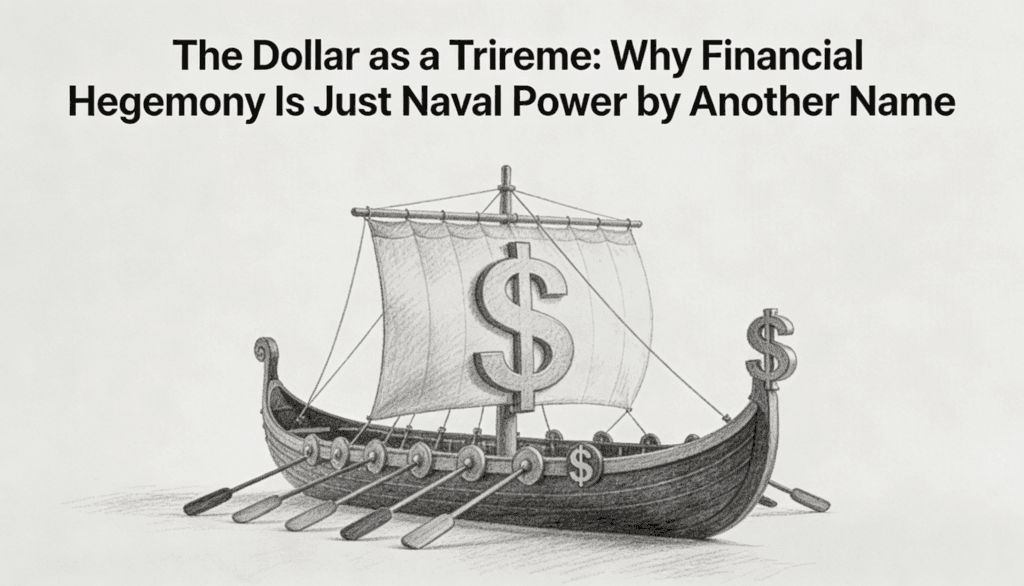
The United States does not patrol global commerce with wooden warships. It does something more elegant. It issues the currency that global commerce runs on. The dollar is the trireme of the modern age. It does not ram enemy hulls or blockade harbors in any literal sense, but it accomplishes the same strategic objective: it makes the cost of defying American power so high that most nations simply choose not to.
Thucydides would have understood this immediately.
The Delian League Had Dues
To understand the dollar’s role in the global order, you first need to understand the Delian League, which was Athens’s great invention and, depending on your perspective, its great fraud. After the Persian Wars, Athens organized an alliance of Greek city states. The stated purpose was mutual defense. Each member contributed ships or money to a common treasury, originally stored on the island of Delos.
Then Athens moved the treasury to Athens.
This was not subtle. It was, in fact, one of the least subtle power grabs in recorded history. But it worked because Athens had the fleet, and the fleet protected the trade routes, and the trade routes generated the wealth that everyone depended on. If you wanted to leave the league, you were welcome to try. Naxos tried. Athens besieged it. Thasos tried. Athens besieged that too. The protection was not optional.
Now replace “ships” with “dollars” and “Delos” with “Bretton Woods” and the story updates itself with remarkably little effort.
In 1944, the United States convinced the world’s major economies to peg their currencies to the dollar, which was itself pegged to gold. The stated purpose was global financial stability. The treasury, so to speak, moved to Washington. When Nixon severed the gold link in 1971, the dollar did not collapse. It did something far more interesting. It became valuable purely because everyone had already agreed to treat it as valuable. The network was the product. The infrastructure of global trade had been built on dollar rails, and rebuilding on anything else would cost more than simply continuing to pay the fare.
Naxos could tell you how that calculation tends to go.
Control the Sea, Control the Story
Thucydides is famous for the Melian Dialogue, where Athenian generals tell the people of Melos that “the strong do what they can and the weak suffer what they must.” It is one of the most quoted passages in political theory, usually by people who want to sound worldly at dinner parties. But the deeper insight is not about brute force. It is about the way power creates its own legitimacy.
Athens did not simply threaten Melos with destruction. It told Melos that resistance was irrational. That the system was the system. That complaining about the rules of the game was pointless because the game was the only one being played. The Athenians were not apologizing. They were explaining, the way you might explain weather to someone who objects to rain.
The dollar operates on the same logic. When the United States imposes financial sanctions, it is not deploying soldiers. It is simply deciding that a particular country, company, or individual no longer gets to use the system. And because the system handles roughly 88 percent of all foreign exchange transactions, being cut off from it is not a minor inconvenience. It is an economic siege.
Iran knows this. Russia is learning it. Even China, which has the second largest economy on earth, has spent decades trying to build alternatives to dollar dominance and has had only modest success. SWIFT, the messaging system that underpins international banking, is nominally based in Belgium. In practice, it answers to American strategic interests. When the United States decided to disconnect Russian banks from SWIFT in 2022, it did not need to fire a single shot.
Thucydides would not have called this a sanction. He would have called it what it is: a blockade.
Tribute by Another Name
Here is where things get genuinely strange, and genuinely interesting.
Athens extracted tribute from its allies and used that tribute to build the Parthenon, fund its navy, and sustain its democracy. This was recognized at the time as imperial behavior, even by Athenians themselves. Pericles was not confused about the nature of the arrangement. He told the Athenians their empire was “like a tyranny” that may have been unjust to acquire but was too dangerous to let go.
The United States extracts something similar, though the mechanism is so abstract that most people do not recognize it as tribute at all. It works like this: because the dollar is the global reserve currency, countries around the world need to hold large quantities of dollars in reserve. To acquire those dollars, they sell goods and services to the United States. Then they take those dollars and invest them back into American assets, primarily Treasury bonds. This means the United States gets to consume more than it produces, borrow at lower interest rates than it otherwise could, and run enormous trade deficits that would sink any other economy.
Economists call this the “exorbitant privilege.” Valéry Giscard d’Estaing, who coined the phrase while serving as French finance minister in the 1960s, was not being complimentary.
The privilege is real, and it is enormous. The United States has run a current account deficit almost every year since 1982. In any normal country, this would eventually trigger a currency crisis. For the United States, it simply triggers more demand for dollars, because every country that trades with every other country that uses dollars also needs dollars. The network feeds itself.
This is not unlike Athens forcing its allies to use Athenian weights, measures, and coinage. You could still be Samian or Lesbian or Chian, but your money was Athenian. The convenience was real. The political implications were also real. When your economy runs on someone else’s currency, your sovereignty has a ceiling, and that ceiling is set in their capital, not yours.
The Paradox of the Indispensable Currency
There is a deeply counterintuitive aspect to all of this that Thucydides, with his taste for irony, would have appreciated.
The dollar’s dominance is not simply imposed on the world. It is, in a meaningful sense, demanded by it. Countries do not hold dollars because the United States forces them to at gunpoint. They hold dollars because dollars are useful. Dollar markets are deep, liquid, transparent, and governed by rule of law. The alternatives are worse. The euro has a fragmented bond market and persistent political uncertainty about whether the eurozone will hold together. The yuan is controlled by a government that imposes capital controls and does not allow its currency to float freely. Gold is heavy and does not pay interest.
So the world chooses the dollar, the way the Aegean islands chose Athenian protection. The choice is real. But the range of options available is shaped by a structure that one power built and maintains for its own benefit. You are free to leave. You are just not free from the consequences of leaving.
This is the essence of hegemony, and it is why Thucydides remains the essential theorist of it. He understood that power is most effective when it does not look like power. When it looks like infrastructure. When it looks like the natural order of things. The Athenian alliance was framed as mutual defense. The dollar system is framed as global public good. In both cases, the framing is not entirely wrong. Athens did protect the Aegean from Persia. The dollar system did enable an unprecedented expansion of global trade. But the framing is also not entirely honest, because the beneficiary of last resort is always the hegemon.
What Happens When the Fleet Gets Old
Thucydides did not just document Athenian power. He documented its decline. The Peloponnesian War was, among other things, a story about what happens when a hegemon overreaches. The Sicilian Expedition, in which Athens sent a massive fleet to conquer Syracuse and lost almost everything, is one of history’s great cautionary tales. Athens did not fall because it was attacked by a superior force. It fell because it became addicted to expansion, confused capability with invincibility, and made enemies faster than it could make allies.
The parallels are imperfect but instructive. The dollar system faces challenges that would be familiar to any student of Athenian decline. The weaponization of finance, particularly sanctions, has accelerated in recent years, and every time the United States uses the dollar as a weapon, it gives other countries a reason to find alternatives. Russia and China have been conducting bilateral trade in their own currencies. The BRICS nations have discussed creating a shared currency. Central bank digital currencies are being developed in over a hundred countries, some explicitly designed to reduce dependence on the dollar.
None of these efforts have yet succeeded in meaningfully denting dollar dominance. But that is what people said about Sparta in 435 BC.
The more interesting question is not whether the dollar will be replaced, because it probably will not be in our lifetimes, but whether the United States will manage the dollar’s structural advantages with the kind of restraint that sustains empires or the kind of overconfidence that collapses them. Pericles warned the Athenians not to expand the empire during the war. They did not listen. They sent the fleet to Sicily. The rest is Thucydides.
The Eternal Return of Thalassocracy
There is a concept that scholars of the ancient world use to describe Athens’s particular form of empire: thalassocracy, rule through the sea. It is distinct from land empires like Persia or Rome in their early centuries. A thalassocracy does not need to occupy territory. It needs to control movement. It needs to make itself the indispensable node through which goods, information, and value must pass. The territory is secondary. The network is primary.
The United States is the most successful thalassocracy in history. Its navy is the largest in the world, and that matters, but its financial system is what truly controls the chokepoints. SWIFT is a strait. The Federal Reserve is a port. Treasury bonds are the tribute that arrives voluntarily, dressed in the language of investment rather than subjugation.
Thucydides wrote his history, he said, as “a possession for all time.” He believed the patterns he documented would recur because human nature does not change. The strong will seek to dominate. The weak will seek to survive. And the mechanisms of dominance will evolve in form while remaining remarkably stable in function.
The trireme is gone. The dollar is here. The logic is the same.
What made Thucydides a great historian, and not merely a chronicler, was his insistence that you look at what power does, not what it says it does. Athens said it led a voluntary alliance of free states. It actually ran a protection racket backed by the most advanced naval technology of its age. The United States says it maintains an open, rules based international financial order. It actually maintains a system in which the rules are open to everyone but the architecture is controlled by one.
The system works until it does not. It endures as long as the benefits of participation outweigh the costs of resistance. And it collapses not when the rival builds a better fleet, but when the hegemon forgets that the fleet was never the point.
The point was the trade. The point was always the trade.