Table of Contents
There is a certain irony in the fact that the most quoted strategist in the history of warfare wrote a book that is, at its core, about avoiding warfare altogether. Sun Tzu’s The Art of War sits on the bookshelves of CEOs, coaches, military generals, and that one guy at every dinner party who thinks he is a tactical genius because he read the first three chapters. Yet almost everyone misses the central thesis.
Sun Tzu did not write a manual for winning fights. He wrote a manual for making fights unnecessary.
This distinction matters more than you might think. It matters in boardrooms where egos clash over quarterly projections. It matters in marriages where the same argument replays on a loop every Sunday evening. It matters in geopolitics, in neighborhood disputes, in the comments section of virtually any post on the internet. We live in a culture that glorifies the counterpunch. Someone swings at you, you swing back harder. Someone raises their voice, you raise yours louder. The logic feels bulletproof until you notice that most of the people following it are surrounded by wreckage.
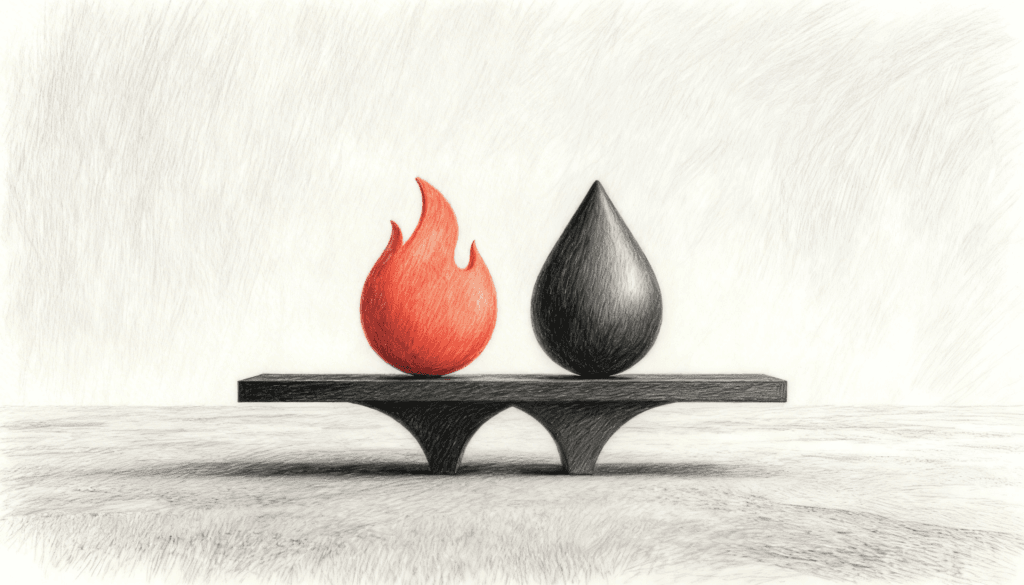
So let us talk about what it actually looks like to stop fighting fire with fire, and why the path that feels like losing is often the only one that leads to winning.
The Seduction of Retaliation
Before we get to the solution, we need to understand why the problem is so persistent.
Retaliation is satisfying. There is no getting around that. When someone wrongs you, the urge to respond in kind is not just emotional. It is biological. Neuroscience research has shown that the anticipation of punishing someone who has treated us unfairly activates the dorsal striatum, the same region of the brain involved in reward processing. In plain language, revenge feels good in the same way that eating chocolate feels good. Your brain literally rewards you for wanting to hit back.
This is why “be the bigger person” is such terrible advice on its own. It asks you to override a reward system that has been fine tuned over millions of years of evolution, and it offers nothing in return except a vague sense of moral superiority. No wonder most people ignore it.
Sun Tzu understood something more sophisticated. He did not say “be passive.” He did not say “let your enemies walk over you.” He said something far more radical: reshape the entire situation so that direct confrontation becomes irrelevant.
The supreme art of war, he wrote, is to subdue the enemy without fighting.
Read that again. He did not say the supreme art of war is to fight better. He said it is to make fighting pointless.
The Chessboard Nobody Sees
Here is where things get interesting, and where Sun Tzu starts to sound less like a military strategist and more like a behavioral psychologist two thousand years ahead of his time.
Most people enter a conflict the way they enter a room with one door. They see only one dimension. Someone attacks, so the options appear binary: fight or flee. Punch back or take the hit. But Sun Tzu operated on a completely different map. For him, the conflict you can see is almost never the real conflict. It is a symptom.
Consider a workplace example. Two department heads are locked in a bitter turf war over budget allocation. On the surface, the conflict is about money. Underneath, it is about status, recognition, and the fear of being seen as dispensable. If you address only the budget question, you might resolve this quarter’s argument. You will not resolve next quarter’s, or the one after that.
Sun Tzu would say that the person who wins this situation is not the one who secures the bigger budget. It is the one who figures out what the other person actually needs and finds a way to provide it without surrendering anything essential. This is not weakness. This is intelligence operating on a level that brute force cannot reach.
There is a concept in game theory called a positive sum game, where both sides can walk away with more than they started with. Most people treat conflict as zero sum. My gain is your loss. Your gain is my loss. But the vast majority of real world conflicts are not zero sum at all. They only look that way because both sides are too busy swinging to notice the door marked “everyone wins” standing wide open behind them.
Water Does Not Fight the Rock
Sun Tzu was famously obsessed with water as a metaphor for strategic excellence. Water does not smash through obstacles. It flows around them. Given enough time, it reshapes the hardest stone on earth without ever throwing a single punch.
This metaphor is more practical than it sounds.
Think about the last serious argument you had with someone you care about. There was probably a moment where you knew exactly what to say to hurt them. You had the verbal ammunition loaded and ready. And if you fired it, you probably would have “won” that exchange in the short term. But what would you have actually gained? A partner who resents you. A friend who trusts you less. A family member who now guards their vulnerabilities around you because you proved you would weaponize them.
The fire with fire approach in personal relationships is particularly devastating because relationships are not battlefields, even though our emotions sometimes convince us otherwise. The person across from you is not an enemy to be defeated. They are someone whose cooperation you need for the foreseeable future. Destroying their position does not strengthen yours. It weakens the entire structure you both depend on.
This is where Sun Tzu’s thinking intersects beautifully with something from an entirely different field: structural engineering. Engineers know that the buildings which survive earthquakes are not the rigid ones. They are the ones designed to flex. Rigidity feels like strength right up until the moment it becomes catastrophic. The same principle applies to how we handle conflict. The person who refuses to bend, who meets every challenge with equal and opposite force, is not displaying strength. They are displaying a failure of imagination.
The Paradox of Yielding
Let us address the obvious objection. Does not all of this amount to being a pushover? If you refuse to fight fire with fire, do you not just get burned?
This is the part that most people get wrong, and it is the part that makes Sun Tzu’s philosophy genuinely counterintuitive.
Yielding is not the same as submitting. A martial artist who redirects an attacker’s momentum is yielding. They are also the one who ends up standing while the attacker ends up on the floor. The entire discipline of aikido is built on this principle. You do not meet force with force. You use your opponent’s energy against them, not through malice but through superior positioning.
In practical conflict resolution, this looks like something specific. It looks like listening when every cell in your body wants to talk. It looks like asking questions when you want to make accusations. It looks like saying “help me understand your perspective” when what you really want to say is “you are completely wrong and here is why.”
These are not soft tactics. They are devastatingly effective ones. And they work for a reason that is almost unfair in its simplicity: most people are so unaccustomed to being genuinely heard that when you actually listen to them, their hostility begins to dissolve on its own. You did not defeat their argument. You removed the emotional fuel that was keeping the argument alive.
When Everyone Else Is Escalating
Of course, this philosophy runs headfirst into a cultural wall. We live in an era that rewards escalation. Social media algorithms are optimized for outrage. Political discourse has devolved into competitive indignation. Even in personal relationships, there is an unspoken belief that the person who cares the most is the person who fights the hardest.
Sun Tzu would find all of this baffling. Not because he was a pacifist. He was decidedly not a pacifist. But because escalation without strategy is just expensive noise. It consumes resources, destroys relationships, and rarely produces outcomes that anyone actually wanted.
Here is a small experiment worth trying. The next time you find yourself in a conflict that is heating up, do nothing for sixty seconds. Not nothing dramatic. Not a theatrical pause designed to communicate disapproval. Just quiet, genuine nothing. Let the other person’s words land. Let the room breathe. You will be amazed at how often the temperature drops on its own when one person simply stops adding fuel.
This is not passivity. This is what Sun Tzu called “winning without fighting.” You are not surrendering ground. You are refusing to play on a battlefield where victory is meaningless.
The Long Game Nobody Wants to Play
There is a reason most people default to fighting fire with fire despite its obvious limitations. It produces immediate results. You hit back, and something happens right now. The alternative, Sun Tzu’s alternative, requires patience. It requires you to prioritize long term positioning over short term satisfaction. And patience, frankly, is not something the modern world is set up to reward.
But consider the track record. Think about every person you know who approaches conflict with aggression as their first tool. How are their relationships? How is their blood pressure? How many bridges have they burned that they later needed to cross?
Now think about the people you know who seem to navigate conflict with an almost eerie calm. The ones who somehow emerge from disagreements with their relationships intact and often even strengthened. They are not pushovers. They are not doormats. They are playing a different game entirely, one where the objective is not to win the battle but to be in the strongest possible position when the battle is over.
This is the essence of Sun Tzu’s teaching, and it is the part that the motivational poster crowd almost always leaves out. He was not interested in moral victories or philosophical high ground. He was interested in winning. He just understood that winning looks very different from what most people assume.
The Fire That Does Not Burn
There is a final irony worth noting. The people who master this approach do not come across as passive or weak. They come across as unshakable. There is something deeply unsettling to an aggressor about a person who simply will not be provoked. It disrupts every script they have prepared. It forces them to recalculate in real time. And more often than not, it causes them to overextend, revealing weaknesses they would never have exposed if you had simply punched back.
Sun Tzu wrote his treatise roughly 2,500 years ago for military commanders navigating the chaos of warring states. The fact that his core insight still applies to a heated Slack thread between coworkers in 2026 tells you something important. Human nature has not changed. The dynamics of conflict have not changed. And the truth remains exactly as counterintuitive today as it was then.
The supreme victory is the one where nobody realizes there was a war at all.
Stop fighting fire with fire. Not because it is the noble thing to do. Because it is the smart thing to do. And Sun Tzu, for all his ancient mystique, was never really interested in nobility. He was interested in results. The results speak for themselves.