Table of Contents
There is something deeply uncomfortable about the idea of putting a price tag on belonging. Citizenship feels sacred, like love or loyalty. It is not supposed to be for sale. And yet, the Nobel laureate economist Gary Becker looked at the global refugee crisis and asked a question that makes most people squirm: what if selling citizenship is not just defensible, but morally superior to what we do now?
Before you recoil, consider what “what we do now” actually looks like. Millions of people languish in camps for years, sometimes decades, waiting for a bureaucratic lottery to decide their fate. Countries argue endlessly about quotas while human beings rot in legal limbo. The system we have is not some noble alternative to markets. It is a failing institution dressed in humanitarian language. Becker’s proposal deserves a serious hearing precisely because the status quo deserves serious scrutiny.
The Economist Who Priced Everything
Gary Becker made a career out of applying economic logic to places where most people thought it did not belong. Crime, discrimination, family life. He wandered into every sacred domain with a supply and demand curve tucked under his arm, and he usually came back with insights that made people uncomfortable and then, eventually, convinced. His 1992 Nobel Prize was essentially a lifetime achievement award for making the world squirm productively.
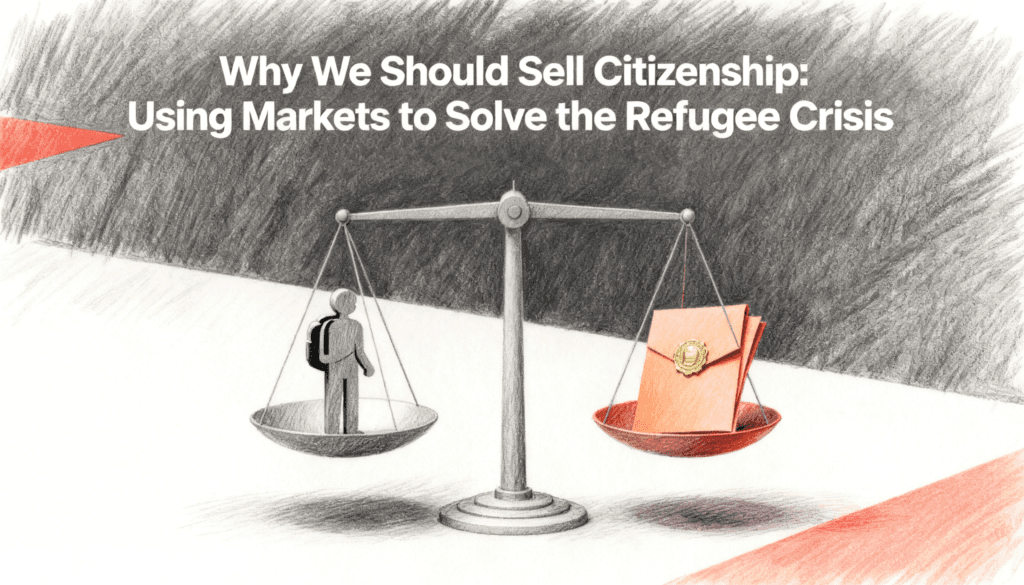
His proposal on citizenship was characteristically blunt. Countries should charge an entry fee, a price for the right to immigrate and eventually become a citizen. Refugees and immigrants would pay this fee, either upfront or through a loan structure they would repay over time from their future earnings. The revenue generated could be used to fund integration programs, public services, or whatever else the receiving country needed to make the arrangement work.
At first glance, this sounds monstrous. You are telling desperate people to buy their way in? But Becker’s argument was not about cruelty. It was about mechanism design. He was asking a deeper question: what kind of system actually produces the best outcomes for the most people, including the refugees themselves?
The Hidden Cruelty of “Free” Systems
Here is where Becker’s thinking gets counterintuitive, and interesting. The current refugee system is technically free. Nobody charges asylum seekers an admission fee. And yet, the actual cost of navigating that system is enormous. People pay thousands of dollars to smugglers. They risk their lives on overcrowded boats. They spend years in camps where their skills atrophy and their children grow up without proper education. They endure a process that is arbitrary, slow, and often corrupt.
The current system does not eliminate the price of entry. It just makes the price invisible and routes the payment to the worst possible recipients. Smugglers and traffickers are the real beneficiaries of our humanitarian squeamishness about markets. Every dollar that goes to a criminal network crossing the Mediterranean is a dollar that could have gone to a legitimate system that actually serves the people paying it.
This is a pattern that shows up across many domains of public policy. When you refuse to let prices do their work openly, prices do not disappear. They go underground. They become black market premiums, bribes, wait times, or physical danger. The economist’s instinct is to look at these hidden costs and ask whether bringing them into the light might actually be kinder than pretending they do not exist.
How the Market Mechanism Would Work
Becker envisioned something more sophisticated than a simple cash register at the border. The fee could be structured as a loan, similar to how student debt works in many countries. A refugee would be admitted, begin working, and repay the entry cost over a period of years from their earnings. The receiving country would effectively be investing in a future taxpayer, and the refugee would be investing in a future of stability and opportunity.
This structure solves several problems simultaneously. First, it creates a self-selection mechanism. People willing to take on a financial obligation to enter a country are signaling something important about their intentions. They are saying, in the most credible way possible, that they plan to contribute. This is not a perfect filter, but it is arguably better than the current system, which selects for people who are lucky, well connected, or willing to risk drowning.
Second, it aligns incentives. Right now, receiving countries face political pressure to limit immigration because voters see refugees as a fiscal burden. If immigrants are paying an entry fee and repaying loans through taxes and direct payments, the political calculus changes. Immigration becomes a revenue source rather than a cost center. This does not make xenophobia disappear, but it removes one of its most powerful practical arguments.
Third, it gives refugees agency. In the current system, people wait passively for decisions made by distant bureaucracies. In a market system, they make choices. They evaluate which country offers the best combination of entry cost, opportunity, and quality of life. They become consumers in a market rather than supplicants in a queue. There is a dignity in that, even if the language of markets feels undignified.
The Moral Objection and Why It Deserves Respect
The strongest objection to Becker’s proposal is moral, and it is not frivolous. Citizenship, the argument goes, is not a commodity. It represents membership in a political community, a relationship of mutual obligation between individuals and the state. Putting a price on it reduces something sacred to a transaction.
This objection carries real weight. There are domains of life where market logic can corrode important values. Michael Sandel has written eloquently about this. We do not allow people to sell their votes, not because we could not design an efficient market for votes, but because doing so would undermine the very meaning of democratic participation. The question is whether citizenship belongs in this protected category.
Becker would argue that it does not, or at least not entirely. We already treat citizenship as something that can be acquired through various mechanisms. Birth location is an accident. Naturalization is a bureaucratic process. Investor visa programs in dozens of countries already sell residency to wealthy foreigners, just without calling it what it is. The golden visa programs of Portugal, Greece, and Malta are citizenship markets that only serve the rich. Becker’s proposal would democratize what already exists for millionaires.
There is a certain irony in a system that allows a Russian oligarch to buy Maltese citizenship for a million euros while a Syrian engineer with a family waits seven years in a camp in Jordan. If we are comfortable with markets for the wealthy, our objection to markets for the desperate is not really about principle. It is about aesthetics.
What Game Theory Tells Us About Refugee Quotas
The current international approach to refugees relies heavily on negotiated quotas and burden sharing agreements. Countries agree, at least in theory, to accept certain numbers of refugees. In practice, these agreements collapse constantly. They are classic collective action problems.
Each country has an incentive to accept fewer refugees than it promised while hoping other countries pick up the slack. This is the free rider problem in its purest form, and anyone who has tried to split a restaurant bill with a large group understands the dynamic intuitively. Everyone orders the steak but wants to divide the check evenly.
Game theory predicts exactly what we observe. Agreements are made and broken. Countries point fingers at each other. The European Union nearly tore itself apart over refugee quotas in 2015 and 2016. The fundamental problem is that quota systems require sustained cooperation among self interested actors, and sustaining that cooperation is brutally difficult without enforcement mechanisms that the international system lacks.
A market system sidesteps this problem entirely. Countries do not need to agree on quotas because they are not being asked to absorb costs. They are being offered revenue. The question shifts from “how many refugees must we accept” to “how many immigrants do we want to attract.” This is a very different question, and it produces very different political dynamics.
The Student Loan Analogy and Its Limits
Becker’s loan model draws an obvious parallel to higher education financing. In many countries, students borrow money to invest in their human capital, then repay the loans from their increased future earnings. The system works, imperfectly but functionally, because education generally does increase earning power.
Immigration works similarly. Moving from a low opportunity environment to a high opportunity one is arguably the single most effective investment a human being can make. The research on this is overwhelming. A low skilled worker who moves from a poor country to a rich country can see their earnings multiply by a factor of three or more, even doing the same job. The gains from migration dwarf the gains from almost any other economic intervention.
But the analogy has limits worth acknowledging. Student loan systems have produced their own crises. When people cannot repay, the consequences are severe. A market for citizenship would need robust protections against debt traps. It would need income contingent repayment structures so that people who fall on hard times are not deported for defaulting on a loan. The design details matter enormously, and Becker sometimes glossed over them in his enthusiasm for the core idea.
The Uncomfortable Question of Who Gets Left Behind
Perhaps the most serious practical objection is about the poorest and most vulnerable refugees. Even with a loan structure, some people simply cannot take on debt. They have no earning potential that would make a loan viable. They are elderly, disabled, or traumatized beyond the capacity for economic self sufficiency.
Becker’s system, in its purest form, would exclude these people. And this is a genuine problem. A market that serves only those with economic potential is not solving the refugee crisis. It is solving the skilled immigration question and relabeling it.
The honest response is that a market system would need to coexist with a humanitarian track. The fees paid by economically viable immigrants could fund the resettlement of those who cannot pay. This is not a radical idea. It is essentially how insurance works. The many subsidize the few, and the system functions better than one that treats everyone identically.
The current system, for all its humanitarian language, does not actually serve the most vulnerable very well either. Camp conditions are dire. Resettlement numbers are tiny relative to need. The choice is not between a perfect humanitarian system and a cold market. It is between two imperfect systems, and the question is which imperfection we prefer.
What Tinder Can Teach Us About Matching Refugees to Countries
There is an interesting connection to matching theory here, the branch of economics that studies how to pair agents in a market efficiently. Alvin Roth won the Nobel Prize for his work on this, designing systems that match medical students to residency programs and kidney donors to recipients.
A well designed immigration market would not just set prices. It would create a matching system where refugees could express preferences about destinations and countries could express preferences about immigrants. The result would be something like a dating app for international resettlement, minus the awkward small talk. People would end up in places where they are wanted rather than places where they are merely tolerated.
This matters because integration outcomes depend enormously on fit. A Syrian doctor placed in a rural German town with no Arabic speakers faces different challenges than one placed in a diverse urban center with an existing community. Markets are remarkably good at aggregating this kind of dispersed information about preferences and compatibility. Bureaucracies are remarkably bad at it.
Why This Idea Will Not Die
Becker first proposed selling immigration rights in the 1980s. The idea was dismissed as provocative nonsense. And yet it keeps resurfacing, each time with a bit more intellectual support and a bit less shock value. As the global refugee population has grown from millions to tens of millions, as climate change threatens to displace hundreds of millions more, the inadequacy of the current system becomes harder to ignore.
The idea persists because it addresses a real structural problem rather than just expressing sympathy about it. Sympathy is abundant. Functional mechanisms for turning sympathy into resettlement are scarce. Becker’s proposal, for all its roughness, is an attempt to build a mechanism. And mechanisms, unlike good intentions, can actually scale.
Nobody is suggesting that citizenship should be sold on Amazon with two day delivery. The proposal is that we should be honest about the costs that already exist in the system, transparent about who bears them, and creative about designing institutions that serve desperate people better than the ones we have. If that requires letting markets into a domain we previously considered sacred, perhaps the sacred thing was never the domain itself. Perhaps it was the obligation to find something that works.
The refugee crisis is not a problem that will be solved by more conferences, more quotas, or more hand wringing. It might, however, be addressed by the unsexy machinery of prices, incentives, and institutional design. Gary Becker understood that markets are not always beautiful. But they are often effective. And when the alternative is a system that lets people drown while we congratulate ourselves on our principles, effectiveness starts to look like its own kind of morality.