Table of Contents
There is a moment in every remote team’s life when someone types “sounds good” in Slack and absolutely nobody knows what it refers to. Three people assume it means the deadline moved. Two others think the project got approved. One person missed the message entirely because they were in a different time zone, asleep, as people in different time zones tend to be.
This is not a communication problem. It is a cohesion problem. And a Chinese general who died roughly 2,500 years ago had already diagnosed it.
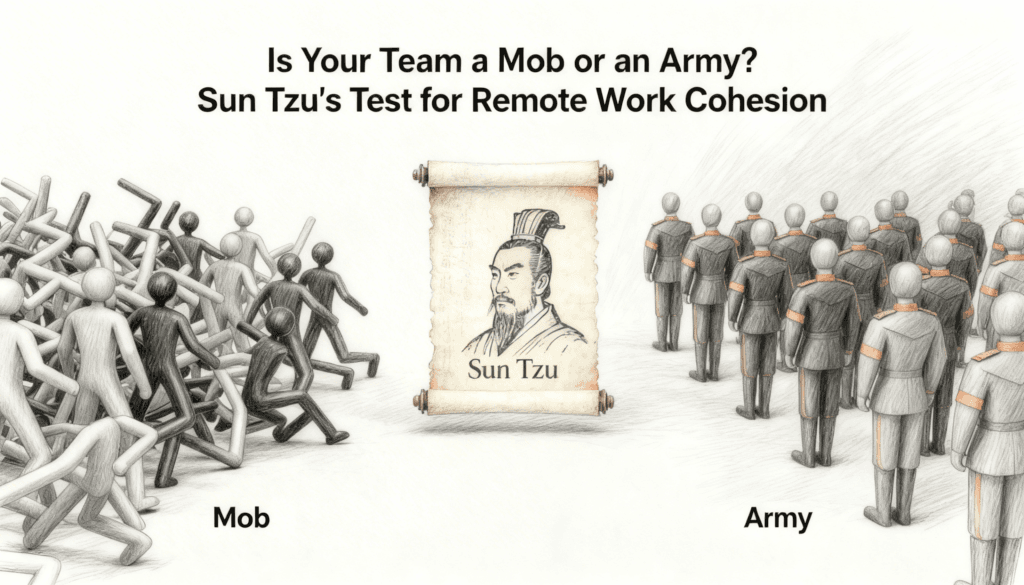
Sun Tzu drew a sharp line between two types of groups. On one side, you have a mob. On the other, an army. Both contain people. Both can be large. Both can even share a common enemy. But only one of them can actually do anything coordinated when the pressure arrives. The other just scatters.
Most remote teams, if we are being honest, are closer to the mob.
The Distinction Sun Tzu Actually Made
In The Art of War, Sun Tzu never used the word “remote.” He did not have opinions on Zoom fatigue or asynchronous standups. What he did have was an obsession with a concept that translates roughly as “unity of purpose combined with coordinated action.” He was not interested in whether people liked each other. He was interested in whether they could move as one body when the drums started beating.
His test was simple. When the signal comes, does everyone move in the same direction? Or do they freeze, scatter, or worse, move in six directions at once while each believing they are doing the right thing?
A mob is a collection of individuals who happen to be in the same place, pursuing roughly the same goal, with no shared system for responding to change. An army is a group that has internalized a common framework so deeply that they can act without waiting for instructions.
The difference is not discipline in the way we usually mean it. It is not about strictness or punishment. It is about shared mental models. An army does not need to be told what to do in every situation because it already knows what the organization would want it to do. A mob needs to be told everything, and even then, half the instructions get lost.
Remote work did not create this problem. It revealed it. When people sat in the same office, the illusion of cohesion was easy to maintain. You could see everyone working. You could walk over and correct a misunderstanding in real time. The proximity masked the absence of genuine alignment. People were moving in roughly similar directions, but that was more a function of physical closeness than actual shared understanding.
Remove the office, and you remove the mask.
Why Mobs Feel Like Teams
Here is the counterintuitive part. Most mobs do not know they are mobs. They feel like teams. They have team channels and team meetings and team rituals. They might even have good relationships with one another. The problem is not hostility or apathy. The problem is that when a genuine decision point arrives, something unexpected, something that was not covered in the last meeting, everyone defaults to their own interpretation of what should happen next.
Sun Tzu observed this in literal armies. Soldiers who trained together, ate together, and marched together could still fall apart in battle if they lacked what he called “shared doctrine.” The shared meals did not matter. The shared doctrine did.
In remote teams, the equivalent of shared doctrine is not your company values poster. Nobody makes a decision in the heat of a deadline by consulting a wall plaque that says “We value innovation.” Shared doctrine is the set of unspoken assumptions about how work gets done. Who makes the call when the information is incomplete? What gets prioritized when two important things compete? How much autonomy does someone actually have before they need to check in?
If you ask five people on your team these questions and get five different answers, you have a mob. A well meaning, possibly high performing mob, but a mob nonetheless.
The Drums Test
Sun Tzu used drums and flags to communicate across a battlefield. The system was crude but effective because every soldier had been trained to respond the same way to the same signal. The drum pattern for “advance left flank” produced one specific movement across thousands of people. Not because they were robots, but because they had practiced the response until it was automatic.
Remote teams have their own version of drums. A message from the CEO about a strategic pivot. A client escalation that lands in the shared inbox on a Friday afternoon. A key team member who suddenly resigns.
These are the moments that reveal whether you have an army or a mob.
In a mob, the Friday escalation produces a flurry of messages. Some people jump in immediately. Others wait for someone to tell them what to do. Someone starts a new channel. Someone else replies in the old channel. A third person sends a direct message to the manager who is offline. By Monday, three different people have sent three different responses to the client, none of which align with each other.
In an army, the same escalation triggers a known response pattern. Not because someone wrote a 47 page playbook for every scenario, but because the team has a shared understanding of roles, priorities, and decision rights. People know who owns the response. They know what “urgent” actually means versus what “important but can wait” means. They act without a meeting because they do not need a meeting. The doctrine is already in their heads.
This is what Sun Tzu meant by unity. Not emotional unity. Operational unity.
The Problem With Hiring Mercenaries
Sun Tzu had a dim view of mercenaries. Not because they lacked skill. Mercenaries were often more skilled than regular soldiers. The problem was that their loyalty was transactional. They fought well when things were going well. They disappeared when things were not.
Remote work has created a mercenary dynamic that nobody planned for. When people work from home, their connection to the organization becomes more abstract. They do not bump into colleagues in the hallway. They do not absorb the culture through proximity. Their relationship with the company is mediated almost entirely through a screen, which means it is mediated almost entirely through the quality of their direct experience.
This does not make remote workers disloyal. It makes them rational. If the only thing connecting you to an organization is a Slack workspace and a biweekly paycheck, your loyalty will naturally calibrate to what that organization gives you in return. Sun Tzu would have predicted this with disturbing accuracy.
The solution he proposed was not to pay mercenaries more. It was to stop relying on mercenary arrangements. He argued that genuine cohesion comes from three things: shared purpose that people actually believe in, leaders who demonstrate competence and care, and systems that make coordination feel effortless rather than exhausting.
Two out of three will not cut it. A team with shared purpose and good leaders but terrible systems will still fumble when it matters. A team with great systems and competent leaders but no real sense of purpose will execute efficiently on things nobody cares about. And a team with purpose and systems but poor leadership will slowly disintegrate as trust erodes.
The Terrain Has Changed, The Principles Have Not
One of the more interesting aspects of The Art of War is how much time Sun Tzu spends on terrain. He categorizes different types of ground: easy ground, difficult ground, death ground, and several others. His argument is that the same army behaves differently depending on where it is. Strategy must adapt to terrain. The terrain does not care about your preferences.
Remote work is new terrain. It has its own properties. Information moves differently. Feedback loops are longer. Social cues are harder to read. Presence is no longer visible, which means trust must be built through outputs rather than optics.
Most organizations responded to this new terrain by trying to recreate the old terrain digitally. They scheduled more meetings to simulate the office. They required cameras on to simulate physical presence. They installed monitoring software to simulate supervision.
Sun Tzu would have found this baffling. His entire philosophy was about adapting to the terrain you are on, not pretending you are on different terrain. An army that marches through a swamp using the same formation it uses on open plains is an army that drowns.
The organizations that have done remote work well are the ones that studied the new terrain and built new formations for it. They over invested in written communication because they recognized that async is the native language of distributed work. They made decision rights explicit because they understood that ambiguity costs more when you cannot resolve it with a quick hallway conversation. They built culture through shared work and shared standards rather than shared office space.
Building the Army
Sun Tzu’s prescription for turning a mob into an army was not complicated, but it was demanding. It required three things that most leaders find uncomfortable.
First, clarity so radical it feels redundant. In Sun Tzu’s world, every soldier knew not just their role but the roles of the people around them. They knew the plan, the backup plan, and what to do when both plans failed. Remote teams need this same level of clarity, and most of them do not have it. They have a vague sense of direction and a lot of assumed context that nobody ever made explicit.
Second, trust built through demonstrated competence, not surveillance. Sun Tzu respected generals who trusted their troops. He had no patience for generals who needed to watch every movement. The modern equivalent is the manager who needs everyone on camera, who checks activity logs, who measures hours instead of outcomes. This is not leadership. It is anxiety wearing a management hat.
Third, regular practice at coordinating under pressure. Sun Tzu drilled his armies relentlessly. Not because he enjoyed drills, but because coordination is a perishable skill. If you do not practice it, you lose it. Remote teams that only coordinate during calm, predictable work are teams that will collapse during their first real storm.
The uncomfortable truth is that most organizations would rather buy new tools than do this work. It is easier to adopt a new project management platform than to have honest conversations about decision rights. It is easier to schedule another meeting than to write down the doctrine that would make the meeting unnecessary.
The Question Worth Asking
Sun Tzu did not believe in half measures. He believed that the outcome of a conflict was largely determined before it began, by the preparation, the cohesion, and the clarity of the force entering it.
Your remote team will face its test eventually. A market shift, a key departure, a client crisis, a moment when everything depends on people in different rooms, different cities, different continents making the right call at the same time without anyone telling them what that call should be.
When that moment comes, will they move together? Or will they scatter, each person doing what seems right from their own individual vantage point, producing a response that is energetic but incoherent?
The answer to that question is not something you discover in the crisis. It is something you build long before it. Sun Tzu knew this. He wrote an entire book about it. The fact that the book is 2,500 years old and still relevant is not a testament to his genius, though it was considerable. It is a testament to how little the fundamental challenge has changed.
Groups of humans either learn to move together or they do not. The terrain changes. The tools change. The principle does not. The only question is whether you are building an army or just managing a mob that happens to use the same software.