Enlightenment

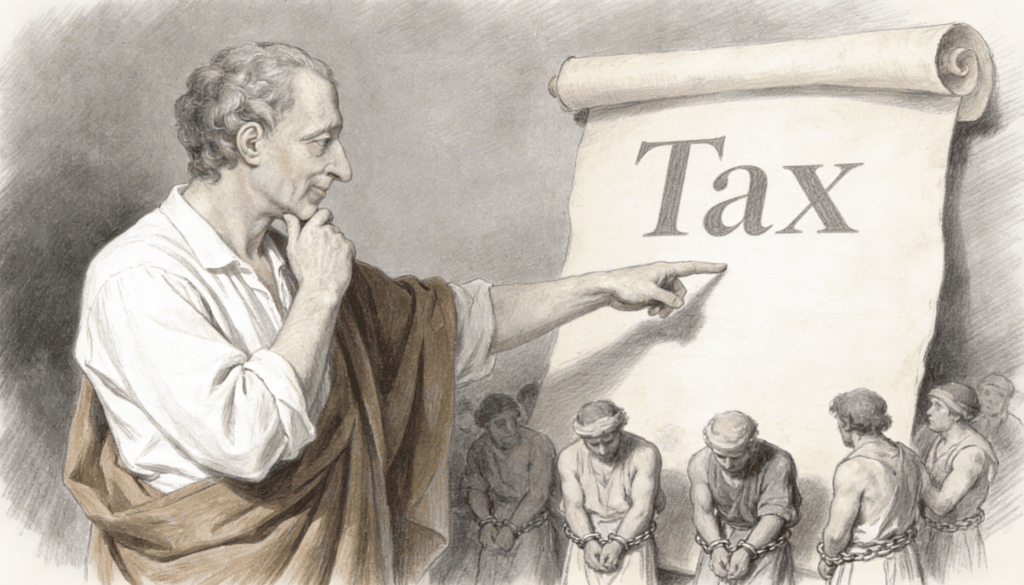
Why Your Country's Geography Pre-Programmed Its Politics (Montesquieu)

Why Your Country’s Geography Pre-Programmed Its Politics (Montesquieu)

Your government didn’t choose you. The rivers, mountains, and weather patterns did. This is the provocative claim made by Charles-Louis de Secondat, better known as Montesquieu, the 18th century French philosopher who looked at the world and saw something his contemporaries missed. While others debated the divine right of kings or the social contract, Montesquieu […]

Why Your Country’s Geography Pre-Programmed Its Politics (Montesquieu) Read More »

Is Profit a Sin? Re-examining Adam Smith's View on 'Interest' and the Ethics of Passive Income

Is Profit a Sin? Re-examining Adam Smith’s View on ‘Interest’ and the Ethics of Passive Income

Your landlord just raised your rent again. Your savings account yields 0.5% while inflation runs at 3%. Meanwhile, someone’s trust fund baby Instagram account shows them sipping cocktails in Bali, captioned “passive income life.” And somewhere in your chest, something tightens—a feeling that’s part envy, part moral indignation, and entirely confused about whether it should

Is Profit a Sin? Re-examining Adam Smith’s View on ‘Interest’ and the Ethics of Passive Income Read More »

Why the AI Revolution Was Predicted in 1637, Netherlands

Why the AI Revolution Was Predicted by Radical Rene Descartes in 1637, Netherlands

AI revolution quietly started in a modest room in the Netherlands, where a French philosopher sat by his stove and contemplated the nature of thought itself. The year was 1637, and Rene Descartes was about to publish a work that would inadvertently lay the conceptual groundwork for the artificial intelligence revolution (AI) that would unfold

Why the AI Revolution Was Predicted by Radical Rene Descartes in 1637, Netherlands Read More »

Hume's Intellectual Legacy: The 18th-Century Shock That Still Echoes

Hume’s Intellectual Legacy: The 18th-Century Shock That Still Echoes

When David Hume published A Treatise of Human Nature in 1739, he expected to revolutionize philosophy. Instead, the book, as he later lamented, “fell dead-born from the press.” Yet this initial failure masked what would become one of the most profound intellectual earthquakes in Western thought. Nearly three centuries later, Hume’s ideas continue to reverberate

Hume’s Intellectual Legacy: The 18th-Century Shock That Still Echoes Read More »

Perpetual Peace Immanuel Kant World War

Can Immanuel Kant’s ‘Perpetual Peace’ Stop the Next World War?

In 1795, amidst Europe’s revolutionary war and the looming threat of Napoleon, the German philosopher Immanuel Kant published a concise treatise that would resonate through the ages. “Perpetual Peace: A Philosophical Sketch” introduced a groundbreaking concept for its era: a systematic framework aimed at eradicating war altogether. Over two centuries later, following two devastating world

Can Immanuel Kant’s ‘Perpetual Peace’ Stop the Next World War? Read More »

Voltaire

Exporting Enlightenment: Why Voltaire’s Free Speech Vision Doesn’t Translate Globally

The saying often attributed to Voltaire—“I disapprove of what you say, but I will defend to the death your right to say it”—has become a cornerstone of Western thought on free expression. Although Voltaire never actually wrote these words, they encapsulate an Enlightenment ideal that has influenced constitutional frameworks, particularly in Europe and North America.

Exporting Enlightenment: Why Voltaire’s Free Speech Vision Doesn’t Translate Globally Read More »