Classical

The Roman Emperor Who Knew Why We Crave Constant Entertainment (Marcus Aurelius)

The Roman Emperor Who Knew Why We Crave Constant Entertainment (Marcus Aurelius)

You’re scrolling through your phone again. Another video, another post, another dopamine hit. You tell yourself you’ll stop in five minutes, but five minutes becomes fifty. When you finally put the device down, you feel somehow emptier than before. A Roman emperor figured out why this happens nearly two thousand years ago. He did it […]

The Roman Emperor Who Knew Why We Crave Constant Entertainment (Marcus Aurelius) Read More »

Seneca Would Say Your Greatest Power Isn’t Your IQ—It’s Your Ability to Handle Insults

The Roman philosopher Seneca once watched a wealthy merchant have a complete meltdown because someone called him uncultured at a dinner party. The merchant—brilliant enough to build a trading empire spanning three continents—spent the next six months obsessing over the comment, writing angry letters, and hiring philosophers to publicly defend his sophistication. Seneca’s observation was

Seneca Would Say Your Greatest Power Isn’t Your IQ—It’s Your Ability to Handle Insults Read More »

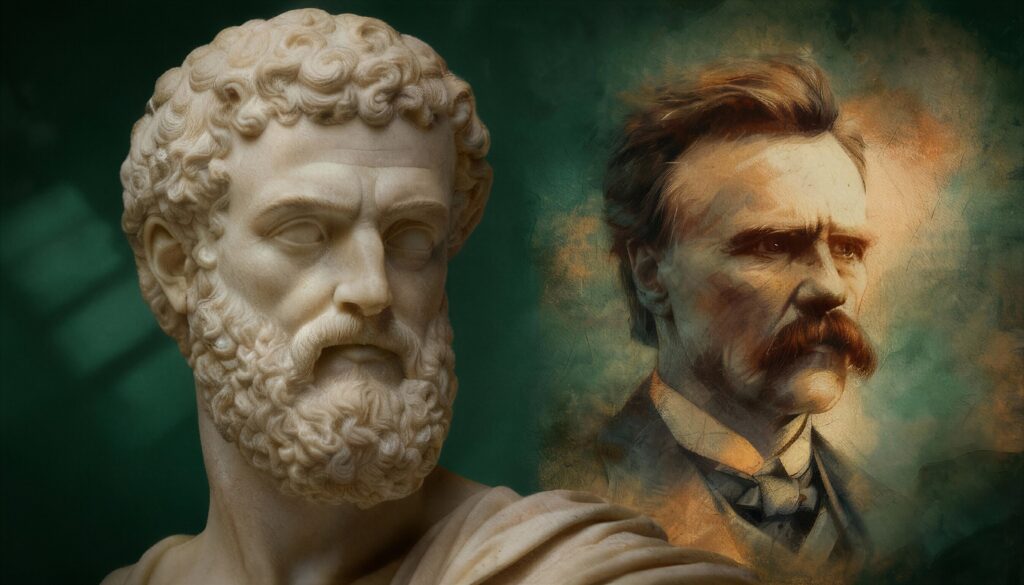
Nietzsche vs. Aristotle: Whose Vision of Excellence Wins?

Nietzsche vs. Aristotle: Whose Vision of Excellence Wins Today?

Two of history’s most influential philosophers separated by nearly two millennia offer radically different answers to one of humanity’s most enduring questions: What does it mean to live excellently? Aristotle, the systematic Greek thinker who tutored Alexander the Great, championed a balanced, socially integrated path to human flourishing. Friedrich Nietzsche, the iconoclastic German philologist writing

Nietzsche vs. Aristotle: Whose Vision of Excellence Wins Today? Read More »

Plato and Artificial Intelligence

Plato and Artificial Intelligence: Ancient Wisdom Meets Modern Machines

In the fourth century BCE, Plato asked a question that continues to perplex thinkers and, increasingly, computer scientists: what distinguishes genuine knowledge from mere belief or opinion? As artificial intelligence systems get advanced capabilities, we find ourselves revisiting this ancient idea that combines Plato and Artificial Intelligence. Can machines genuinely possess knowledge, or do they

Plato and Artificial Intelligence: Ancient Wisdom Meets Modern Machines Read More »