Table of Contents
There is a particular kind of comfort that kills slowly. It is the comfort of a business that has not changed its product in fifteen years. The comfort of an industry that lobbies for protection instead of innovating. The comfort of an economy where nothing fails, nothing breaks, and nothing new is born.
Most people hear the word “stability” and think safety. They think prosperity. They think everything is working as it should. Joseph Schumpeter heard the word and thought something closer to a funeral.
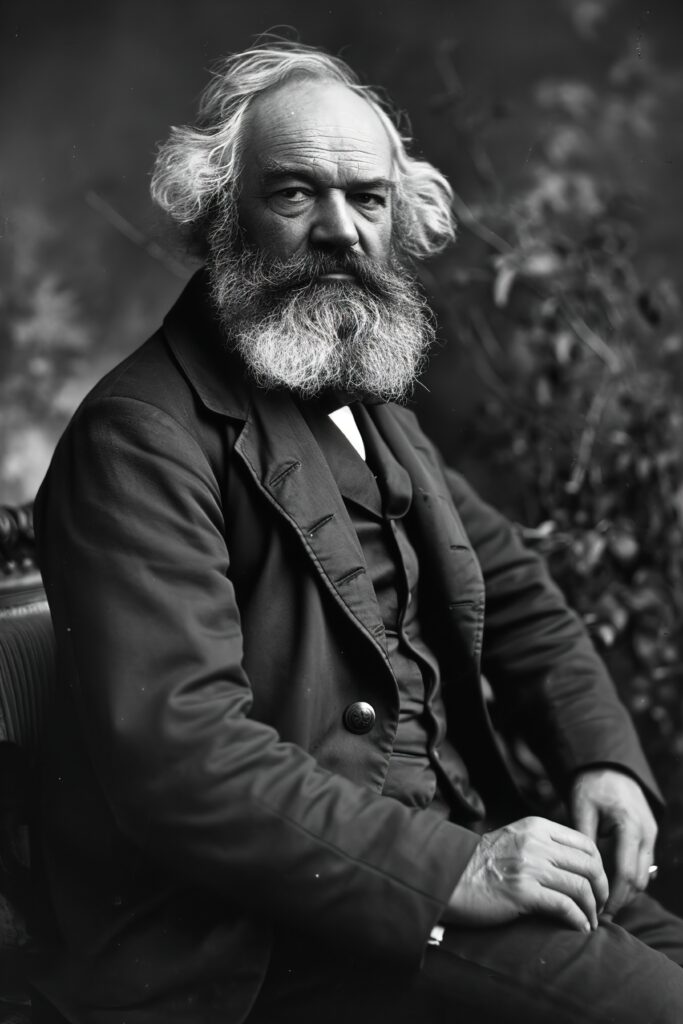
Schumpeter was an Austrian born economist who spent the most productive years of his career at Harvard. He was not interested in equilibrium. He was not interested in the tidy models that his contemporaries obsessed over, the ones where supply meets demand and everyone shakes hands. He was interested in the mess. The upheaval. The part of capitalism that most economists treated like an embarrassing relative at a dinner party.
His central argument was deceptively simple: capitalism does not work in spite of disruption. It works because of it. The force he called creative destruction was not a bug in the system. It was the system.
And if you take that idea seriously, it changes how you look at everything.
The Myth of the Steady State
Classical economics loved balance. The idea was that markets, left to their own devices, would find a natural resting point. Prices would settle. Resources would allocate efficiently. The economy would hum along at a pleasant, predictable frequency.
Schumpeter thought this was a fantasy. Not because markets are irrational, but because a market in perfect balance is a market where nobody is doing anything new. If every firm is earning exactly its expected return, if every consumer is getting exactly the product they expect, then nobody has any reason to take a risk. Nobody builds a better engine. Nobody invents a new process. Nobody bets their savings on an idea that might not work.
An economy in equilibrium is an economy in a coma.
This is the part that makes people uncomfortable. We are trained to think of volatility as a problem and calm as a solution. But Schumpeter noticed something that most observers missed: the periods of greatest economic advancement in capitalist history were not the calm ones. They were the chaotic ones. The railroad boom. The electrification of industry. The rise of the automobile. Each of these episodes was disorderly, painful for incumbents, and enormously productive for society as a whole.
The stability that came after was not a sign of health. It was a sign that the revolution had run its course and the next one had not yet begun.
Creative Destruction Is Not a Metaphor
Schumpeter did not use the phrase creative destruction as a poetic device. He meant it literally. For something new to be created, something old has to be destroyed. Not damaged. Not reformed. Destroyed.
The automobile did not improve the horse drawn carriage industry. It annihilated it. Digital photography did not make film cameras slightly less popular. It made Kodak, once one of the most powerful companies on Earth, functionally irrelevant within a decade. Streaming did not complement the video rental market. It buried it so thoroughly that explaining what Blockbuster was to a teenager now feels like describing a medieval trade guild.
This is not gentle. It is not polite. People lose jobs. Entire towns built around a single industry can hollow out. Schumpeter understood this. He was not naive about the human cost. But he also understood that preventing this process does not save an economy. It freezes it.
Think of it this way. A forest that never burns accumulates deadwood. The canopy grows so thick that no sunlight reaches the ground. New growth becomes impossible. When a fire finally comes, and it always does, the accumulated fuel makes the blaze catastrophic rather than cleansing. Forest ecologists have known this for decades. Schumpeter was saying something remarkably similar about economies long before fire management became mainstream ecology.
The Entrepreneur as the Engine
If creative destruction is the process, the entrepreneur is the person who lights the match. And Schumpeter had a very specific idea of what an entrepreneur actually is.
In his framework, an entrepreneur is not simply someone who starts a business. Opening a coffee shop on the corner is not entrepreneurship in the Schumpeterian sense. An entrepreneur is someone who introduces a genuinely new combination: a new product, a new method of production, a new market, a new source of supply, or a new organizational structure.
This distinction matters enormously. A person who copies an existing business model is an imitator. The economy needs imitators, sure. They spread successful ideas. But they do not drive transformation. The entrepreneur, in Schumpeter’s view, is someone who disrupts the existing arrangement by doing something that has not been done before. They do not optimize the current system. They replace it.
This also means that the entrepreneur is, almost by definition, a threat to established players. The incumbent does not welcome the entrepreneur. The incumbent fears the entrepreneur, lobbies against the entrepreneur, and, when possible, tries to buy or crush the entrepreneur before the damage is done.
Which brings us to a deeply counterintuitive point: the stronger and more politically connected the established firms in an economy become, the less innovative that economy is likely to be. A stable economy dominated by large, entrenched corporations is not a sign of strength. It is a sign that the entrepreneurs have been successfully kept out.
When Protection Becomes the Disease
Every declining industry in history has asked for the same thing: protection. Tariffs. Subsidies. Regulations that raise the cost of entry for newcomers. The argument always sounds reasonable. We need to protect jobs. We need to preserve communities. We need stability.
Schumpeter would not have dismissed these concerns. He was not heartless. But he would have pointed out that protection does not stop change. It delays change while making the eventual adjustment far more painful.
Consider the steel industry in the United States during the late twentieth century. For decades, American steelmakers lobbied for and received tariff protections against foreign competition. The tariffs did preserve some jobs in the short term. But they also insulated the industry from pressure to modernize. While protected American mills continued using outdated processes, foreign competitors and eventually domestic mini mills developed vastly more efficient technologies. When the protection finally proved insufficient, the collapse was not a gentle downturn. It was a wipeout. Entire regions that had depended on steel were devastated not because change happened, but because change had been artificially postponed.
The Monopoly Paradox
Here is where Schumpeter gets genuinely surprising, even to people who think they agree with him.
Most economists, particularly those in the tradition of perfect competition, view monopoly as a problem. A monopoly restricts output, raises prices, and reduces consumer welfare. Standard textbook material.
Schumpeter did not entirely disagree, but he added a twist that made nearly everyone uncomfortable. He argued that some degree of monopoly profit is actually necessary to fund innovation. A firm operating in a perfectly competitive market, earning zero economic profit, has no resources to invest in research. It has no cushion to absorb the cost of failed experiments. It cannot afford to take the kind of risks that lead to breakthroughs.
The monopoly, in Schumpeter’s view, is not the end of the story. It is a temporary reward. The entrepreneur disrupts the existing market, captures monopoly profits for a while, and then gets disrupted in turn by the next entrepreneur. The cycle continues. Monopoly is not a permanent state. It is a phase in a larger process.
The problem arises when monopoly becomes permanent. When a firm uses its market power not to innovate but to prevent innovation. When it captures regulatory agencies, builds legal moats, and ensures that no newcomer can challenge it. At that point, the cycle of creative destruction breaks down. The economy does not stagnate because of too much competition. It stagnates because of too little.
This is a distinction that both the political left and right tend to miss. The left sees monopoly and wants to break it up immediately. The right sees monopoly and wants to leave it alone as a reward for success. Schumpeter would tell both sides that they are asking the wrong question. The question is not whether a monopoly exists. The question is whether the door behind it is locked.
Why Silicon Valley Understood Schumpeter Better Than Economists Did
It is somewhat ironic that the place that most fully embraced Schumpeter’s ideas was not an economics department. It was a strip of suburban California.
The culture of Silicon Valley, for all its considerable flaws, is built on a fundamentally Schumpeterian premise. Failure is not just tolerated. It is expected. The entire venture capital model is designed around the assumption that most investments will fail, a few will succeed modestly, and one or two will generate returns so enormous that they cover all the losses and then some.
This is creative destruction operating at high speed. Companies rise and fall in years rather than decades. Entire product categories appear, dominate, and vanish within a single business cycle. The instability is the point. The messiness is productive.
Compare this to industries that have successfully insulated themselves from disruption. Banking, prior to the fintech wave, had not meaningfully changed its consumer experience in thirty years. Healthcare in many countries remains organized around structures designed in the mid twentieth century. Higher education charges exponentially more than it did a generation ago while delivering a product that, in many cases, has not fundamentally improved.
These are stable industries. They are also, by Schumpeterian standards, stagnant ones. The stability is not a sign of excellence. It is a sign that creative destruction has been blocked, and the cost is borne by consumers who get less and pay more.
Schumpeter did not end his career as an optimist. In his later work, particularly in Capitalism, Socialism, and Democracy, he made a prediction that has aged disturbingly well. He argued that capitalism would eventually undermine itself, not through its failures, but through its successes.
As capitalism produces wealth, it also produces a class of intellectuals and administrators who are hostile to the disorder that created that wealth in the first place. Bureaucracy grows. Regulation thickens. The entrepreneurial function gets absorbed into corporate R&D departments where it is managed, measured, and ultimately neutered. The system becomes so focused on preserving what exists that it loses the ability to create what comes next.
This is not a prediction about socialism replacing capitalism through revolution. It is a prediction about capitalism slowly suffocating under the weight of its own comfort. The economy does not crash. It just stops growing in any meaningful sense. The forms of capitalism remain. The corporations still exist. The stock market still functions. But the underlying engine, the creative destruction that gives capitalism its transformative power, has been quietly switched off.
Look around and ask yourself whether that prediction sounds familiar.
What Schumpeter Would Tell Us Now
If Schumpeter were alive today, he would likely observe that the economies most desperate to project stability are the ones most at risk. He would notice that corporate profit margins in the United States have remained elevated for an unusually long period, and he would not celebrate this as a sign of efficiency. He would see it as a sign that competitive pressure has weakened.
He would look at the growing gap between the dynamism of a few sectors and the stagnation of many others, and he would diagnose it as a failure of destruction. Not too much disruption, but too little.
He would remind us, probably with more elegance than most economists can manage, that the choice is never between change and no change. It is between change that happens continuously and manageably, driven by entrepreneurs who take risks and absorb consequences, or change that happens all at once, violently, because the pressure was allowed to build behind a dam that was never going to hold forever.
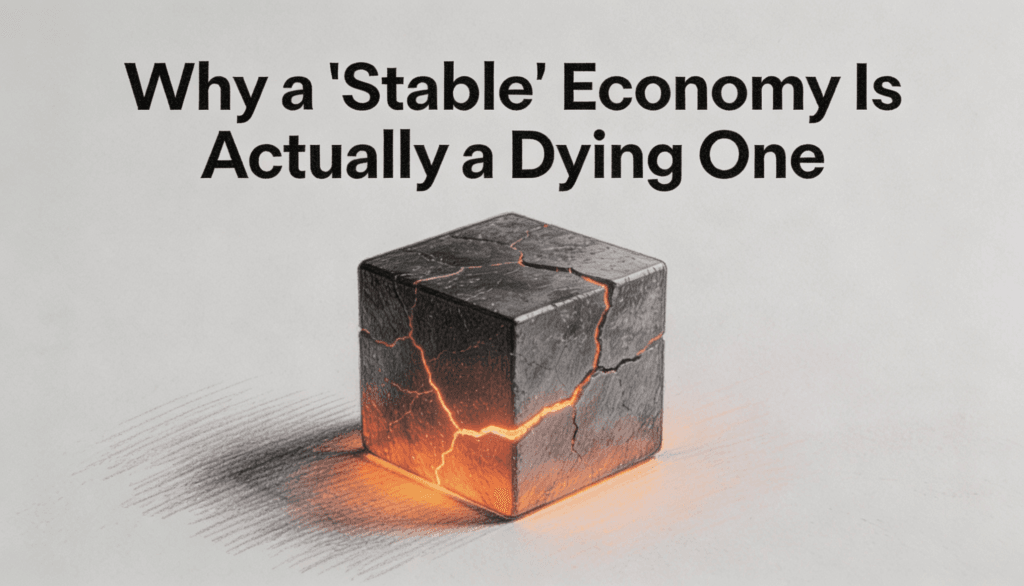
A stable economy is not a healthy economy. A healthy economy is one that is perpetually, productively, and sometimes painfully in motion. The disruption is not the disease. The disruption is the immune system.
And an immune system that never activates is not peaceful. It is simply waiting for an infection it cannot survive.