Table of Contents
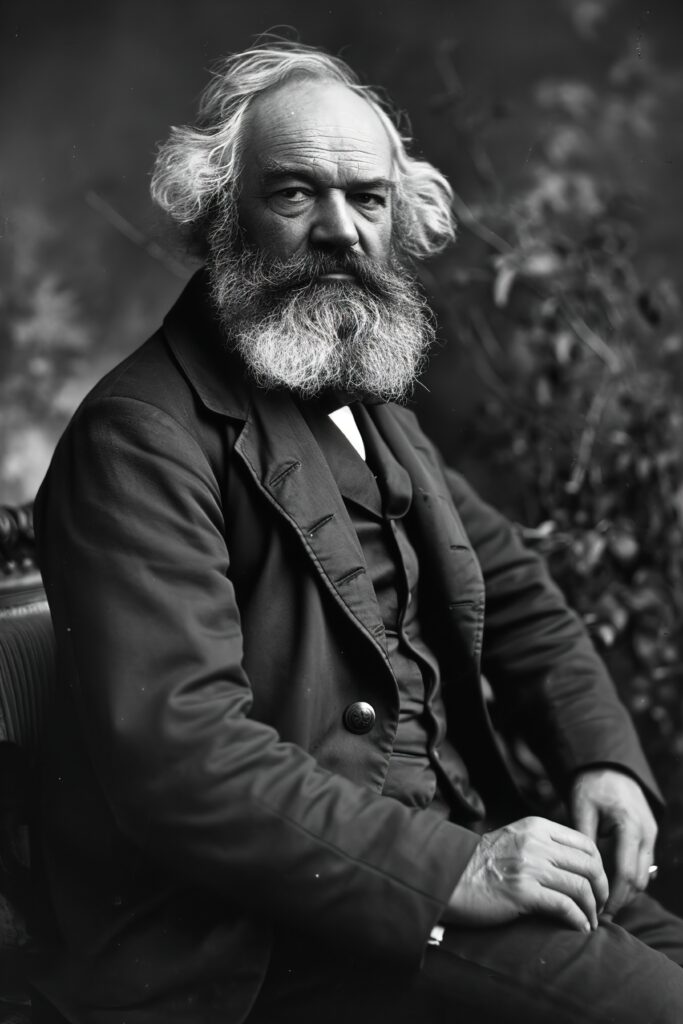
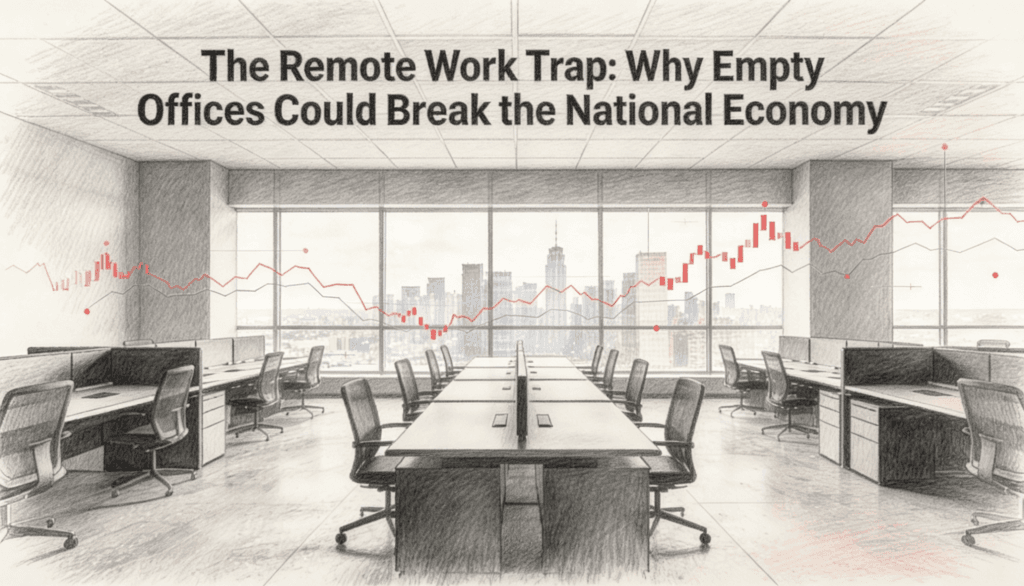
There is a particular kind of economic damage that does not announce itself. It does not arrive with a crash or a headline. It shows up as a slow, creeping erosion, the kind you only notice when you try to build something and realize the foundation has been hollowed out. That is the story of remote work and the national economy, and the economist who best explained why is a man who died before Zoom was even a concept.
Nicholas Kaldor spent much of the twentieth century arguing that economies do not grow the way most textbooks claim. Growth is not simply about having more stuff or more people. It is about density, connection, and the strange magic that happens when economic activity concentrates in physical space. He would have looked at millions of empty office buildings and seen something far more alarming than a real estate problem. He would have seen the machinery of national prosperity slowly grinding to a halt.
But let us not get ahead of ourselves.
The Man Who Thought Cities Were Engines
Kaldor was Hungarian born, Cambridge raised, and magnificently stubborn. He spent decades fighting with other economists, most notably Milton Friedman, about how economies actually function. His big insight, the one that matters here, was deceptively simple: manufacturing and concentrated economic activity generate increasing returns to scale. The more you do in one place, the more productive that place becomes. Not linearly. Exponentially.
He formalized this in what became known as Kaldor’s Growth Laws. The first law states that GDP growth is fundamentally tied to the growth of the manufacturing and productive sector. The second, often called Verdoorn’s Law as reinterpreted by Kaldor, argues that productivity growth is itself a function of output growth. In plain language: doing more makes you better at doing more. The third law extends this to the broader economy, arguing that as the productive sector absorbs more labor and capital, overall economic efficiency rises.
Now replace “manufacturing” with “knowledge work” and “factory floor” with “office district,” and you begin to see the problem with forty percent of the professional workforce logging in from their kitchen tables.
The Geography of Getting Things Done
Here is something that sounds obvious but carries enormous implications: economic activity has a physical footprint. When thousands of workers converge on a downtown core every morning, they do not just occupy desks. They buy coffee. They eat lunch. They drop off dry cleaning. They stop at the pharmacy. They browse a bookstore. They grab drinks after work. Each of these transactions supports another job, which supports another transaction, which supports another job.
Kaldor would have recognized this as a textbook case of cumulative causation, a concept he borrowed and refined from Gunnar Myrdal. The idea is straightforward. Success breeds success. A thriving commercial district attracts more businesses, which attracts more workers, which attracts more services, which makes the district more thriving. The cycle feeds itself.
The reverse is also true, and this is the part nobody in the “remote work is the future” camp wants to discuss honestly. Decline breeds decline. When offices empty, the sandwich shop loses customers. When the sandwich shop closes, the neighborhood becomes less attractive. When the neighborhood deteriorates, the remaining businesses leave. When the businesses leave, the tax base collapses. When the tax base collapses, public services degrade. When public services degrade, nobody wants to come back.
This is not speculation. It is happening right now in downtown cores across the United States, Canada, the United Kingdom, and Australia. San Francisco’s office vacancy rate has hovered around thirty percent. Manhattan has seen entire blocks of ground floor retail go dark. The commercial property market has lost value globally. And every empty storefront represents not just a failed business but a broken link in the chain of cumulative causation that Kaldor spent his career describing.
The Productivity Illusion
Remote work advocates love to cite productivity studies. Workers report being more productive at home. They accomplish more tasks. They attend fewer pointless meetings. All of this is probably true, and all of it is probably irrelevant.
The reason is that individual productivity and systemic productivity are not the same thing. You can be spectacularly efficient at your individual tasks while the broader system you are part of slowly loses its capacity to generate new ideas, new businesses, and new economic relationships. Kaldor understood this distinction deeply. His growth laws are not about individual firms or workers. They are about systems, about the emergent properties that arise when economic agents cluster and interact in physical space.
Think of it this way. A single musician practicing alone in a room can be extraordinarily productive in terms of technical skill development. But jazz was not invented by musicians practicing alone in rooms. It was invented in the dense, chaotic, overlapping social spaces of New Orleans, where musicians bumped into each other, heard each other, stole from each other, and created something none of them could have produced in isolation.
The modern knowledge economy works the same way, whether we want to admit it or not. The casual hallway conversation that sparks a new product idea. The lunch where two people from different departments realize their projects overlap. The after work drink where someone mentions a problem and someone else says, “I know a person who solved that.” These interactions are not inefficiencies to be optimized away. They are the engine of innovation itself.
Kaldor would have called this a form of increasing returns, the productive surplus generated by concentration and interaction. Remote work systematically eliminates it while measuring only the things that remain visible on a screen.
The Tax Base Time Bomb
Let us talk about money, because that is where the Kaldorian framework gets genuinely frightening.
Commercial real estate in major cities is not just buildings. It is the fiscal foundation of urban governance. Property taxes on office buildings fund schools, police, fire departments, public transit, and infrastructure. When those buildings lose value, which they are doing at an alarming rate, the tax revenue follows.
New York City generates roughly thirteen billion dollars annually from Class 4 property taxes on commercial real estate. If office valuations drop by thirty to forty percent, the city faces a multi billion dollar hole in its budget. This is not a problem that can be solved by raising rates on residential properties without triggering a political and economic backlash that makes the original problem worse.
Kaldor, who served as an economic advisor to multiple governments and was deeply interested in fiscal policy, would have recognized this as a structural crisis rather than a cyclical one. The revenue is not coming back because the workers are not coming back. And the workers are not coming back because the infrastructure of urban convenience, the restaurants, the transit, the retail, the nightlife, has deteriorated because the workers are not there. Cumulative causation, working in reverse, is a devastating force.
This creates what you might call a doom loop, though Kaldor himself would have used more measured language. The city cannot maintain services without revenue. It cannot generate revenue without occupied offices. It cannot fill offices without good services. Each element depends on the others, and all of them are moving in the wrong direction simultaneously.
The Distributional Disaster
There is another dimension to this that Kaldor would have found deeply troubling, and it concerns inequality.
Remote work is not available to everyone. It is overwhelmingly a privilege of the professional and managerial class. The barista, the bus driver, the janitor, the security guard, and the retail worker cannot do their jobs from home. Their livelihoods depend on the physical presence of office workers in commercial districts.
When the professional class retreats to home offices in the suburbs, it effectively withdraws its economic participation from the ecosystems that support lower income urban workers. The result is a transfer of economic activity from dense, diverse urban cores to diffuse, homogeneous suburban settings. The professional class experiences this as convenience. The service class experiences it as unemployment.
Kaldor was always attentive to these distributional questions. He argued persistently that economic policy could not be separated from questions of who benefits and who loses. The remote work transition represents one of the largest unplanned redistributions of economic activity in modern history, and it has been conducted almost entirely without democratic deliberation or policy planning. Nobody voted for it. Nobody modeled its consequences. It just happened, and now we are living inside the results.
There is an uncomfortable irony here. Many of the same people who advocate loudly for economic justice and worry about inequality are the same people who most enthusiastically embrace remote work. They do not see the contradiction because the harm is indirect. It is mediated through the Kaldorian mechanisms of cumulative causation and increasing returns that operate below the threshold of everyday visibility.
What Would Kaldor Actually Recommend
Kaldor was never shy about policy prescriptions. He would almost certainly have argued for active government intervention to manage the transition rather than letting market forces and individual preferences drive outcomes unguided.
This might include tax incentives for office occupancy, investment in making urban cores more attractive and livable, redesigning commercial districts to blend residential and office uses, and rethinking public transit to reflect new commuting patterns. It would definitely include some mechanism for ensuring that the costs of the transition do not fall disproportionately on the workers least able to absorb them.
He might also have pointed out, with characteristic intellectual sharpness, that the remote work debate suffers from a massive collective action problem. Each individual firm and worker makes a rational decision to embrace remote work based on their private costs and benefits. But the aggregate effect of millions of such decisions is a systemic outcome that nobody wants and nobody chose. This is, in many ways, a tragedy of the commons played out across the commercial geography of entire nations.
The most unsettling thing about the Kaldorian analysis of remote work is that it suggests the damage may be largely invisible until it is largely irreversible. Cumulative causation works slowly. The feedback loops take years to play out fully. By the time the consequences become undeniable, the urban commercial ecosystems that took decades to build may be beyond practical restoration.
We are running the largest uncontrolled experiment in economic geography in modern history. We are doing it without a plan, without a theory, and without a serious public conversation about the tradeoffs. We are letting millions of individual decisions about convenience and comfort reshape the physical and economic structure of our cities, and we are assuming it will all work out because individual workers report being happier on surveys.
Kaldor would have found this astonishing. Not because he was opposed to progress or flexibility, but because he understood something that our current discourse has almost entirely forgotten: economies are systems, and systems have properties that cannot be understood by looking at individual components in isolation. The fact that each remote worker is individually more comfortable tells us almost nothing about whether the aggregate outcome is sustainable.
The offices are empty. The sandwich shops are closing. The tax base is eroding. The feedback loops are turning. And somewhere, in whatever corner of the intellectual afterlife is reserved for stubbornly argumentative Cambridge economists, Nicholas Kaldor is shaking his head.