Table of Contents
In 1936, a British economist published a book that would reshape how governments manage economies for the next century. John Maynard Keynes was not writing about Bitcoin, obviously. The technology would not exist for another 73 years. But buried in the pages of The General Theory of Employment, Interest and Money was an idea so sharp, so uncomfortably true, that it describes the Bitcoin market better than most things written about Bitcoin itself.
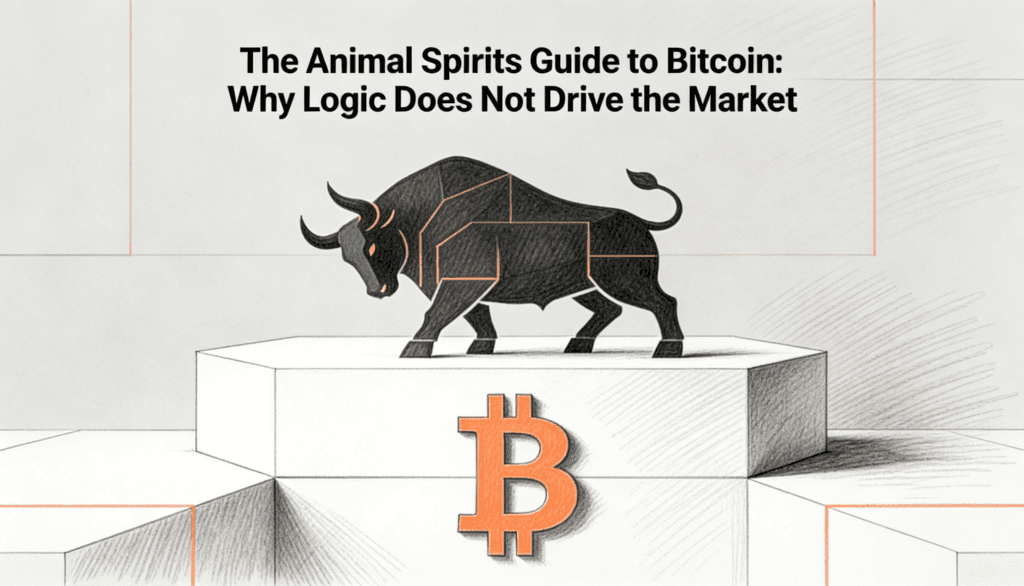
Keynes called it “animal spirits.”
He was not talking about mysticism or astrology. He was describing the raw, ungovernable emotional energy that drives human beings to act in markets. The spontaneous optimism. The gut feeling. The urge to do something rather than nothing, even when the math says to sit still. Keynes argued that most economic decisions are not the product of careful calculation. They are the product of mood. Of narrative. Of vibes, if you want to use the modern term.
Now look at Bitcoin. Look at it honestly. And tell me Keynes was wrong.
The Myth of the Rational Bitcoiner
There is a popular story the crypto world tells about itself. It goes like this: Bitcoin is a rational response to monetary policy failure. Central banks print too much money. Inflation erodes purchasing power. Therefore, a mathematically scarce digital asset with a fixed supply of 21 million coins is the logical hedge. Buy Bitcoin because the numbers make sense.
This story is neat. It is internally consistent. It is also, at best, a half truth.
If Bitcoin were driven purely by rational inflation hedging, its price would move in a relatively smooth upward trajectory correlated with money supply expansion. Instead, it does this: it sits around for months doing nothing, then erupts 300% in a year, then collapses 70%, then sits around again. The chart does not look like a rational hedge. It looks like the heart rate monitor of someone who just saw a spider.
The reason is simple. Most people do not buy Bitcoin because they have read monetary theory. They buy Bitcoin because someone they know made money. Or because a chart went vertical on social media. Or because a celebrity tweeted a laser eyes emoji. The decision is emotional first, and the rational justification comes after. Keynes had a term for this kind of backward reasoning too. He called it the tendency to disguise uncertainty with a veneer of mathematical precision.
Sound familiar?
What Keynes Actually Meant by Animal Spirits
It is worth spending a moment on the original concept, because it is more subtle than most people realize.
Keynes was not simply saying that people are dumb and emotional. He was making a deeper point. He was arguing that in situations of genuine uncertainty, where the future is truly unknowable, rationality itself breaks down as a useful guide. You cannot calculate the expected return of an investment when you have no reliable way to estimate future conditions. The math requires inputs that do not exist yet.
So what do humans do when they cannot calculate? They feel. They follow instincts. They look at what other people are doing and copy it. They tell themselves stories and believe them.
This is not a flaw in human cognition. Keynes treated it almost as a feature. Without animal spirits, he argued, most investment would never happen at all. If every entrepreneur waited until they had mathematical proof that their business would succeed, nobody would ever start anything. The global economy runs on irrational confidence.
Bitcoin takes this principle and amplifies it to a degree Keynes could not have imagined.
Think about what you are actually buying when you buy Bitcoin. You are not buying a claim on future earnings, like a stock. You are not buying a promise of repayment, like a bond. You are not buying a physical commodity with industrial uses, like copper. You are buying a digital entry on a distributed ledger, and the entirety of its value depends on the collective belief that other people will continue to value it. Bitcoin is worth something because we agree it is worth something. The moment that agreement fractures, it is worth less. The moment it strengthens, it is worth more.
In other words, Bitcoin is animal spirits in their purest possible form.
The Beauty Contest That Never Ends
Keynes had another idea that maps onto the Bitcoin market with eerie precision. He compared stock market investing to a newspaper beauty contest. Not the kind where you pick the prettiest face. The kind where you win by picking the face that most other people will pick as the prettiest.
Read that again. You are not trying to identify true value. You are trying to guess what everyone else thinks the value is. And they are trying to guess what you think the value is. And so on, in an infinite regression of guessing about guessing.
Bitcoin trading works exactly like this. Nobody knows the “correct” price of Bitcoin, because there is no earnings report, no dividend yield, no book value to anchor it. The price is whatever the collective psychology decides it is at any given moment. So the successful Bitcoin trader is not the one who understands the technology best or who can recite the whitepaper from memory. The successful trader is the one who can best anticipate shifts in crowd sentiment.
This is why technical analysis, which is essentially the study of patterns in crowd behavior, has such a devoted following in crypto. It is also why Twitter influencers can move the market with a single post. In the Keynesian beauty contest, narrative is everything. The story people believe about where Bitcoin is going matters more than any underlying reality, because in a very real sense, the story is the underlying reality.
The Paradox of Bitcoin Fundamentalists
Here is where things get interesting and slightly uncomfortable for the true believers.
The Bitcoin community includes a significant contingent of hardcore fundamentalists. They believe in the technology. They believe in the fixed supply. They believe in the long term thesis. They call themselves HODLers and they do not sell, regardless of price action. Diamond hands. Conviction.
On the surface, this looks like the opposite of animal spirits. It looks like cold, principled rationality. But is it?
Consider what HODLing actually requires. It requires you to watch your investment lose 70% of its value and do nothing. No rational risk management framework in the world would endorse this behavior. Every standard portfolio theory would tell you to rebalance, to cut losses, to manage downside exposure. The HODLer ignores all of this.
What sustains them through the drawdown is not logic. It is faith. It is community. It is identity. Being a Bitcoin maximalist is not just an investment thesis. It is a worldview, a social group, a sense of belonging. The conviction does not come from a spreadsheet. It comes from the gut.
Keynes would have recognized this immediately. This is animal spirits wearing the costume of rationality. The emotion comes first. The sophisticated arguments about monetary debasement and Metcalfe’s Law and stock to flow models come second, as intellectual armor to protect a decision that was fundamentally emotional from the start.
This is not an insult, by the way. Keynes would probably have admired it. He understood that animal spirits are what make things happen. Without irrational conviction, Bitcoin would have died in 2011 when it crashed from $32 to $2. Instead, a small group of irrationally committed people kept building, kept buying, kept believing. Their animal spirits carried the network through its most vulnerable years.
When the Spirits Turn Dark
The trouble with animal spirits is that they swing both ways.
The same spontaneous optimism that drives a bull market can reverse into spontaneous despair. And when it does, the effect is devastating precisely because there is no fundamental floor beneath the price. A stock can only fall so far before its dividend yield or asset value attracts buyers. Bitcoin has no such anchor. When confidence evaporates, the only thing stopping the price from falling further is the point where someone else’s animal spirits kick in and tell them it is time to buy.
Every Bitcoin crash follows the same emotional arc. Disbelief. Anxiety. Panic. Capitulation. Depression. Then, slowly, hope. Then optimism. Then euphoria. Then the cycle starts again. This is not a market moving on information. This is a market moving on emotion, just as Keynes described nearly a century ago.
The 2022 bear market was a textbook example. Bitcoin lost roughly 75% from its all time high. The rational thesis had not changed. The supply was still capped at 21 million. The halving cycle was still intact. The network was still functioning. But none of that mattered because the animal spirits had shifted. The vibes were bad. So the price fell.
So What Do You Actually Do With This Information?
If you have read this far, you might be feeling a mix of recognition and unease. Recognition because you have probably experienced these emotional cycles yourself. Unease because the implication seems to be that the Bitcoin market is fundamentally irrational and therefore unpredictable.
But that is not quite the takeaway. The takeaway is more nuanced.
Understanding animal spirits does not make you immune to them. But it does give you a kind of peripheral vision. You can start to notice when the narrative is shifting before the price does. You can recognize the signs of euphoria and the signs of despair. You can catch yourself making decisions based on feeling and at least pause to ask whether the feeling is based on anything real.
Keynes himself was an extraordinarily successful investor, despite or perhaps because of his dim view of market rationality. He understood that markets can remain irrational longer than you can remain solvent. But he also understood that the crowd’s emotions create opportunities for those who can see them clearly.
The practical application is this: do not trust the narrative at the extremes. When every taxi driver is telling you to buy Bitcoin, the animal spirits are running too hot. When your most committed crypto friends are quietly deleting their portfolio apps, the animal spirits are running too cold. The crowd is a useful signal, but only if you are reading it rather than joining it.
Keynes Would Have Been Fascinated by Bitcoin
It is tempting to speculate about what Keynes would have thought about cryptocurrency. I think he would have been simultaneously appalled and delighted. Appalled because Bitcoin represents everything he warned about: a market driven almost entirely by animal spirits, with no institutional framework to cushion the swings. Delighted because it proves his thesis more completely than anything that existed in his own era.
Keynes spent his career arguing that markets are not the efficient, rational mechanisms that classical economists believed. He said that emotion, narrative, and herd behavior play a far larger role than anyone wanted to admit. For decades, the efficient market hypothesis crowd pushed back, insisting that prices reflect all available information and that markets tend toward equilibrium.
Then Bitcoin came along. A trillion dollar asset class whose price swings 80% in a year based on tweets, memes, and collective mood. If Keynes needed a case study, he could not have designed a better one.
The lesson is not that Bitcoin is worthless because it is driven by emotion. The lesson is that understanding the emotional machinery is the closest thing you will get to an edge in this market. The numbers matter. The technology matters. But in the end, what moves the price is the same thing that has always moved prices, long before the first block was ever mined.
Animal spirits. Wild, irrational, and absolutely unstoppable.