Table of Contents
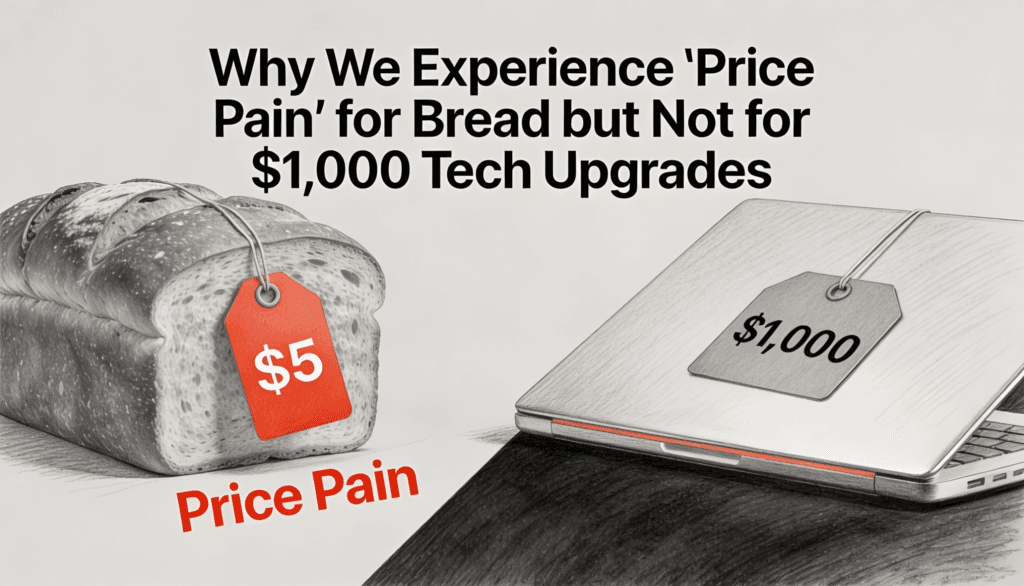
You will haggle over the price of bread. You will compare three stores to save forty cents on a loaf. You will feel genuine irritation when the price jumps from $3.50 to $4.20.
Then you will walk into an Apple Store and spend $1,000 on a phone that is barely different from the one in your pocket. You will not flinch. You might even feel good about it.
This is not because you are bad at math. It is because your brain is running a completely different program for each purchase, and the professor Dan Ariely has spent decades figuring out why.
The short answer is that humans do not experience price as a number. We experience it as a feeling. And that feeling is shaped by context, comparison, proportion, and a dozen invisible forces that have almost nothing to do with the actual value of what we are buying. The long answer is stranger, more interesting, and a little bit embarrassing for all of us.
The Relative Thinking Trap
Ariely’s research builds on a foundational insight that sounds simple until you realize how deeply it runs. We do not evaluate prices in absolute terms. We evaluate them relative to something else.
Here is a classic scenario from behavioral economics. You are buying a pen for $25. Someone tells you the same pen is available at a store twenty minutes away for $18. Most people say they would make the trip. Seven dollars saved on a $25 pen feels meaningful.
Now change the setup. You are buying a suit for $455. Someone tells you the same suit is available twenty minutes away for $448. Same seven dollars. Same twenty minutes. But most people shrug and say it is not worth the trip.
The money is identical. The effort is identical. But the feeling is completely different because your brain is not calculating the absolute savings. It is calculating the percentage. Seven dollars off $25 is 28 percent. Seven dollars off $455 is barely 1.5 percent. Your brain sees the first discount as a small victory and the second as a rounding error.
This is what Ariely calls relative thinking, and it is one of the core engines behind price pain. It explains why a fifty cent increase in bread feels like an assault on your household budget while a hundred dollar jump in laptop prices barely registers. The bread went up fifty percent. The laptop went up 10 percent. Your emotional accounting system cares about the ratio, not the receipt.
Anchoring and the Disappearing Dollar
Relative thinking is only the beginning. The next layer is anchoring, and this is where things get genuinely uncomfortable for anyone who likes to believe they make rational decisions.
Ariely demonstrated this beautifully in experiments where he asked people to write down the last two digits of their social security number before bidding on items in an auction. People with higher social security numbers consistently bid more. The number was completely irrelevant to the value of the item. It was random. But it stuck in the mind as a reference point, and the bids shifted accordingly.
Now apply this to everyday spending. When you walk into a grocery store, you carry anchors for every product. You know what bread should cost. You know what milk should cost. You have years of reference points, weekly exposure, and an almost instinctive sense of the “right” price. When bread costs more than your anchor, it feels wrong. It feels like you are being cheated.
Technology operates in a completely different anchoring environment. What should a phone cost? You do not really know. The category barely existed twenty years ago. The price has always been high. Your anchor for a flagship phone is already somewhere near $800 or $900 because that is what you paid last time. When the new one costs $1,099, the jump from your anchor is moderate. When bread goes from $3.50 to $4.20, the jump from your anchor is proportionally enormous and emotionally loud.
This is also why tech companies are so careful about pricing architecture. They do not just set prices. They set anchors. Show the $1,199 model first, and suddenly the $999 model looks like a bargain. This is not an accident. It is anchoring deployed with surgical precision.
Pain of Paying and the Credit Card Anesthetic
Ariely’s work on the “pain of paying” adds another dimension that helps explain the bread versus tech gap. He found that the act of paying itself produces a form of psychological discomfort. But the intensity of that discomfort depends heavily on the payment method and the timing.
Cash hurts the most. Handing over physical bills creates a tangible sense of loss. You can feel the money leaving. Credit cards hurt less because the loss is abstract and delayed. You do not feel it now. You feel it in thirty days, and by then the pain has faded.
Think about how you buy bread versus how you buy technology. Bread is a frequent, small, often cash adjacent purchase. Even if you use a card, you see the price every week. You are reminded constantly. The pain is fresh and recurring. A tech upgrade is a single event, almost always purchased on a credit card, sometimes broken into monthly payments that disguise the total cost entirely. Twelve payments of $83 does not feel like $1,000. It feels like a subscription. And we have been trained to accept subscriptions the way we accept weather.
There is a fascinating connection here to what psychologists call the “drip pricing” effect used in completely different industries. Airlines discovered this years ago. Show a $200 base fare and then add $35 for bags, $28 for seat selection, $15 for priority boarding. By the time the total hits $278, each individual addition felt small enough to accept. The pain was distributed. Tech financing and trade in programs work the same way. The sticker price is just the starting point of a negotiation designed to dissolve your resistance one small step at a time.
The Story We Tell Ourselves
Ariely has also explored how narrative and identity shape our spending emotions, and this might be the most powerful lens of all.
When you buy an expensive piece of technology, you are not just buying a product. You are buying a story about yourself. You are someone who values innovation. You are someone who stays current. You are making an investment in productivity, creativity, connection. The purchase comes wrapped in meaning, and meaning is a powerful painkiller.
Bread has no story. Bread is not aspirational. Nobody posts an unboxing video for a loaf of sourdough. The purchase carries no identity value, no social signal, no narrative of self improvement. It is pure utility, and pure utility purchases are where price sensitivity lives.
This connects to a broader pattern that the sociologist Thorstein Veblen identified over a century ago, long before anyone was lining up for product launches. Veblen noticed that for certain goods, a higher price actually increases desire. These are goods that serve a social signaling function. You do not want them despite the cost. You want them partly because of the cost. The price is the point.
Nobody has ever bought an expensive loaf of bread to signal status. But people absolutely buy expensive phones, headphones, and laptops for reasons that go well beyond the technical specifications. The price pain is dulled by the social reward. And when social reward is absent, as with bread, there is nothing left to feel except the price.
The Decoy Effect and How Companies Exploit All of This
Once you understand the mechanics of price pain, you start to see how deliberately companies engineer around it. Ariely’s work on the “decoy effect” is a perfect example.
If you offer people two options, they will compare them and often feel torn. But if you add a third option that is clearly worse than one of the original two, people will overwhelmingly choose the option that dominates the decoy. The decoy exists only to make one choice look better. It is not a real option. It is a psychological tool.
Tech companies use decoys constantly. The base model exists to make the mid tier look reasonable. The mid tier exists to make the premium look like only a small step up. By the time you have navigated the pricing ladder, you have spent $300 more than you intended and you feel clever about it.
Grocery stores cannot play this game as easily. Bread is bread. There is no premium tier with a titanium crust. The category is too simple, the purchase too transparent, and the comparison too direct. You see the price, you compare it to last week, and you feel the difference. There is no architecture of distraction.
What This Actually Means for How We Live
The uncomfortable truth buried in all of Ariely’s work is that we are not spending based on value. We are spending based on feeling. And the feelings are being shaped by forces we rarely examine.
You are more “careful” with bread not because you are being financially responsible. You are more careful with bread because your brain is wired to notice small frequent losses in familiar categories. You are more “careless” with technology not because you are irresponsible. You are careless with technology because the payment is abstract, the anchors are high, the frequency is low, and the purchase comes wrapped in a flattering story about who you are.
This creates a genuinely strange economic landscape. People who will argue with a cashier about a thirty cent price discrepancy on yogurt will cheerfully add $200 for extra storage they will never use on a device they will replace in two years. The same person. The same brain. Completely different behavior. The only thing that changed was the context.
Ariely does not argue that we should feel the same way about every purchase. He argues that we should at least be aware of what is happening. If you knew that your brain was running a percentage calculation instead of an absolute one, you might think twice before driving twenty minutes to save seven dollars on a pen while ignoring the seven dollars you could save on a suit. If you knew that payment timing was dulling your sensitivity, you might look at the total cost of ownership instead of the monthly payment.
The Final Irony
Perhaps the richest irony in all of this is that the purchases where we feel the most pain are often the ones where we are making the most rational decisions. You compare bread prices because the category is simple enough for your brain to process honestly. You check unit costs. You notice changes. You respond to real information.
The purchases where we feel the least pain are often where we are being the most irrational. We are anchored to arbitrary numbers. We are seduced by narratives. We are numbed by payment structures designed to suppress exactly the critical thinking we apply so effortlessly to groceries.
We are brilliant economists at the bakery and willing amateurs at the electronics counter. And the gap between those two versions of ourselves is not a flaw in our character. It is a feature of our psychology, one that was never designed for a world where you can finance a thousand dollar rectangle on a twelve month plan and never once confront the total.
The next time you feel a flash of irritation at the price of bread, take a moment to appreciate it. That irritation is your brain working correctly. It is the silence at the Apple Store that should worry you.