Table of Contents
The eighteenth century had a project. It was ambitious, optimistic, and slightly drunk on its own confidence. The project was called the Enlightenment, and its promise was simple: human reason could figure out everything. God, morality, politics, the natural world. Give us enough time and enough thinking, and we will hand you the blueprint of reality.
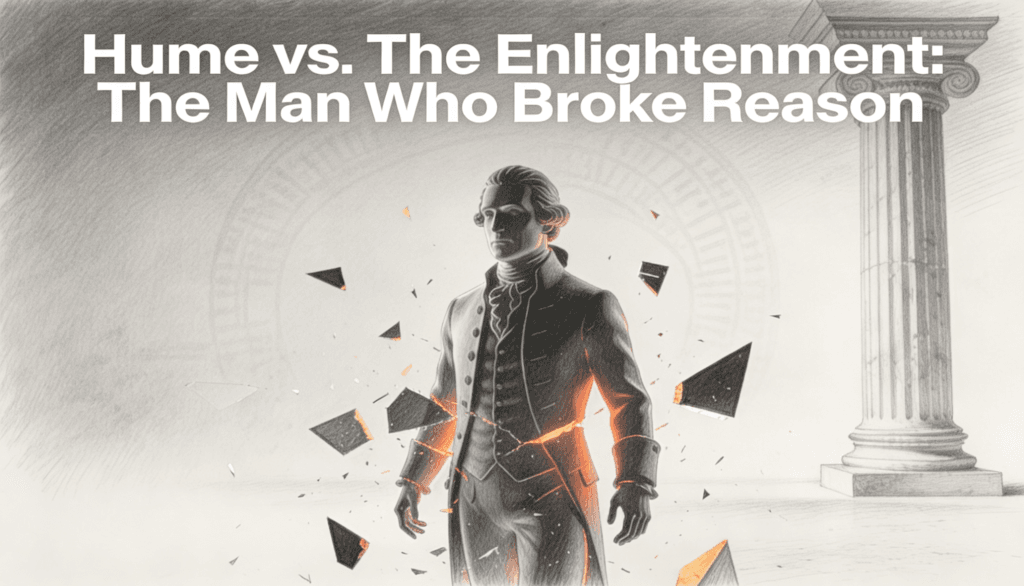
Then David Hume walked in, sat down, and politely dismantled the entire thing.
What makes Hume so fascinating is not that he rejected reason. Plenty of people have done that, usually while yelling about tradition or God or the dangers of thinking too much. Hume did something far more devastating. He used reason to demonstrate the limits of reason. He played the game better than anyone else at the table, and then showed everyone that the game was rigged.
This is the story of how one Scottish philosopher became the Enlightenment’s greatest product and its greatest threat at the same time.
The Promise That Ate Itself
To understand what Hume broke, you need to understand what was being built.
The Enlightenment was not a single movement. It was more like a mood that swept across Europe in the seventeenth and eighteenth centuries. Thinkers like Descartes, Locke, Leibniz, and Newton were constructing a vision of the universe that ran on logic and observation. The medieval world had operated on faith, authority, and “because the Church said so.” The Enlightenment replaced that with a radical bet: human beings, armed with nothing but their own minds, could arrive at truth.
Descartes had kicked things off by doubting everything until he found one thing he could not doubt: the fact that he was doubting. “I think, therefore I am.” From that tiny foothold, he tried to rebuild all of human knowledge through pure rational deduction. Locke took a different route, arguing that knowledge comes from experience. Newton showed that the physical universe obeys mathematical laws so elegant they seemed to prove that a rational God had designed the whole machine.
The mood was electric. Reason was winning. Superstition was retreating. The future belonged to the mind.
And then Hume, born in Edinburgh in 1711, grew up inside this tradition, absorbed it completely, and asked a question that nobody had a good answer for: what if reason cannot actually do what you think it can?
The Problem of Cause and Effect
Hume’s most famous argument is deceptively simple. It attacks something so basic that most people never think to question it: causation.
You put a pot of water on a flame. The water boils. You say the flame caused the water to boil. Obviously. Except Hume pointed out that what you actually observed was one event followed by another event. You saw the flame. Then you saw the boiling. You did not see the causing. You never perceive causation directly. You perceive sequence and regularity, and your mind fills in the rest.
This sounds like a minor technical point. It is not. The entire scientific method rests on causal reasoning. Every law of physics is a statement about what causes what. If Hume is right that we never actually observe causation, then the foundation of empirical knowledge is not observation. It is habit. We expect the future to resemble the past because it always has before. But that expectation is itself based on past experience, which means we are using the very thing we are trying to justify as the justification. The argument is circular.
Hume was not saying that the water will not boil tomorrow. He was saying that our confidence that it will boil is not grounded in reason. It is grounded in a psychological tendency. We are pattern recognition machines, and we mistake our programming for proof.
If this feels uncomfortable, good. It is supposed to.
Induction and the Sunrise You Cannot Prove
The technical name for this problem is the Problem of Induction, and it remains unsolved to this day. That is not an exaggeration. Over three hundred years of philosophy and science have passed since Hume raised the issue, and no one has produced a universally accepted answer.
Induction is the process of reasoning from specific observations to general conclusions. You observe that the sun has risen every morning of your life. You conclude that it will rise tomorrow. This seems perfectly reasonable. But Hume showed that the reasoning only works if you assume that nature is uniform, that the future will continue to operate by the same rules as the past. And you cannot prove that assumption without using induction, which is the very thing you are trying to prove.
The philosopher Bertrand Russell later illustrated this with the story of a chicken that is fed every morning by the farmer. Every day, the chicken’s confidence grows. The evidence is overwhelming. The farmer always brings food. Then one morning, the farmer brings an axe.
The chicken’s inductive reasoning was impeccable. Its conclusion was fatal.
Hume did not think we should stop trusting induction. He thought we should be honest about what induction actually is: a practical habit that works remarkably well, not a product of pure logic. The distinction matters more than it might seem. If you think reason alone guarantees your beliefs, you will defend those beliefs with absolute certainty. If you understand that your beliefs rest on habits that happen to be reliable, you hold them with a certain appropriate humility.
Reason Is the Slave of the Passions
Hume did not stop at knowledge. He went after morality too, and what he said there is possibly even more unsettling.
The Enlightenment assumed that reason could tell us not just what is true but what is good. If we think clearly enough, we can derive moral principles from rational analysis. Hume said no. Reason can tell you how to get what you want. It cannot tell you what to want. You cannot derive an “ought” from an “is.”
This is known as Hume’s Guillotine, and it cuts deep. You can observe that giving to charity reduces suffering. You can calculate the most efficient way to distribute resources. But the judgment that suffering is bad and should be reduced? That comes from feeling, not logic. Reason is, as Hume put it, the slave of the passions. It serves our desires. It does not generate them.
Think about how radical this claim was in context. The Enlightenment was building a civilization on the idea that reason could guide human life. Hume was saying that reason is a tool, not a compass. It can navigate, but it cannot choose the destination. The destination is always chosen by something deeper, something emotional, something that does not submit to logical proof.
There is a strange modern echo of this argument in artificial intelligence research. When engineers build AI systems, they quickly discover that intelligence alone does not produce goals. You can make a system extraordinarily good at processing information, but you still need to tell it what to optimize for. The objectives come from outside the system. Hume saw this three centuries before anyone built a neural network.
The Miracle Argument That Still Works
Hume also produced what is probably the most elegant argument against miracles ever written. It goes like this.
A miracle, by definition, is a violation of the laws of nature. The evidence for the laws of nature is the uniform experience of all humanity. So when someone tells you they witnessed a miracle, you are weighing two things: the reliability of their testimony versus the entire accumulated experience of the human species regarding how nature works.
For it to be rational to believe in the miracle, it would have to be even more miraculous that the testimony was false than that the miracle actually occurred. In almost every case, the testimony being wrong is the less extraordinary option.
Notice that Hume did not say miracles are impossible. He said it is almost never rational to believe in them based on testimony. The argument is not metaphysical. It is about evidence and probability. And it works equally well whether you are evaluating a biblical miracle or a friend who swears they saw a UFO.
The beauty of the argument is its modesty. It does not claim to know the ultimate nature of reality. It simply asks: given what we know, what is the most reasonable thing to believe? This is Hume at his best. Not dogmatic, not arrogant, just relentlessly clear.
The Fork That Left No Room
Then there is Hume’s Fork, which divides all human knowledge into two categories. The first is relations of ideas: things that are true by definition, like mathematical truths. A triangle has three sides. Two plus two equals four. These are certain but they do not tell you anything about the real world. They are true regardless of what exists.
The second category is matters of fact: things we learn through experience. The sun is hot. Water is wet. These tell you about the real world but they are never absolutely certain, because they depend on observation, and observation can always be wrong.
That is it. Those are your two options. And if a claim fits into neither category, Hume’s recommendation was blunt: commit it to the flames, for it can contain nothing but sophistry and illusion.
This eliminates a staggering amount of what philosophers and theologians had spent centuries arguing about. Metaphysical claims about the nature of God, the soul, ultimate reality. If they are not mathematical truths and they are not based on observation, they are, by Hume’s standard, meaningless.
You can see why the Enlightenment found Hume both thrilling and terrifying.
The Man Who Woke Kant Up
The philosopher Immanuel Kant famously said that Hume woke him from his “dogmatic slumber.” Kant recognized that Hume had identified a genuine crisis. If reason cannot justify causation, induction, or morality, then the Enlightenment project needs to be rebuilt from scratch.
Kant spent decades trying to solve this problem. His solution, laid out in the Critique of Pure Reason, was that our minds actively structure experience. Causation is not something we observe in the world or infer from habit. It is a category that the mind imposes on experience as a precondition for having any experience at all. Space, time, and causation are the lenses through which we see reality, built into the architecture of consciousness itself.
Whether Kant actually solved Hume’s problem is still debated. Some philosophers think he did. Others think he just moved the problem somewhere else. But the point is that Hume’s challenge was so severe that it forced the greatest mind of the next generation to spend his entire career responding to it.
That is the measure of how deeply Hume cut.
The Cheerful Skeptic
Here is the part that confuses people. You would expect someone who demolished the foundations of human knowledge to be a gloomy, tortured figure. Hume was the opposite. By all accounts, he was cheerful, sociable, and genuinely good company. He was known in Paris as “le bon David.” He hosted dinner parties. He was kind to his friends and generous with his enemies.
Hume’s skepticism did not lead him to despair. It led him to a kind of relaxed acceptance. We cannot prove that the sun will rise tomorrow, but we naturally believe it will, and that natural belief is good enough. We cannot derive morality from logic, but we have feelings of sympathy and benevolence that guide us well enough. The foundations are not as solid as we thought, but the building still stands.
There is something deeply mature about this position. It is the philosophical equivalent of a seasoned adult who has lost certain illusions about the world but has not become bitter about it. The universe is less certain than we pretended, and that is fine. We can live well without absolute guarantees.
Why Hume Still Matters
Hume matters today because the temptation he identified has not gone away. We still want reason to be a foundation rather than a tool. We still want certainty where only probability exists. We still confuse strong feelings of conviction with actual proof.
Look at how people argue on the internet. Every side is absolutely certain. Every side thinks the evidence is overwhelmingly on their side. Every side thinks the other side is not just wrong but irrational. Hume would recognize this instantly. He would point out that most of these convictions are driven by passion, not reason, and that the certainty people feel is a psychological state, not a logical achievement.
This does not mean all positions are equally valid. Some beliefs are better supported by evidence than others. But recognizing that even our best beliefs rest on assumptions that cannot be proven is a form of intellectual honesty that is increasingly rare.
Hume broke reason not to destroy it but to save it from its own arrogance. He showed that a tool which knows its own limits is far more useful than one that pretends to have none. Three centuries later, we are still catching up to that insight.
The Enlightenment built a cathedral to reason. Hume checked the foundations and found them resting on something softer than anyone wanted to admit. He did not tear the cathedral down. He just made sure everyone knew exactly what they were standing on.
Most of us still prefer not to look.