Table of Contents
Marcus Tullius Cicero was, by most accounts, the greatest orator Rome ever produced. He defended the Republic against conspirators, wrote philosophical treatises that shaped Western thought for two millennia, and delivered speeches so devastating that his enemies eventually had his hands and tongue nailed to the Roman Forum’s speaking platform. That last detail matters. It tells you something about what happens to people who are very, very good at public speech and refuse to stop using it.
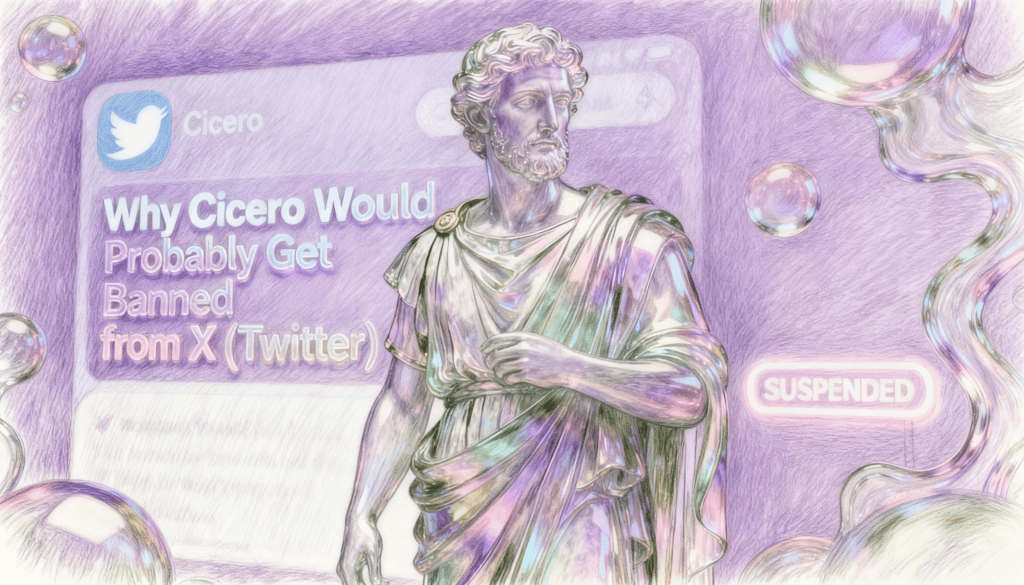
Now imagine dropping this man into the year 2026 with a smartphone and a verified account on X.
He would last about six weeks.
The Problem with Being Too Good at Rhetoric
Modern social media rewards a specific kind of communication. It is short. It is reactive. It is usually shallow. The ideal post captures a feeling, not an argument. It performs outrage or agreement in the space of a breath. Cicero would have understood the mechanics of this instantly, because he literally wrote the manual on persuasion. His treatise De Oratore breaks down exactly how to move a crowd through emotion, logic, and character. He knew the game better than anyone alive today.
And that is precisely why he would be dangerous.
Cicero would not post “This is wild” under a news article and move on. He would compose a thread. And that thread would be structurally perfect. It would begin by establishing common ground with the reader, shift into a careful reframing of the issue, build emotional pressure through vivid language, and arrive at a conclusion that made you feel stupid for ever thinking otherwise. He did this in courtrooms. He did this in the Roman Senate. He would absolutely do this about cryptocurrency regulation or the latest political scandal.
The algorithm would love him at first. Engagement would be enormous. People would share his threads not because they agreed, but because they could not look away. There is a difference between content that gets clicks and content that actually changes minds. Cicero was in the business of the latter. That makes platforms nervous.
A Man Who Insulted People for a Living
Let us talk about the Philippics. These were a series of speeches Cicero delivered against Mark Antony, one of the most powerful men in the Roman world. They were not polite disagreements. They were systematic demolitions of a man’s character, intelligence, and right to hold power. Cicero accused Antony of being a drunk, a thief, a tyrant in waiting, and a man whose personal life was so depraved it would embarrass a gladiator.
He did all of this publicly. Repeatedly. With eloquence that made each insult land harder than a simple slur ever could.
Now, X has community guidelines. You are not supposed to engage in targeted harassment. You are not supposed to dehumanize people. There is a whole section about not inciting violence. Cicero’s Philippics would violate at least three of these categories before the second paragraph. But here is the interesting part: Cicero would not be using slurs or crude language. He would be using irony, implication, and the kind of devastating understatement that makes the reader do the dirty work. When he said that Antony had “vomited his way through” that is technically a metaphor. Try explaining that to a content moderation team.
This highlights something genuinely strange about how we police speech online. A person can post something vicious and obvious, and it gets flagged immediately. But a person who can dress destruction in beautiful language? The system does not know what to do with that. Our content moderation infrastructure is built to catch blunt instruments. Cicero was a scalpel.
The Paradox of Civic Speech on Private Platforms
Cicero believed, with every fiber of his being, that public speech was the foundation of a free republic. He was not being romantic about this. He had watched the Roman Republic start to collapse in real time, and he identified the cause with uncomfortable clarity: people stopped arguing and started killing. When persuasion fails, violence follows. Speech, for Cicero, was not just a right. It was the load bearing wall of civilization.
This puts him in direct conflict with the fundamental structure of social media. X is not a public forum. It is a private company that looks like a public forum. The distinction matters enormously and would have driven Cicero absolutely mad. In Rome, the Forum was genuinely public. Anyone could speak. The crowd could respond. There were social consequences for bad speech, but those consequences came from the community, not from an invisible authority that could silence you without explanation.
Cicero would have found the concept of shadowbanning philosophically obscene. Not because he believed everyone deserved an audience, but because he believed the act of silencing speech should itself be a public act, subject to public scrutiny. If you are going to shut someone up, you should have to stand in front of everyone and explain why. The Roman Senate did this. They debated censorship openly. Agree or disagree with their conclusions, at least the process was visible.
This is not how content moderation works in 2026. Decisions happen behind closed doors, enforced by algorithms trained on datasets no one outside the company has reviewed, applied by moderators who have seconds to evaluate context that took hours to create. Cicero would have written a twelve part thread about this. It would have gone viral. Then it would have been flagged for “platform manipulation” because the engagement was suspiciously high.
He Would Have Been a Reply Guy (The Worst Kind)
There is a social norm on X that you are not supposed to write too much. Long replies are seen as aggressive. Detailed rebuttals are read as obsessive. The culture rewards the quick comeback, the clever dunk, the screenshot with a single word caption. Cicero was constitutionally incapable of this kind of brevity when it mattered.
If someone posted a bad political take, Cicero would not quote tweet it with “ratio.” He would write a five hundred word reply dissecting every logical fallacy, tracing the historical precedent the poster was ignoring, and ending with a rhetorical question so perfectly constructed that the original poster would lie awake thinking about it at three in the morning. This is, in modern internet culture, considered unhinged behavior.
There is something worth examining here about how we have come to associate length with instability. In academic and legal contexts, thoroughness is a virtue. Online, it is a red flag. A person who writes four paragraphs in a reply section is assumed to be either unemployed or emotionally compromised. Cicero wrote speeches that lasted hours. He prepared for weeks. He considered this basic professional hygiene. The internet would consider it a symptom.
This connects to something broader about how digital culture has reshaped our relationship with attention itself. The economist Herbert Simon observed decades ago that information abundance creates attention scarcity. When there is too much to read, we develop heuristics for what to skip. Length becomes a cost signal. Cicero’s entire art form depended on an audience that would sit still. Social media has produced an audience that physically cannot.
The Verification Problem
Cicero was a senator and a consul. In Rome, his authority was visible. When he spoke, everyone knew who he was, what office he held, and what he had done to earn the right to speak. This context was inseparable from his rhetoric. When he accused Catiline of conspiracy, the accusation carried weight because it came from the consul of Rome, standing in the Temple of Jupiter, surrounded by armed guards. The medium was part of the message.
On X, a blue checkmark now means you pay eight dollars a month. Cicero’s credentials would be visually identical to those of a person who posts memes about protein powder. The flattening of authority is one of the most underappreciated features of social media. It is, in some ways, deeply democratic. It is also the reason a former consul of the Roman Republic would have the same visual credibility as an account called @AlphaGrindset2024.
Cicero would have hated this with a passion that borders on the spiritual. He was, let us be honest, an elitist. He believed that some people were more qualified to speak on public matters than others, and he believed this qualification came from education, experience, and demonstrated virtue. You can argue with that position. Many people do. But you cannot deny that it sits in violent opposition to a platform where everyone’s voice arrives in the same font size.
He Would Get Mass Reported
Here is the mechanism that would actually get Cicero banned. It would not be a single violation. It would be coordinated reporting. Cicero made enemies the way other people make small talk. His style of rhetoric was specifically designed to make powerful people look foolish in front of an audience. In Rome, those people hired assassins. On X, they would organize their followers to mass report his account.
The reporting system on most platforms is volume sensitive. If enough people report an account in a short period, automated systems kick in. Suspensions happen. Reviews take days. For a man who built his entire career on the principle that silencing speech is the first step toward tyranny, this would be the ultimate indignity: not being defeated by a better argument, but being buried by a button.
And this reveals a real tension in how platforms handle conflict. The tools designed to protect users from harassment can be weaponized by the very people Cicero spent his life opposing. Demagogues and authoritarians have always understood that you do not need to win the argument if you can prevent the argument from happening. Cicero watched Julius Caesar figure this out in real time. He would recognize the pattern immediately on social media. He would just be unable to stop it.
What Cicero Would Actually Think About All This
If we are being honest, Cicero would probably see modern social media as a confirmation of his deepest fears about democracy. He loved the Republic, but he did not love the mob. He spent his career trying to channel public passion through institutional structures: courts, senates, formal debates with rules and procedures. He believed that unstructured public discourse was not freedom but chaos wearing freedom’s clothing.
Social media is, in many ways, the mob without the forum. It has the passion, the collective energy, the ability to elevate and destroy. What it lacks is structure. There is no procedure. There is no chairperson. There is no agreed upon standard for evidence. Cicero would look at a trending topic and see the Roman crowd at its worst: reactive, emotional, and profoundly easy to manipulate.
But he would also see something else. He would see millions of people trying to participate in public life, trying to be heard, trying to hold the powerful accountable. He would recognize that impulse because it was his impulse. The Roman Forum was loud and messy and sometimes violent. He loved it anyway. He loved it because the alternative was silence, and silence meant someone else was making decisions for you.
So Cicero would get on X. He would post. He would argue. He would be brilliant and petty and self righteous and occasionally wrong. He would get banned, appeal, get reinstated, and get banned again. He would write a long essay about it and post it somewhere else.
And two thousand years later, we would still be reading it.