Table of Contents
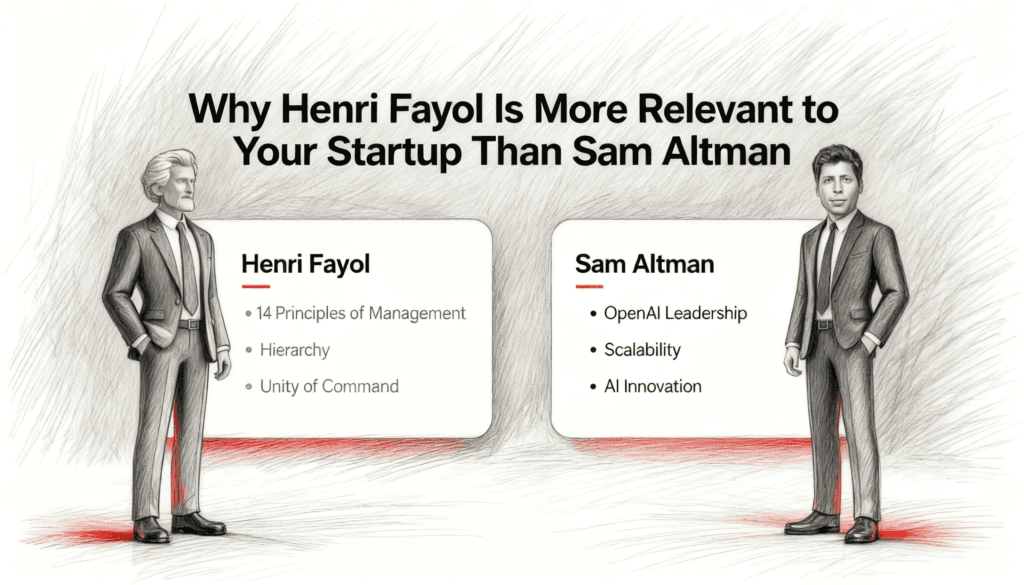
There is a man whose ideas quietly run your company. He has been dead for nearly a century. He never raised a seed round, never posted a thread on X, and never pivoted. His name is Henri Fayol, and he understood more about building organizations than most of the people currently gracing the covers of business magazines.
Meanwhile, Sam Altman is everywhere. He is the face of the AI revolution, the CEO of OpenAI, the man who supposedly holds the keys to the future. Founders quote him like scripture. They study his essays, parse his interviews, and try to reverse engineer his playbook. And yet, if you are running a startup of five, fifteen, or even fifty people, almost nothing Altman talks about applies to your daily reality. His problems are not your problems. His scale is not your scale. His Tuesday morning looks nothing like yours.
Fayol, on the other hand, wrote the operating manual you did not know you needed.
The Frenchman Nobody Talks About at Demo Day
Henri Fayol was a French mining engineer who spent his career running a large mining company in the late 1800s and early 1900s. He took over the company when it was on the verge of bankruptcy and turned it into one of the most successful industrial operations in France. Then he sat down and wrote about what he had learned. His book, published in 1916, laid out fourteen principles of management and five core functions that every organization needs to perform.
This does not sound exciting. It sounds like something a professor would assign to punish a class. But here is the thing: Fayol was not theorizing from a library. He was writing from the mud. He ran actual operations with actual people who had actual problems. He dealt with supply chains, labor disputes, financial constraints, and the daily grind of keeping a complex organization alive. Sound familiar?
The startup world has developed a bizarre allergy to anything that smells like “management theory.” The word management itself has become almost embarrassing. Founders want to be leaders, visionaries, disruptors. Nobody wants to be a manager. That is like a chef refusing to learn knife skills because it is not creative enough. You can have all the vision in the world, but if you cannot organize five people to ship a product on time, your vision is just an expensive hobby.
The Five Functions That Actually Run Your Company
Fayol identified five functions of management: planning, organizing, commanding, coordinating, and controlling. The language is old. The substance is not.
Planning means looking ahead and building a course of action. Not a pitch deck. Not a fantasy revenue projection designed to impress investors. Actual planning. What are we doing this quarter? What resources do we need? What happens if our main assumption turns out to be wrong? Most startups confuse fundraising narratives with planning. They are not the same thing. A fundraising narrative is a story you tell other people. A plan is a story you tell yourself, honestly.
Organizing means structuring the work. Who does what? Who reports to whom? Where does responsibility actually live? Early stage founders often resist this because it feels bureaucratic. It is not. It is the difference between a team and a group of people who happen to share a Slack workspace. When nobody knows who owns a decision, every decision takes three times longer than it should. Fayol understood this in 1916. Many startups in 2026 still do not.
Commanding, which we might soften today to “directing,” means giving clear instructions and expecting them to be followed. This is where things get uncomfortable for the modern founder who wants to run a flat organization where everyone is empowered and nobody is told what to do. Fayol would have found this amusing. Someone has to make the call. Someone has to say, “We are doing this and not that.” Consensus is wonderful until it becomes a mechanism for avoiding responsibility.
Coordinating is the function that separates functional companies from chaotic ones. It means making sure all the parts of the organization work together instead of pulling in different directions. Your engineering team is building one thing. Your sales team is promising another. Your marketing team is talking about a third. This is a coordination failure, and it is the single most common disease in startups between ten and fifty people. Fayol would diagnose it in seconds.
Controlling means measuring results against plans and correcting course. Not controlling people. Controlling outcomes. Are we hitting our targets? If not, why not? What do we change? This is not micromanagement. This is the basic act of paying attention to whether your company is actually working.
Sam Altman does not talk about any of this. He talks about artificial general intelligence, the future of compute, and the trajectory of civilization. These are fascinating topics. They are also completely useless when you are trying to figure out why your product launch slipped by three weeks and nobody can explain where the time went.
Fourteen Principles and the Startup Graveyard
Fayol also laid out fourteen principles of management. Not all of them translate perfectly to a modern startup, but an unsettling number of them do.
Take “unity of command,” the idea that each employee should receive orders from only one superior. This sounds almost quaint until you realize that violating it is a startup specialty. The engineer who reports to the CTO but also takes direction from the CEO and gets urgent requests from the head of sales is not empowered. That person is confused. And confused people do not do their best work.
Or consider “unity of direction,” which means that activities with the same objective should be grouped under one plan and one leader. How many startups have you seen where three different people are running three different experiments aimed at the same goal, none of them aware of what the others are doing? Fayol would call this a failure of direction. Most startups call it Tuesday.
His principle of “order” is equally underrated. A place for everything and everything in its place. Applied to a startup, this means your documentation, your processes, your tools, and your communication channels should have structure. Not rigid, soul crushing structure. Just enough structure that a new hire can figure out where things are without conducting an archaeological dig through old Slack messages.
Then there is “stability of tenure,” Fayol’s argument that high employee turnover is both a cause and an effect of bad management. The startup world has normalized turnover to a shocking degree. People leave after eight months and everyone shrugs. But Fayol would point out that every departure carries away institutional knowledge, disrupts coordination, and costs far more than the recruiting fee. The revolving door is not a sign of a dynamic culture. It is a sign that something is broken.
The Cult of the Visionary and Its Costs
The startup ecosystem has built a religion around the visionary founder. The person with the big idea, the reality distortion field, the ability to see around corners. Sam Altman fits this archetype perfectly. He is brilliant, articulate, and operating at a level of strategic complexity that most people will never encounter.
But there is a dangerous conflation happening. Founders look at Altman and conclude that what they need is more vision. More ambition. A bigger narrative. In reality, what most struggling startups need is better management. Not more inspiration. More coordination. Not a grander mission. A clearer plan.
This is similar to what happens in professional sports. Fans obsess over star players and dramatic plays. But the teams that consistently win are usually the ones with the best systems, the best coaching, and the best fundamentals. The flashy dunk makes the highlight reel. The disciplined defensive rotation wins the championship. Fayol is the defensive rotation of business thinking. Essential, effective, and almost entirely ignored in favor of the spectacular.
The irony is thick. The startup world, which prides itself on being data driven and first principles oriented, has fallen for a form of celebrity worship that would make a tabloid blush. Founders spend hours consuming content from people whose situations bear zero resemblance to their own, while ignoring frameworks that were specifically designed for the problems they actually face.
Where Altman Is Useful and Where He Is Not
To be fair, Altman has said genuinely valuable things about startups. His old essays from Y Combinator contain practical advice about focus, hiring, and building something people want. That material is solid. The problem is that his current public presence is almost entirely about the frontier of AI, the geopolitics of technology, and the long term trajectory of the industry. These are important conversations. They are just not relevant to the question of whether your startup can execute its plan for the next ninety days.
If you are building an AI company, understanding Altman’s perspective on the market is genuinely useful. But understanding it will not help you run a standup meeting, resolve a conflict between cofounders, or figure out why your burn rate is climbing faster than your revenue. For those problems, the dead French mining engineer is your man.
The Management Deficit Nobody Wants to Admit
There is a management deficit in the startup world, and it is hiding in plain sight. First time founders are expected to figure out management on the fly, learning through failure, absorbing lessons the hard way, and burning through employees and resources in the process. This is treated as normal. It is actually insane.
Imagine if we took the same approach to engineering. “Just figure out how databases work as you go. Break a few in production. You will learn.” Nobody would accept this. But when it comes to the equally complex challenge of organizing human beings to accomplish a shared goal, we somehow expect people to wing it.
Fayol’s work is not a silver bullet. His principles were developed in a specific industrial context, and some of them need adaptation. The principle of “centralization,” for example, needs careful calibration in a startup where speed and autonomy matter. But the core insight, that management is a distinct skill with identifiable principles that can be studied and practiced, is as true now as it was a century ago.
This connects to a broader pattern in how we treat knowledge. In medicine, nobody reinvents anatomy. New doctors study what previous generations discovered and build on it. In business, especially in startups, there is a strange impulse to ignore everything that came before and start from scratch. The result is that founders keep making the same mistakes, over and over, with great confidence and impressive funding.
The Practical Takeaway
If you are a founder, here is what this means in concrete terms.
Read Fayol. Not because he is always right, but because he gives you a vocabulary for problems you are already experiencing. When your company feels chaotic, his framework helps you identify whether it is a planning problem, an organizing problem, a coordination problem, or a control problem. That specificity matters. “Things feel messy” is not a diagnosis. “We have a coordination failure between product and engineering” is a diagnosis, and it points toward a solution.
Build management skills with the same seriousness you bring to product development. The idea that great products manage themselves is a myth that has sunk more startups than bad markets ever have.
Stop looking to people operating at a completely different scale for answers to your current problems. Sam Altman is managing a company that is reshaping the technology industry, navigating relationships with governments, and making decisions that could affect billions of people. You are trying to ship a feature and keep your team from quitting. Both are valid challenges. They require different playbooks.
And finally, get over the embarrassment of being a manager. The best founders are not just visionaries. They are people who can translate a vision into organized action, day after day, in the midst of uncertainty and constraint. That is management. Fayol knew it. The sooner the startup world remembers it, the fewer companies will end up in the graveyard of brilliant ideas that nobody could execute.
Henri Fayol never trended on social media. He never had a podcast. He never announced a product that made the world hold its breath. He just figured out how organizations actually work and wrote it down clearly. In a world drowning in noise, that might be the most radical thing anyone has ever done.