Table of Contents
You filled out the form. Then you filled out the form about the form. Then someone asked you to resubmit the first form because it was the wrong version. You sat there, staring at your screen, wondering how an organization of supposedly intelligent adults could make ordering a new laptop feel like applying for a passport in a country that does not exist yet.
Welcome to bureaucracy. And whether you know it or not, the man responsible for explaining why your life feels this way has been dead for over a century. His name was Max Weber, and he thought bureaucracy was the greatest organizational invention in human history. He also thought it would slowly crush the human spirit. He was right on both counts.
The Man Who Took Organizations Seriously
Max Weber was a German sociologist born in 1864 who spent a significant portion of his intellectual life trying to understand why modern societies work the way they do. While Karl Marx was focused on who owns the factory, and Émile Durkheim was worried about what holds society together, Weber was asking a different question: how does power actually operate on a Tuesday afternoon?
His answer was bureaucracy. Not as an insult, the way we use the word now, but as a specific system of organization built on rules, hierarchy, written records, and trained professionals. Weber saw that modern states and corporations were not run by kings barking orders or by charismatic leaders making it up as they went along. They were run by systems. Procedures. Filing cabinets. And the people who maintained those filing cabinets held more real power than anyone wanted to admit.
Weber identified bureaucracy as the dominant form of what he called “rational legal authority.” This is the kind of authority where you do not obey a person because they are strong or holy or descended from a famous bloodline. You obey because there is a rule, and the rule applies to everyone, and the person telling you what to do has been placed in that position through a recognized process. It is not personal. That is the entire point.
The Six Features That Run Your Life
Weber laid out the core characteristics of bureaucracy with the precision of someone designing a machine, which is basically what he was describing. These features are worth understanding because they still define how most large organizations operate today.
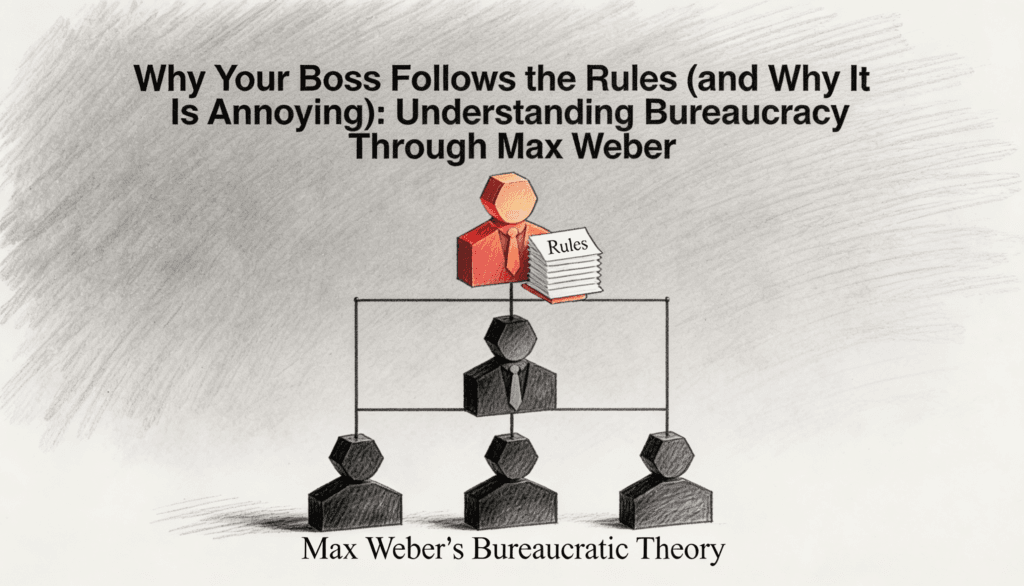
First, there is a clear hierarchy of authority. Everyone has a boss. Your boss has a boss. That boss has a boss. This chain goes up until it reaches someone who probably also has a board to answer to. The chain of command is not an accident. It is the architecture.
Second, there are formal rules and procedures. Things are done a certain way not because it is the best way or the most creative way, but because it is the documented way. The rules exist to make outcomes predictable. When you get frustrated that no one can make an exception for your obviously reasonable request, this is why. The system was not designed for exceptions. It was designed to eliminate them.
Third, there is a division of labor based on specialization. Everyone has a defined role. The person in accounting does not make marketing decisions. The person in human resources does not approve engineering budgets. Each person is a specialist in their narrow domain. This makes the organization efficient. It also means that getting anything done that crosses departmental lines requires what can only be described as an act of diplomatic negotiation.
Fourth, hiring and promotion are based on technical qualifications. In theory, it does not matter who your father is or which golf club you belong to. What matters is whether you have the credentials and the competence. Weber saw this as a radical improvement over the old systems where positions were bought, inherited, or granted as favors. And in many ways, it was.
Fifth, there is impersonality. Decisions are supposed to be made without favoritism, without emotion, and without regard for personal relationships. The rules apply equally. Your request gets processed the same way whether you are the CEO’s cousin or a new hire who started on Monday. This is both the most admirable and the most maddening feature of bureaucracy. It treats everyone the same, which sounds wonderful until you are the one with a genuinely unusual situation that the system cannot accommodate.
Sixth, everything is documented. Written records, official files, emails, memos, reports. If it was not written down, it did not happen. This creates accountability. It also creates the mountain of paperwork that has launched a thousand workplace complaints.
Why It Actually Works (No, Really)
Here is the part that might be difficult to accept if you have ever spent forty five minutes on hold with a customer service department: bureaucracy works. It works extraordinarily well for certain things.
Before bureaucratic systems, most organizations were run on personal loyalty, family connections, and the whims of whoever happened to be in charge. If the local lord liked you, you got the contract. If the king was in a bad mood, you lost your head. There was no consistency, no predictability, and no recourse.
Bureaucracy replaced all of that with something impersonal but fair. Or at least fairer. When Weber looked at the Prussian state, he saw an administrative machine that could collect taxes, deliver mail, and mobilize armies with a reliability that no previous system of governance could match. It was not exciting. It was not romantic. But it delivered results.
Consider something as mundane as a driver’s license. You go to an office. You take a number. You wait. You present your documents. You take a test. You get your license. The process is the same for everyone. It does not matter what you look like or who you know. The bureaucrat behind the counter follows the same checklist for every person. This is Weber’s vision working exactly as intended.
In a strange way, bureaucracy is one of the most democratic inventions in organizational history. It is the anti-aristocracy. It says that the rules matter more than the ruler.
The Iron Cage Problem
But Weber was not naive. He saw clearly where this was heading, and he did not like it.
He used a phrase that has become one of the most cited metaphors in all of sociology: the iron cage. His argument was that the rational systems humans built to organize society would eventually become prisons. Not because anyone designed them to be oppressive, but because the logic of efficiency and rationality, once set in motion, tends to expand until it colonizes everything.
The rules multiply. The procedures get layered on top of each other. The forms beget more forms. And at some point, the system stops serving the people inside it and starts serving itself. The original purpose gets buried under process. You are no longer trying to solve a problem. You are trying to satisfy the requirements of a system that has forgotten why it exists.
This is not a bug. It is the natural trajectory of every bureaucratic system. Weber understood that the same qualities that make bureaucracy effective, its impersonality, its rule following, its resistance to individual discretion, are also the qualities that make it feel inhuman. You cannot have the benefits without the costs.
Think of it this way. A thermostat is a brilliant device. It keeps your house at a constant temperature without you having to think about it. But a thermostat cannot tell the difference between a February blizzard and a day when you just want to open the windows and feel the breeze. It does not care what you want. It follows the rule. Bureaucracy is a thermostat for human organizations. It keeps things stable. But it does not know when to stop.
Why Your Boss Cannot Just Make an Exception
This brings us back to the original frustration. Your boss follows the rules not because they are a robot or because they enjoy watching you suffer. They follow the rules because the system is designed to make rule following the rational choice.
If your manager approves your unusual request by bending the procedure, they take on personal risk. If something goes wrong, they are the one who deviated from the process. The system punishes discretion and rewards compliance. So your boss does the safe thing. They follow the procedure. They ask you to fill out the form. They forward your request to the appropriate department. They cc three people who do not need to be involved.
This is what Weber meant by rationalization. It is not that people become irrational. It is that they become rational in a narrow, system serving way. They optimize for the rules of the game they are in, even when those rules produce absurd outcomes.
The Bureaucracy Paradox
Here is perhaps the most counterintuitive thing about bureaucracy: the more you try to fix it, the more of it you create.
Every time an organization discovers an inefficiency, the solution is usually a new process. Every scandal produces new compliance requirements. Every failure generates a new reporting structure. The cure for bureaucracy is, almost always, more bureaucracy.
This is not stupidity. It is the logical consequence of a system that solves problems through formalization. When something goes wrong, the bureaucratic response is to write a new rule that prevents it from happening again. Over time, you end up with an organization that has a rule for every possible scenario and a workforce that spends more time following rules than doing the work the rules were meant to support.
Weber saw this with remarkable clarity over a hundred years ago. He predicted that modern life would be defined by this tension between the efficiency of rational systems and the suffocation they impose on the people within them. He was not wrong.
What Weber Means for You on a Monday Morning
So what do you do with all of this? Knowing that your frustration with organizational red tape was predicted by a German sociologist in the early 1900s does not, on its own, make your Monday any better. But there is practical value in understanding the machine you are inside.
First, it helps to recognize that bureaucracy is not a failure of intelligence. It is a system working as designed. The people enforcing the rules are not the problem. The architecture is the problem, or more precisely, the architecture is the cost of the benefits you also enjoy. You benefit from the predictability, the fairness, the accountability. You pay for it with the rigidity.
Second, understanding Weber helps you navigate organizations more effectively. If you know that the system rewards documentation and process compliance, you can work within those parameters instead of fighting them. The people who succeed in bureaucratic organizations are not always the most talented. They are often the ones who understand how the system processes information and who know how to present their requests in a way the system can digest.
Third, and this is where Weber’s thought connects to something deeper, it is worth asking whether the iron cage is inevitable. Weber himself was pessimistic. He believed that rationalization would continue to expand and that there was no going back. But other thinkers have suggested that this is not necessarily true. Organizations can be redesigned. Rules can be simplified. Hierarchy can be flattened. The fact that bureaucracy tends to grow does not mean it must grow. It means that resisting that growth requires conscious, sustained effort.
So What?
Weber gave us a framework for understanding something that everyone experiences but few people examine closely. The frustration you feel when dealing with a rigid organization is not random. It is the predictable result of a system that was built to be rigid on purpose. That rigidity solved real problems. It replaced chaos with order, favoritism with process, and arbitrary power with accountable authority.
But it also replaced human judgment with checklists. And it replaced flexibility with forms.
The uncomfortable truth is that we need bureaucracy. We need rules and processes and hierarchies, especially in large, complex organizations where personal trust cannot scale. But we also need to recognize that these systems have a life of their own. They grow. They calcify. They start serving themselves instead of the people they were created for.
Max Weber saw all of this coming. He described the machine with precision and then warned us that the machine would not stop. It is up to the people inside it, all of us, to decide whether we run the system or the system runs us.
Next time you are filling out a form that seems pointless, remember: someone, somewhere, had a very good reason for creating it. That reason might be long gone. But the form remains.
It always remains.