Table of Contents
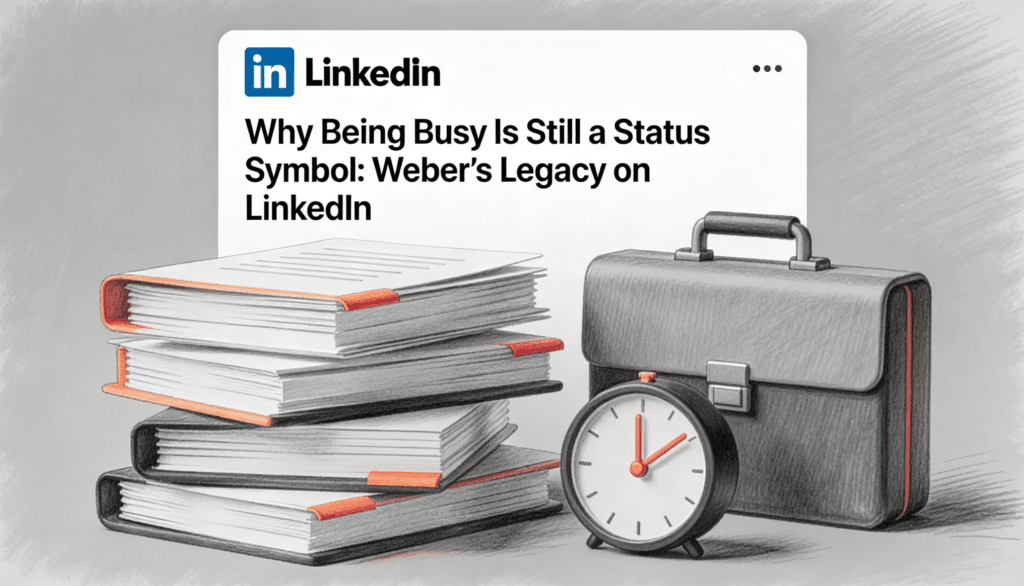
There is a peculiar ritual that plays out every Monday morning on LinkedIn. Thousands of professionals post about their packed schedules, their 5 AM wake up calls, their back to back meetings, their weekend work sessions. They do not complain about these things. They brag about them. Being busy, in the economy of social media status, is not a burden. It is a badge.
And if you want to understand why, you need to go back more than a century to a German sociologist who never saw a smartphone but somehow predicted the entire culture of performative productivity. His name was Max Weber, and he had a lot to say about why you feel guilty for taking a nap.
The Ghost of the Protestant Ethic
In 1905, Weber published The Protestant Ethic and the Spirit of Capitalism, a work that tried to answer a deceptively simple question: why did capitalism flourish in some parts of Europe and not others? His answer was not about geography or natural resources. It was about belief.
Weber argued that early Protestantism, particularly Calvinism, created a psychological framework where hard work was not just economically useful. It was spiritually necessary. Calvinists believed in predestination, the idea that God had already decided who was saved and who was damned. You could not earn your way into heaven. But here is the twist: you could look for signs that you were among the chosen. And the most convincing sign? Worldly success through disciplined, relentless labor.
So work became a calling. Not a means to an end, but an end in itself. Leisure was suspect. Idleness was practically sinful. The good life was the productive life, and productivity was its own moral justification.
Now strip away the theology. Remove the church. What do you have left? You have LinkedIn in 2026.
From Calling to Personal Brand
Weber would have found the modern professional internet fascinating and probably a little horrifying. The religious scaffolding is gone, but the underlying logic remains perfectly intact. We no longer work hard because God might be watching. We work hard because the algorithm definitely is.
Consider what gets rewarded on LinkedIn. It is not rest. It is not reflection. It is not someone saying they spent Tuesday afternoon staring out a window and thinking about nothing in particular. What gets rewarded is output. Volume. The appearance of relentless forward motion. People post about reading 50 books a year, attending conferences on weekends, answering emails at midnight. And other people applaud them for it.
This is Weber’s Protestant ethic wearing a blue suit and a personal brand. The content has changed but the structure has not. Work is still a moral performance. Busyness is still the visible proof that you are among the elect. Only now, instead of a Calvinist God deciding your worth, it is the marketplace. Your followers. Your engagement metrics.
The sociologist would have called this the “iron cage” of rationalization, a system that was originally built on spiritual conviction but eventually runs on its own mechanical logic, long after the original conviction has faded. We do not remember why we worship productivity. We just do.
Busyness as Social Currency
Here is something counterintuitive. In most of human history, being busy was not a status symbol. It was the opposite. The ancient Greeks thought manual labor was beneath free citizens. The European aristocracy measured status precisely by how little they needed to do. Thorstein Veblen, writing just a few years before Weber, coined the term “conspicuous consumption” to describe how the wealthy demonstrated their position by not working.
So when did the script flip?
It flipped when capitalism matured enough that simply having money stopped being impressive on its own. In a world where anyone could theoretically get rich, the story of how you got rich started to matter more than the wealth itself. And the most culturally acceptable story, the one Weber’s ethic had already prepared us for, was the story of hard work.
Today we live in what researchers have called a culture of “conspicuous busyness.” People who described themselves as busy were perceived as higher status than those who described themselves as having leisure time. Think about that for a moment. We now admire people not for what they have achieved but for how little free time they claim to have.
LinkedIn did not invent this dynamic. But it gave it a stage, a microphone, and an audience of millions who are all performing the same script simultaneously.
The Hustle Gospel
Weber identified something important about how ethical systems evolve. They start as sincere belief. Then they become habit. Then they become performance. By the time everyone is doing it, nobody remembers the original reason. They just know that deviation feels dangerous.
This is the lifecycle of hustle culture in miniature. The early startup founders who worked 80 hour weeks did so because their companies would literally die if they did not. That was survival, not philosophy. But then the narrative got abstracted. Working 80 hours became a virtue independent of outcome. The hustle became the point, not the product.
And LinkedIn became the cathedral where this gospel is preached. Scroll through the feed on any given day and you will find a remarkably consistent theology. Suffering is noble. Rest is suspicious. Balance is a word used by people who are not serious enough. The most successful post format is the struggle narrative: I was broke, I was rejected, I worked harder than everyone else, and now I am here to tell you about it from my standing desk at 4:47 AM.
Weber called the original Protestant attitude toward work “worldly asceticism.” The faithful denied themselves pleasure not because pleasure was unavailable but because denial itself was the proof of virtue. The LinkedIn version is almost identical. People do not brag about being busy because they have no choice. They brag about it because choosing busyness over comfort is the narrative that signals moral seriousness.
The Algorithm as Invisible Church
There is another layer here that Weber could not have anticipated but would have immediately understood. The algorithm functions as a kind of secular theology. It has rules that are partially known and partially mysterious. It rewards certain behaviors and punishes others. And, crucially, nobody fully understands how it works.
This is not unlike the Calvinist relationship with God. You did not know if you were saved. You could not be sure. But you could behave as if you were and hope the outcomes confirmed it. On LinkedIn, you do not know what the algorithm will promote. But you can post consistently, engage relentlessly, and produce content that looks like the content the platform seems to favor. You act on faith.
The result is a community of people optimizing their behavior for an authority they cannot see and do not fully comprehend. Weber described the transition from religious authority to bureaucratic rationality as one of the defining features of modern life. Social media has simply added another chapter. The algorithm is the new bureaucracy. Its logic is opaque, its demands are constant, and its rewards go to those who perform compliance most convincingly.
What Gets Lost in the Performance
Here is where things get genuinely interesting, and a little dark. Weber was not celebrating the Protestant ethic. He was diagnosing it. He saw the iron cage not as an achievement but as a trap. Modern capitalism, he believed, had taken a system of profound religious meaning and hollowed it out, leaving only the compulsive behavior without the belief that originally justified it.
The same diagnosis applies to LinkedIn busyness culture with uncomfortable precision. When someone posts about their 14 hour workday, what are they actually communicating? Not that they accomplished something specific. Not that their work created meaning or value they can articulate. Just that they were busy. The activity is the message. The output is secondary to the performance of effort.
This is what Weber meant by disenchantment. A world where the forms of meaning persist but the substance has evaporated. We go through the motions of the work ethic without the ethic. We perform productivity without asking productive toward what.
And the platform itself ensures this continues. LinkedIn does not reward depth. It rewards frequency. It does not reward rest. It rewards posting about how you do not rest. The incentive structure is perfectly designed to perpetuate exactly the kind of meaningless compulsion Weber feared.
The Cage Scrolls On
Weber died in 1920. He did not live to see social media, the gig economy, or the rise of productivity as a lifestyle identity. But his framework fits the present moment so precisely that it almost feels like cheating to apply it. He told us this would happen. He told us that once work became a moral category, separated from its original religious context, it would take on a life of its own. It would become compulsive, performative, and ultimately empty. And we would keep doing it anyway, because the cage does not need a lock when the inhabitants have forgotten there is a door.
The next time you see someone on LinkedIn posting about their 5 AM morning routine and their seven simultaneous projects and their passion for the grind, remember what you are actually looking at. It is not ambition. It is not even work. It is a 400 year old religious anxiety dressed in athleisure, still performing for a God it no longer believes in, hoping the algorithm will bless it with reach.
Weber tried to warn us. But we were too busy to read him.