Table of Contents
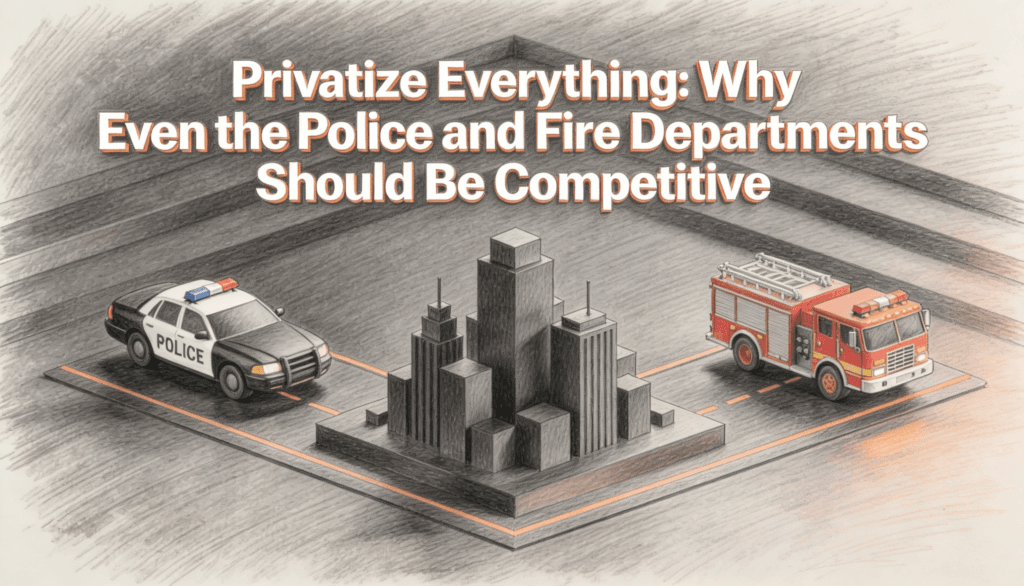
There is a thought experiment that most people refuse to take seriously. Not because it fails on logic, but because it attacks something almost sacred. The idea is simple: what if the government did not run the police? What if it did not run the fire department? What if these services, like your morning coffee or your internet provider, had to compete for your business?
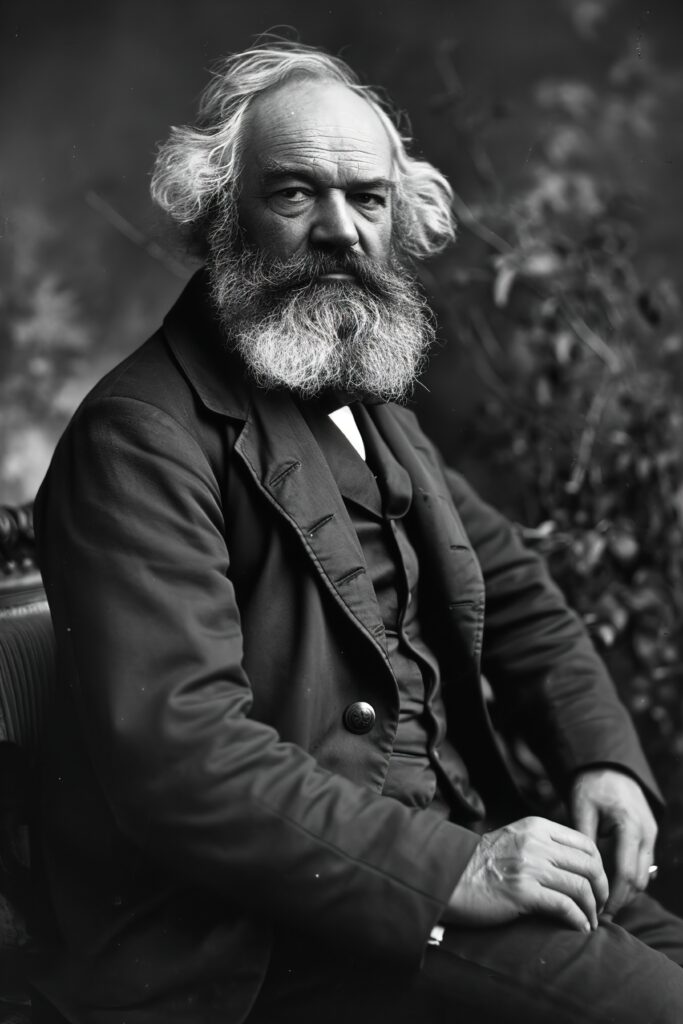
Murray Rothbard, the economist and political theorist who spent his career making people uncomfortable, argued exactly this. He did not think it was radical. He thought it was obvious. And whether you end up agreeing with him or not, the argument is worth following all the way to its conclusion. Because it reveals something important about how we think about public services, competition, and the strange relationship between safety and monopoly.
The Assumption Nobody Questions
Most political debates happen within a narrow band. People argue about tax rates, regulation levels, how much funding the police should receive. But almost nobody asks the prior question: should the government be the one providing police and fire services at all?
Rothbard noticed this. He pointed out that we treat certain government functions as if they were laws of nature. The sun rises, water flows downhill, and the state runs the fire department. But there is nothing inevitable about it. For most of human history, fire protection was privately organized. The first fire brigades in ancient Rome were private enterprises. In early America, private fire companies were the norm, not the exception. The government takeover of these services is a relatively recent development, and Rothbard would argue it was not an upgrade.
The trick is that once the government monopolizes a service, we lose the ability to compare it with alternatives. It is like growing up eating only one restaurant’s food and then declaring it the best restaurant in town. You have no basis for comparison. You just have faith.
The Economics of a Monopoly You Cannot Fire
Here is the core of Rothbard’s case, stripped down to its essentials.
When a private company does a poor job, you stop paying it. You switch to a competitor. This feedback mechanism, brutal and efficient, forces businesses to improve or disappear. It is not sentimental. It does not care about tradition or prestige. It only cares about whether the service is worth the price.
Now consider your local police department. If the response time is slow, if officers are rude, if crime in your neighborhood keeps climbing, what exactly can you do about it? You can vote. You can attend a city council meeting. You can write a strongly worded letter. But you cannot take your money elsewhere. You cannot cancel your subscription. You are locked in. Your taxes fund the department regardless of its performance.
Rothbard saw this as the fundamental disease. Not that government employees are inherently lazy or corrupt, but that the structure itself removes the incentive to excel. A monopoly protected by law does not need to earn your loyalty. It already has your money.
Think about it through the lens of any other industry. Imagine if there were only one airline, run by the government, and you could not choose to fly with anyone else. Would you expect that airline to innovate? Would you expect friendly service? Would you expect it to care deeply about your experience? The history of government monopolies in telecommunications, postal services, and transportation suggests the answer is a confident no.
But Who Would Protect the Poor?
This is the objection that arrives fastest, and Rothbard had an answer for it, though not everyone finds it satisfying.
The argument goes like this: in a free market for security and fire protection, the wealthy would get excellent service and the poor would get nothing. Rothbard countered that this misunderstands how markets actually work. Markets do not only serve the rich. They serve anyone willing to pay, and competition drives prices down over time. The cell phone, once a luxury for Wall Street traders, is now in the pocket of nearly every human on the planet. The same pattern plays out in food, clothing, transportation, and technology.
Moreover, Rothbard pointed out something counterintuitive. The current system does not actually serve the poor particularly well. Police response times in low income neighborhoods are often longer. Fire stations in wealthier districts tend to be better equipped. The monopoly does not distribute its services equally. It distributes them politically. And political distribution tends to favor those with influence, which is rarely the poorest members of a community.
A competitive market, Rothbard argued, would at least be honest about the transaction. You pay for what you get. And charitable organizations, mutual aid societies, and community groups could fill gaps for those who could not afford coverage, just as they did historically before government displaced them.
The Strange History of Private Fire Companies
This is not purely theoretical. Private fire protection has a real and fascinating history, and it is worth examining because it complicates the narrative in both directions.
In the early 1800s, American cities were served by competing private fire companies. These companies would race to fires, and the first one to arrive would claim the insurance payout. The result was sometimes chaotic. Companies occasionally fought each other at the scene of a fire while the building burned. Critics point to this as proof that privatization leads to disaster.
But Rothbard and his intellectual allies would note something important: the chaos was not caused by competition itself. It was caused by a poorly defined property rights system and perverse incentive structures tied to insurance payouts. The problem was not that private companies existed. The problem was that the rules of engagement were badly designed. A well structured market with clear contracts, defined service areas, and proper legal frameworks would look nothing like the brawling fire brigades of 1830s New York.
This distinction matters because critics of privatization often point to historical failures and attribute them to the market, when the real culprit was the absence of a functioning legal framework. It is like blaming capitalism for fraud while ignoring that fraud is already illegal. The system failed not because it was private, but because it was unregulated in the wrong ways.
What Would Private Police Actually Look Like?
This is where the conversation gets genuinely interesting, and where most people’s imaginations fail them.
Rothbard envisioned private security firms operating under contract. You, your neighborhood, or your business would hire a security company. That company would patrol your area, respond to emergencies, and investigate crimes. If it did a poor job, you would switch to a different firm. Multiple firms could operate in the same city, competing on price, response time, professionalism, and results.
The immediate objection is: what about jurisdiction? What happens when a crime involves people protected by different security firms? Rothbard’s answer was arbitration. Private arbitration already handles billions of dollars in commercial disputes every year. International trade, which crosses dozens of legal jurisdictions, functions largely through private arbitration and contractual agreements. The idea that two security firms could not agree on how to handle a dispute is not as far fetched as it sounds when you realize that this kind of cross boundary cooperation already happens constantly in the commercial world.
There is a parallel here with how the internet works. The internet has no central governing body, yet billions of transactions happen daily across borders, languages, and legal systems. It functions through protocols, agreements, and mutual self interest. Rothbard would say that security could work the same way, not through top down command, but through voluntary cooperation driven by market incentives.
The Accountability Problem
Here is where Rothbard’s argument gains its sharpest edge.
Government police departments face a chronic accountability problem. When officers use excessive force, when departments engage in racial profiling, when evidence is mishandled, the consequences are often minimal. Officers are protected by qualified immunity. Departments investigate themselves. Union contracts make it nearly impossible to fire bad actors. The system is designed, whether intentionally or not, to shield itself from the consequences of its own failures.
A private security firm would not have this luxury. If a firm’s employees abused citizens, the firm would face lawsuits, lose contracts, and watch customers flee to competitors. The market would punish misconduct in a way that the political system often does not. This is not a fantasy about corporate virtue. Corporations are not virtuous. But they are responsive to financial consequences, and that responsiveness can be a more reliable check on behavior than the ballot box.
Consider the analogy with private hospitals versus government run hospitals. Private hospitals are far from perfect. But when a private hospital consistently provides poor care, patients go elsewhere, and the hospital either improves or closes. A government hospital can continue providing poor care for decades, sustained by tax revenue regardless of outcomes. The incentive structures are fundamentally different, and Rothbard believed that difference matters more than we typically admit.
The Deepest Objection: Can Safety Be a Product?
Beneath all the practical arguments lies a philosophical one, and it is the one that makes people most uncomfortable.
The deepest objection to Rothbard’s position is not economic. It is moral. Many people believe that safety is a right, not a commodity. That it should not depend on your ability to pay. That making protection a market good is fundamentally incompatible with a just society.
Rothbard would not have dismissed this concern. But he would have reframed it. He would ask: is food a right? Is shelter a right? These are even more fundamental to survival than police protection, and yet we provision them primarily through markets. We do not have a single government grocery store that everyone must use. We have thousands of competing providers, and the result is an abundance of food at prices that, relative to historical standards, are astonishingly low. The market did not make food less available. It made food more available than any government program in history.
The moral intuition that safety is different, that it occupies some special category beyond the reach of markets, is powerful but not self evidently correct. Rothbard challenged people to examine why they felt that way and whether the feeling was based on evidence or on habit.
Where the Argument Gets Honest
No serious engagement with Rothbard’s ideas can avoid acknowledging the difficulties. Transition costs would be enormous. The potential for abuse by private firms is real. Coordination problems are not trivial. And there is a genuine concern that in the gap between the old system and the new, vulnerable people would suffer.
Rothbard’s critics are not wrong to raise these points. But Rothbard’s supporters are not wrong to note that the current system also produces abuse, also fails the vulnerable, and also suffers from coordination problems. The question is not whether a privatized system would be perfect. The question is whether it would be better. And that question can only be answered honestly if we stop treating the current arrangement as the default state of nature and start treating it as one option among many.
The Real Value of the Argument
Even if you walk away from this article unconvinced that privatizing police and fire departments is a good idea, something valuable has happened. You have been forced to examine assumptions that usually go unquestioned. You have had to articulate why you believe certain services should be government monopolies and whether those reasons hold up under scrutiny.
Rothbard’s gift was not that he was always right. It was that he asked questions other people considered off limits. He looked at institutions everyone took for granted and asked: why? Why this way? Who benefits from this arrangement? What would happen if we tried something else?
Those questions do not belong to any political tribe. They belong to anyone who takes ideas seriously. And in an era when trust in public institutions is declining across the political spectrum, when police reform is a live issue, when municipal budgets are strained and services are deteriorating, the questions Rothbard raised decades ago feel less like provocations and more like invitations.
Invitations to think harder. To imagine differently. And to stop confusing the way things are with the way things have to be.
The fire is already burning. The only question is who you want to call.