Table of Contents
There is something almost comically awkward about Friedrich Nietzsche becoming a mascot for German nationalism. The man spent the better part of his productive life attacking German culture, mocking the German state, and calling for a future that would make borders look like chalk lines drawn by children. Yet here we are, over a century later, still untangling his ideas from the knots that others tied them into. The phrase “Good European” runs through his later works like a quiet drumbeat, and it points toward something that most of his loudest admirers and fiercest critics have conveniently ignored: Nietzsche wanted nationalism to die.
Not reformed. Not softened. Dead.
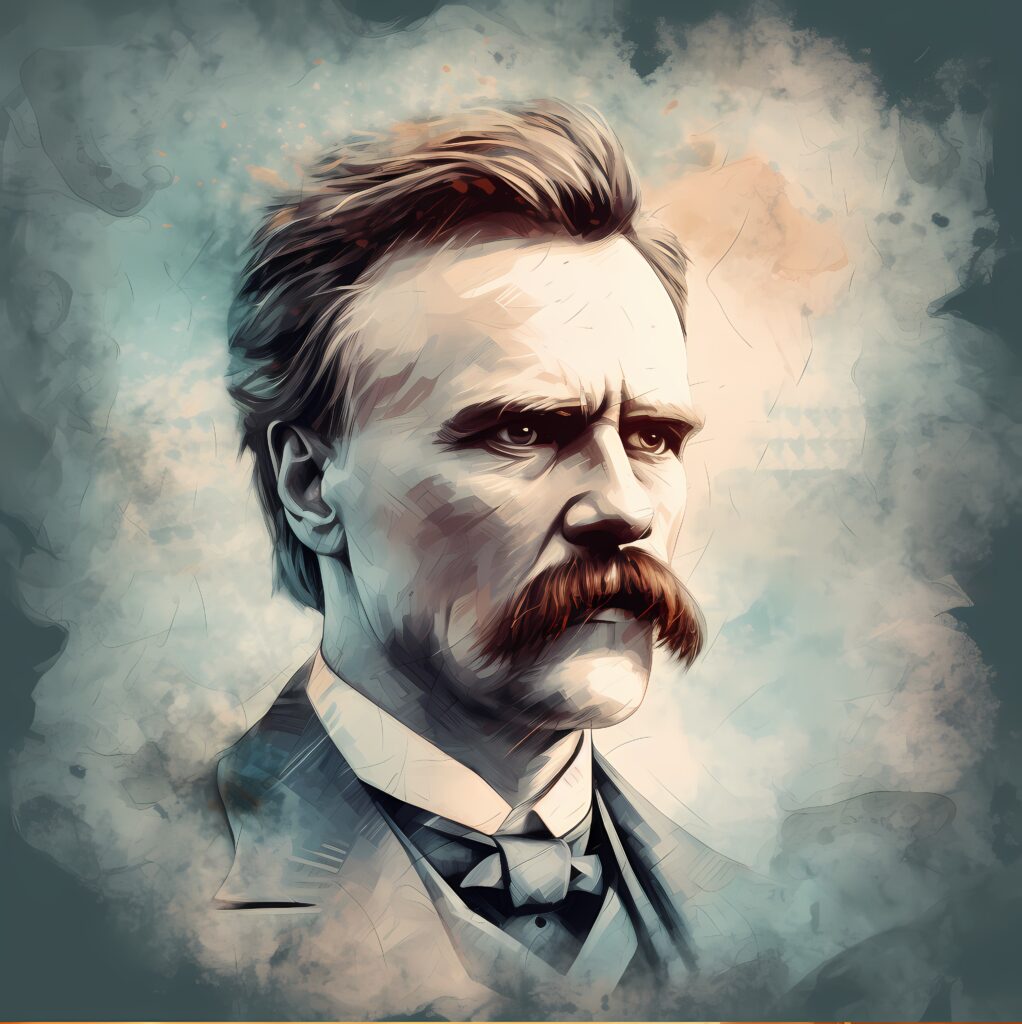
To understand what he meant by the “Good European,” we need to set aside the caricature. Forget the mustache, the madness, the unfortunate sister. What Nietzsche was proposing was not a political program. It was a cultural vision, one that asked what human greatness might look like once people stopped defining themselves by the patch of earth they happened to be born on.
The Problem With Flags
Nietzsche came of age during the formation of the German Empire. Bismarck had stitched the nation together through wars, diplomacy, and a talent for spectacle. Most Germans were thrilled. Nietzsche was not. He saw the new nationalism as a narrowing of the spirit, a way for mediocre people to feel significant by borrowing the achievements of their geography. You did not compose a symphony. You did not win a battle. But you were born within certain coordinates, and so you get to feel proud. It was, in his view, a participation trophy for existence.
This was not casual contrarianism. Nietzsche believed that culture and the state were fundamentally opposed. When a nation becomes powerful, he argued, its culture tends to become shallow. Energy that might have gone into art, philosophy, or genuine self-overcoming gets redirected into military parades and trade policy. The citizens become comfortable. Comfort, for Nietzsche, was a kind of spiritual poison. It made people satisfied with what they already were, which was precisely the condition he wanted them to escape.
The comparison to ancient Rome is instructive here. Rome built roads, aqueducts, and an empire that stretched across continents. It also produced relatively little original philosophy after absorbing Greece. The machinery of empire consumed the creative energies that might have produced something more lasting than concrete. Nietzsche saw modern Germany heading down the same path: lots of power, declining depth.
What “Good European” Actually Means
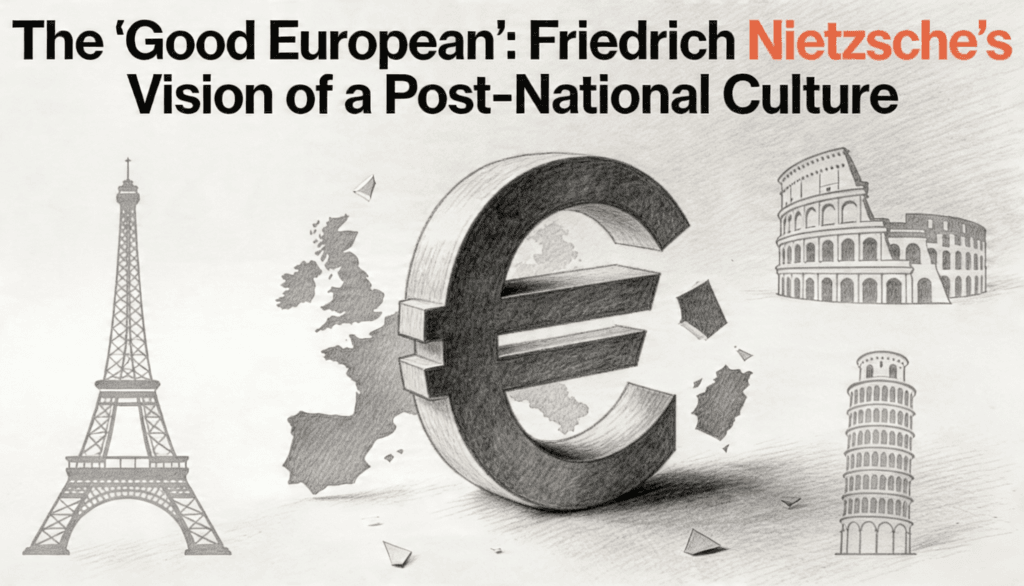
The phrase appears most prominently in Beyond Good and Evil and The Gay Science, though it echoes across his notebooks and letters. A “Good European” is someone who has outgrown national identity. Not someone who has no identity, but someone whose identity is rooted in something richer than a flag or a language or a set of inherited customs.
Nietzsche imagined a future European culture that would be a fusion. The disciplined intellectualism of France, the musical depth of Germany, the psychological sharpness of the ancient Greeks, the spiritual intensity that certain religious traditions had cultivated before dogma calcified them. The Good European would draw from all of these without pledging allegiance to any single tradition. Think of it as cultural multilingualism. You do not lose your native tongue by learning others. You gain the ability to think thoughts that your first language could not accommodate.
This is where Nietzsche parts company with the cosmopolitanism that was fashionable in Enlightenment salons. He was not arguing for a bland universalism where everyone holds hands and agrees on basic principles. That kind of flattening horrified him almost as much as nationalism did. He wanted tension. He wanted the collision between different traditions to produce something new, something that could not have emerged from any single culture in isolation. The Good European was not a citizen of nowhere. The Good European was a citizen of a culture that did not yet exist, one that would be forged in the friction between competing excellences.
The Aristocracy Nobody Voted For
Here is where things get uncomfortable, because Nietzsche was not a democrat. He did not believe that this post-national culture would arise from popular movements or parliamentary debate. He thought it would be created by a small number of exceptional individuals who happened to share a certain restlessness, a dissatisfaction with the available options for human life.
He called them “free spirits” and sometimes “philosophers of the future.” These were people who had the intellectual courage to live without the safety nets that most humans cling to: religion, nationalism, conventional morality, the comforting belief that the universe has a plan. Free spirits were not rebels for the sake of rebellion. They were people who had genuinely thought their way past the inherited frameworks and were trying to build something on the other side.
This is not a comfortable idea for modern readers, and it should not be. Nietzsche’s aristocratic instincts are real, and pretending they are not there does his work no favors. But it is worth noting what kind of aristocracy he had in mind. It was not based on blood, wealth, or military rank. It was based on a willingness to suffer for the sake of understanding. The people who would create the new European culture would not be those who had the most power. They would be those who had endured the most honest confrontation with themselves.
There is an unexpected parallel here with how startup culture talks about founders. The mythology of Silicon Valley celebrates people who reject established institutions, tolerate extreme uncertainty, and try to build something that does not yet have a name. Nietzsche would have recognized the impulse, even if he would have found most of the products trivial. The structural similarity matters: both frameworks elevate a minority of risk-takers who refuse to accept the world as they find it. The difference, of course, is that Nietzsche was not interested in market share. He was interested in what a human being could become.
Against the “Fatherland”
Nietzsche’s critique of nationalism was not abstract. He named names. He attacked anti-Semitism repeatedly and broke off his friendship with Richard Wagner in part because of Wagner’s nationalist and anti-Semitic posturing. He called anti-Semites “failures” and “resentful creatures” who blamed others for their own mediocrity. He admired Jewish culture for its intellectual resilience and saw the Jews of Europe as potential contributors to exactly the kind of transnational culture he envisioned.
This point cannot be emphasized enough, given what happened to his legacy after his death. His sister, Elisabeth, married a prominent anti-Semite and later curated Nietzsche’s unpublished writings in ways that made them friendlier to nationalist and eventually Nazi ideology. The archive she controlled became a tool for exactly the kind of politics her brother had spent his career opposing. It is one of the great ironies of intellectual history: a man who despised nationalism had his words repurposed to serve its most catastrophic expression.
When we read Nietzsche’s actual texts, the picture is unambiguous. In Beyond Good and Evil, he writes about the “European problem” of breeding a new ruling caste and explicitly frames it as a project that transcends national boundaries. He argues that the mixing of European peoples is not a disaster but an opportunity, a chance to create human beings of unprecedented range and depth. The “Good European” is someone who welcomes this mixing rather than fearing it.
Culture as Experiment
One of the most striking aspects of Nietzsche’s vision is its experimental character. He did not claim to know what the post-national culture would look like. He did not offer a blueprint. He was not that kind of thinker. What he offered was a direction and a disposition.
The direction was away from national self-satisfaction and toward a more demanding engagement with the full range of European and, potentially, global traditions. The disposition was one of creative restlessness. Nietzsche thought culture should function like an ongoing experiment, constantly testing its own assumptions, discarding what had become stale, and risking the discomfort of genuine novelty.
This experimental attitude explains why Nietzsche was so hostile to systems. Hegel had his dialectic. Marx had his historical materialism. Both offered comprehensive explanations of how history works and where it is going. Nietzsche found this kind of certainty suspicious. Life, he believed, was too chaotic and too rich to be captured by any single framework. The philosopher who thinks he has found the final answer has merely found the place where his thinking stopped.
There is something genuinely radical about applying this principle to culture itself. Most people, whether they realize it or not, treat their own culture as a finished product. The customs, values, and assumptions they grew up with feel like natural facts rather than historical accidents. Nietzsche wanted to make culture feel contingent again, to remind people that everything they take for granted was once somebody’s wild experiment. And if it was an experiment, it could be revised.
The Loneliness Tax
Nietzsche knew, better than most, what it felt like to live outside the warmth of national belonging. He spent his adult life as a wanderer, moving between boarding houses in Italy, Switzerland, and southern France. He had few close friends. His books sold poorly. His health was terrible. He wrote some of the most penetrating philosophy in history while battling migraines so severe they left him bedridden for days.
The Good European, as Nietzsche conceived the figure, was not someone who had found a better home. It was someone who had given up the idea of home altogether, at least in the conventional sense. The freedom that came with rejecting national identity also came with isolation. You could see further, but you stood alone on the ridge.
This is not a minor point. It speaks to a tension that runs through all of Nietzsche’s thought. He wanted human beings to become greater, but the path to greatness he described was genuinely painful. He was not selling comfort. He was not even selling happiness. He was selling a particular kind of meaning, the meaning that comes from pushing against your own limits and refusing to settle for the version of yourself that your culture handed you.
Why It Still Matters
We live in a moment when nationalism is resurgent across much of the world. Borders are hardening. Cultural identities are being asserted with renewed aggression. Politicians have discovered, or rediscovered, that there is no easier way to mobilize people than to tell them their way of life is under threat.
Nietzsche would not have been surprised. He never expected nationalism to disappear quickly. He saw it as a deep human temptation, rooted in the desire for belonging and the fear of complexity. What he insisted on was that giving in to this temptation came at a price. The price was stagnation. A culture that closes itself off from outside influence becomes a museum of its own past, impressive to visit but incapable of producing anything new.
The “Good European” was Nietzsche’s answer to this stagnation. It was not a policy proposal. It was a challenge. Could you hold your identity lightly enough to let other traditions reshape you? Could you tolerate the discomfort of not knowing exactly who you were? Could you treat your own culture as material to be worked with rather than a monument to be preserved?
These questions have not become less urgent. If anything, the acceleration of global communication has made them more pressing. We now have access to more cultural traditions than any previous generation could have imagined, and yet the dominant response seems to be retreat into smaller and smaller circles of familiarity. Nietzsche would have found this tragic. All that richness, all that potential friction and creative collision, and people use it to find others who already agree with them.
The Good European remains a provocation. It asks whether belonging to something larger than a nation, something not yet fully formed, something that would require real courage and real loss, might be worth the price. Nietzsche thought it was. Whether we agree with him or not, the question he posed has not gone away.