Table of Contents
Thomas Kuhn ruined everything for scientists. Not by proving them wrong, but by proving something worse: that they could not see what they were not looking for. His 1962 book The Structure of Scientific Revolutions made a simple but devastating argument. Science does not progress in a straight line. It lurches. It gets stuck. It defends its blind spots with the fury of a homeowner chasing a stranger off the lawn. And the people doing the defending are not fools. They are the best trained, most rigorous thinkers of their era.
That is the problem.
The Cage You Cannot See
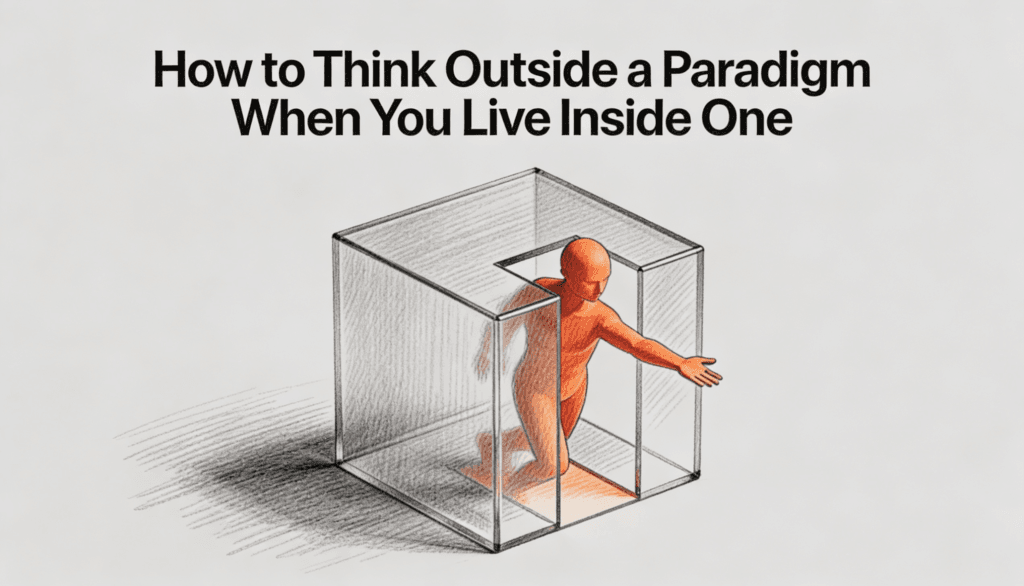
Kuhn introduced the word “paradigm” to describe the invisible architecture of assumptions that scientists work inside. A paradigm is not just a theory. It is the whole package: the questions worth asking, the methods considered legitimate, the results that count as evidence, and the anomalies that get filed under “we will deal with that later.” A paradigm is not a room you walk into. It is the air you breathe. You do not notice it until someone cuts off the supply.
Before Kuhn, most people assumed science worked like bricklaying. Each generation adds a row. Knowledge accumulates. The building goes up. Kuhn said no. What actually happens is that scientists build within a framework, and the framework itself determines what counts as a brick. When enough strange findings pile up that the framework cannot explain, the whole structure does not get renovated. It gets demolished. A new one goes up in its place. Kuhn called these moments “paradigm shifts,” and the phrase has since been borrowed by every marketing team on earth, which is unfortunate but also kind of proves his point about how paradigms spread.
The real insight, though, is not about the shift. It is about the period before the shift. The long, strange, uncomfortable era when the old paradigm is failing but nobody can quite articulate why. When the data does not fit but the textbooks have not been rewritten. When the smartest people in the field are working harder and harder to defend conclusions that a first year student in the next century will find obviously wrong.
That era is not a historical curiosity. You are living in one right now. Probably several.
Why Smart People Are the Last to Notice
Here is the counterintuitive part. Expertise makes you more trapped, not less. Kuhn observed that it was almost never the established authorities who drove paradigm shifts. It was outsiders, young researchers, or people working at the margins of the field. The experts had too much invested. Not just careers and reputations, but cognitive infrastructure. They had spent decades learning to see the world through a specific lens, and that lens had become fused to their face.
This is not a failure of intelligence. It is a feature of how intelligence works. To become an expert in anything, you have to internalize a set of assumptions so deeply that they stop feeling like assumptions. They feel like reality. A chess grandmaster does not consciously think about the rules of chess. A fluent speaker does not parse grammar. A physicist trained in Newtonian mechanics does not question whether space and time are absolute. Until Einstein shows up and politely suggests otherwise.
Kuhn pointed out that scientists working within a paradigm are doing what he called “normal science.” They are solving puzzles. The paradigm defines the puzzle, provides the tools, and tells you what a solution looks like. This is enormously productive. Most of the actual progress in science happens during normal science. But it comes at a cost. The paradigm also defines what is not a puzzle. What is merely noise. What is an error in your equipment. What is a question not worth asking.
The philosopher of science Paul Feyerabend, a contemporary of Kuhn who took things further and with considerably more attitude, argued that the methods scientists use to defend their paradigms are not fundamentally different from the methods the Catholic Church used to defend geocentrism. That is an overstatement, probably. But it is the kind of overstatement that makes you uncomfortable in a productive way.
The Anomaly Problem
Paradigms do not die from a single blow. They die from a thousand paper cuts. Kuhn called these cuts “anomalies,” results that the current framework cannot explain. But here is the thing about anomalies: the paradigm has a immune system. When a result does not fit, the first response is never “maybe our entire framework is wrong.” The first response is always something more reasonable. The equipment was miscalibrated. The sample was contaminated. The researcher made an error. The conditions were unusual.
And most of the time, these explanations are correct. That is what makes the immune system so effective. Ninety nine times out of a hundred, the weird result really is just a weird result. But the hundredth time, it is the edge of a continent nobody knew existed.
Think about how doctors treated ulcers for decades. The paradigm said ulcers were caused by stress and diet. When Barry Marshall and Robin Warren proposed in the 1980s that ulcers were actually caused by a bacterium, the response was not curiosity. It was ridicule.
Marshall eventually drank a petri dish of the bacteria to prove his point, gave himself an ulcer, cured it with antibiotics, and won a Nobel Prize. The medical establishment did not reject his theory because they were stupid. They rejected it because their paradigm had no room for it. Bacteria were not supposed to survive in stomach acid. That was not a gap in knowledge. It was a wall in perception.
So How Do You Think Outside the Box When the Box Is Your Brain?
This is where Kuhn gets both more useful and more frustrating. He was better at diagnosing the problem than prescribing solutions. But if you read carefully, and if you supplement his work with insights from other fields, some strategies emerge.
Read outside your discipline. This sounds like generic advice, but Kuhn gives it teeth. If your paradigm determines what questions you can ask, then exposure to a different paradigm gives you a different set of questions. Darwin was influenced by Malthus, an economist. Watson and Crick were influenced by Linus Pauling, a chemist working on protein structure. The insights that break paradigms almost never come from inside the paradigm. They come from someone who wandered in from a neighboring field and asked a question that the locals considered either obvious or absurd.
Take anomalies seriously. Not every anomaly is a revolution. But every revolution started as an anomaly. The discipline of paying attention to what does not fit, rather than explaining it away, is genuinely rare. It requires a kind of intellectual humility that runs counter to how expertise normally works. You have to be willing to sit with discomfort. To look at a result that contradicts everything you know and resist the urge to immediately domesticate it.
Study the history of your field. Kuhn himself was a physicist who became a historian of science, and the shift in perspective is what allowed him to see patterns that practicing scientists could not. When you study the history of a discipline, you discover that the things currently treated as obvious were once controversial. And the things once treated as obvious were later abandoned. This does not mean that current knowledge is wrong. But it does mean that current knowledge is contingent. It is the best framework available, not the final one.
Cultivate productive outsiders. Organizations and fields that want to avoid paradigm paralysis need people who are not fully socialized into the dominant framework. This is why interdisciplinary teams sometimes produce breakthroughs that specialized teams do not. Not because the outsiders are smarter, but because they are differently blind. Their blind spots do not overlap with everyone else’s.
The Paradigm of Everyday Life
Here is where Kuhn becomes relevant far beyond the laboratory. You do not have to be a scientist to live inside a paradigm. Every industry, every organization, every culture operates within a set of assumptions so deeply embedded that they feel like the laws of physics rather than the choices of humans.
The music industry in 2000 was certain that people would always pay for albums. The taxi industry in 2010 was certain that medallion systems would last forever. Blockbuster Video was certain that people wanted to browse physical shelves. These were not stupid beliefs. They were paradigmatic ones. They were supported by decades of evidence, reinforced by business models, taught in schools, and shared by every credible person in the industry.
The connection to behavioral economics is worth noting here. Daniel Kahneman showed that humans are not rational calculators but pattern matching machines running on shortcuts. Kuhn showed something similar about entire fields of knowledge. The paradigm is the collective shortcut. It tells everyone what to pay attention to and what to ignore. It is incredibly efficient right up until the moment it is catastrophically wrong.
The Trap of Knowing You Are Trapped
There is a final irony in Kuhn’s work that deserves attention. Once you understand paradigms, you might think you are free of them. You are not. Knowing that you live inside a framework does not teleport you outside of it. It just makes you a slightly more anxious resident.
This is because paradigms are not optional. You cannot think without a framework. You cannot observe without assumptions. You cannot ask a question without a context that determines what counts as an answer. The goal is not to escape paradigms entirely. That is not possible and would not be desirable even if it were. A scientist without a paradigm is not a free thinker. That person is just confused.
The goal is something more modest and more difficult. It is to hold your paradigm lightly. To use it as a tool rather than worship it as a truth. To remain genuinely curious about the things it cannot explain rather than treating them as nuisances. To remember that the history of knowledge is a history of confident people being wrong in ways they could not have predicted.
The Practical Takeaway
If Kuhn were alive and consulting for your company or advising your career, his advice would probably sound something like this:
Whatever you are most certain about, that is where you are most vulnerable. Not because certainty is bad, but because certainty is where your attention stops. And the future has a habit of arriving precisely at the spot where nobody was looking.
The ability to question your own assumptions is not a personality trait. It is a practice. It requires deliberate effort, structural support, and a tolerance for the deeply unpleasant sensation of discovering that the ground you are standing on is not as solid as it felt.
Kuhn showed us that the history of knowledge is not a story of ignorance being replaced by truth. It is a story of one useful framework being replaced by a more useful one. The people living inside the old framework were not wrong about everything. They were wrong about something specific, and that specific thing turned out to be load bearing.
The question worth sitting with is simple. What load bearing assumption are you standing on right now that might, one day, turn out to be the thing that needed replacing all along?
You will not be able to answer that question. Almost nobody can, from inside the paradigm. But the act of asking it, sincerely and repeatedly, is the closest thing we have to a crack in the wall.
And sometimes, a crack is all the light needs.