Table of Contents
Carl von Clausewitz never managed a corporate department. He never sat through a quarterly review where someone explained, with a straight face, that the report could not be finished because the system was down. He never watched a mid level manager respond to an urgent request with a nineteen paragraph email that answered nothing. And yet, Clausewitz understood all of it.
His concept of friction, introduced in On War, was meant to describe why military operations that look perfect on paper collapse into chaos on the ground. Sand in the gears. Fog in the air. The thousand small failures that turn a brilliant strategy into a mess. Clausewitz saw friction as the great equalizer, the invisible force that drags everything toward disorder. What he did not anticipate, or perhaps what he was too polite to say, is that friction can be manufactured. Deliberately. Strategically. And with remarkable effectiveness.
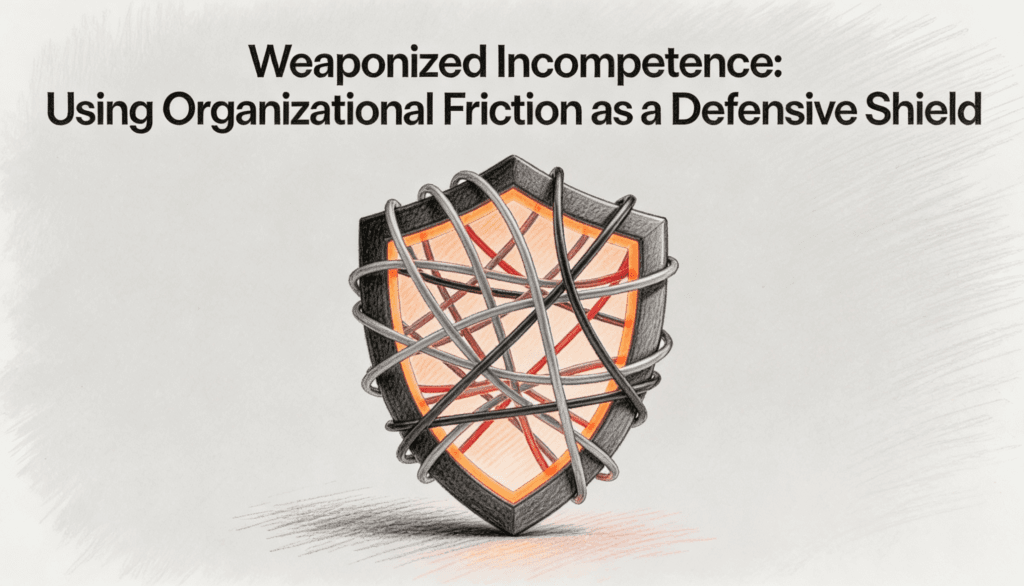
Welcome to weaponized incompetence: the art of using organizational friction not as a bug, but as a feature. Not as something to overcome, but as something to deploy.
The Friction Nobody Talks About
Clausewitz described friction as the difference between war on paper and war in reality. Every plan meets resistance. Communication fails. Supplies arrive late. Soldiers get tired. Weather turns. The cumulative weight of these small disruptions is what makes real conflict so different from theoretical conflict. In his words, everything in war is simple, but the simplest thing is difficult.
Now translate that into any large organization. Every process meets resistance. Emails go unanswered. Approvals get stuck. Committees form to discuss the formation of other committees. Someone always needs “more data” before making a decision. The simplest task, like getting a budget approved, becomes an odyssey through layers of review that seem to exist for no reason.
Most people assume this is accidental. It is not always accidental.
The uncomfortable truth is that organizational friction can be a weapon. Those who understand this gain a peculiar kind of power. Not the power to do things, but the power to prevent things from being done. And in many contexts, that second kind of power is far more valuable than the first.
The Defensive Logic
To understand why friction works as a defense, consider what Clausewitz called the superiority of defense over offense. In military theory, the defender has natural advantages. They choose the ground. They fortify their position. They force the attacker to expend energy just to reach them. The attacker must be stronger, more organized, and more motivated simply to achieve parity.
Organizational friction operates on the same principle. When someone introduces complexity, delay, or confusion into a process, they force anyone who wants to change that process to expend enormous energy just to understand what is happening. The person who controls the friction controls the terrain. They do not need to fight directly. They just need to make the fight exhausting.
Think about it this way. If you want to block a proposal, you do not need to argue against it. You just need to ask for another round of review. Request additional stakeholder input. Suggest that legal should take a look. Wonder aloud whether this aligns with the strategic plan from two years ago that nobody remembers. Each of these moves is individually reasonable. Collectively, they are a fortress.
This is the genius of weaponized incompetence. It never looks like opposition. It looks like diligence. It looks like caution. It looks like someone who just wants to make sure we get this right.
The Bureaucratic Terrain
Clausewitz wrote extensively about terrain and how it shapes the possibilities of combat. A mountain pass is easy to defend. An open field favors the attacker. The character of the ground determines who has the advantage.
Organizations have terrain too. It is made of org charts, approval chains, reporting structures, and institutional norms. And just like physical terrain, organizational terrain can be shaped by those who occupy it. A department head who insists on personally approving every expenditure over fifty dollars has not created a policy. They have created a chokepoint. A team that maintains its own proprietary system, incompatible with everything else in the company, has not made a technical choice. They have dug a moat.
The most effective practitioners of this strategy are the ones who build terrain that looks natural. The approval process seems reasonable. The incompatible system seems like a legacy issue. The seventeen step workflow seems like it must exist for compliance reasons. Nobody remembers who built these things or why. They just exist, like mountains, and everyone routes around them.
The Paradox of Competence
This leads to a deeply counterintuitive observation. In many organizational settings, being too competent is a vulnerability.
The person who can do everything quickly and clearly becomes the person everyone depends on. They become load bearing. They cannot say no because everything routes through them. They cannot take a vacation because the system collapses without them. Their competence is a trap.
Meanwhile, the person whose work is slow, opaque, and wrapped in layers of unnecessary process enjoys a strange kind of freedom. Nobody asks them to take on more because interacting with them is painful. Nobody tries to change their systems because understanding those systems would take months. They have achieved, through strategic friction, a kind of institutional untouchability.
Clausewitz would recognize this immediately. It is the principle of economy of force applied in reverse. Instead of concentrating effort where it matters most, you disperse confusion everywhere, forcing others to waste their effort on things that do not matter at all.
The most successful bureaucrats in history have understood this instinctively. They did not need to read Clausewitz. They lived his principles every day, turning paperwork into fortifications and process into barbed wire.
The CIA Understood This Perfectly
During World War II, the Office of Strategic Services, the predecessor to the CIA, produced a document called the Simple Sabotage Field Manual. It was designed to help ordinary citizens in occupied countries disrupt enemy organizations from within. The advice is breathtaking in its familiarity.
Insist on doing everything through channels. Make speeches. Refer all matters to committees. Bring up irrelevant issues as frequently as possible. Haggle over precise wordings of communications. Refer back to matters decided upon at the last meeting and attempt to reopen the question.
Read that list again and tell me it does not describe at least three meetings you attended last month.
The manual was not describing incompetence. It was describing the deliberate weaponization of organizational friction. Every tactic it recommended was individually defensible. Nobody can be fired for wanting to follow proper channels. Nobody gets reprimanded for being thorough. The sabotage is invisible because it wears the disguise of professionalism.
This is perhaps the most unsettling aspect of weaponized incompetence. It is almost impossible to distinguish from genuine diligence. The person who asks for more data before making a decision might be cautious. Or they might be ensuring that no decision ever gets made. From the outside, the two look identical.
Why Organizations Cannot Fix This
If weaponized incompetence is so damaging, why do organizations not simply eliminate it? The answer is another Clausewitzian concept: the fog of war. In military operations, commanders never have complete information. They make decisions based on partial knowledge, guesses, and instinct. The fog makes it impossible to know exactly what is happening on the ground.
Organizations live in permanent fog. Leaders cannot tell the difference between necessary complexity and manufactured complexity. They cannot distinguish between a process that exists for a good reason and one that exists because someone built it to protect their position. They lack the information to know which friction is real and which is artificial.
And here is the deeper problem. Attempts to eliminate friction often create more of it. Hire consultants to streamline processes, and you get a new layer of reporting requirements. Implement a new software system to reduce bureaucracy, and you get six months of training programs and change management committees. Launch a simplification initiative, and watch it acquire its own project manager, steering committee, and quarterly review cycle.
The system is self reinforcing. Friction breeds more friction. Clausewitz called this the culminating point of the attack, the moment when an offensive force has expended so much energy that it can no longer advance. Every reform effort in every large organization eventually hits this point. The friction wins. It always wins.
It would be easy to read all of this as cynical. As a celebration of the mediocre and the obstructionist. But there is a more nuanced reading.
What This Means for You
If you work in any organization larger than a dozen people, you are surrounded by friction. Some of it is natural. Some of it is engineered. Learning to tell the difference is one of the most valuable skills you can develop.
Watch for the patterns. The person who always has one more question before a decision can be finalized. The team whose systems are so unique that nobody else can contribute. The process that grows more complex every year without anyone being able to explain why. The meeting that exists to prepare for another meeting.
These are not signs of incompetence. They are signs of a defensive position being maintained. And like any defensive position, they can be overcome, but only if you recognize them for what they are.
Clausewitz advised that the best way to deal with friction is not to eliminate it but to accept it as a fundamental condition of operations. Train for it. Plan for it. Build organizations that function despite it. The general who expects a clean battle will always lose to the general who expects chaos.
The same is true in organizations. The leader who expects smooth execution will always be outmaneuvered by the person who understands that friction is not a flaw in the system. It is the system. And the person who controls it controls everything.
The Final Irony
Clausewitz died before finishing On War. His masterwork on military strategy was left incomplete, edited and published posthumously by his wife. The greatest theorist of friction was himself defeated by the ultimate friction: the limits of a single human life.
There is something fitting in that. The man who explained better than anyone why things never go according to plan did not get to finish his own plan. The universe, it seems, has a sense of humor about these things.
But his insight endures. Friction is real. It is powerful. And in the hands of those who understand it, it is not a problem to be solved. It is a weapon to be wielded. The next time you find yourself stuck in an endless approval loop, unable to get a straight answer, watching a simple task dissolve into complexity, consider the possibility that you are not witnessing failure.
You are witnessing strategy.